
Wuhan does not have a regional cuisine. It is not a food city the way Chengdu is a food city, with its own grammar and its own arguments about what belongs inside it.
There is one exception, and it is the dish everyone knows. Hot dry noodles are genuinely a Wuhan invention, and I have written about them at length in the hot dry noodles guide. That is the one item here that stops being a port city’s imports and becomes its own.
This is not a criticism and it is not a gap. It is the consequence of being a provincial capital at a river junction, which is that everything arrives. Trains come down from the north, boats come up from the west, and none of those passengers arrived with the intention of not cooking their own food. Wuhan’s food is a port that got very large.
That is the thing worth knowing before you order, because when a Wuhan restaurant tells you it is serving local food, the honest answer is usually that it is serving Hubei food, and Hubei is not one thing.
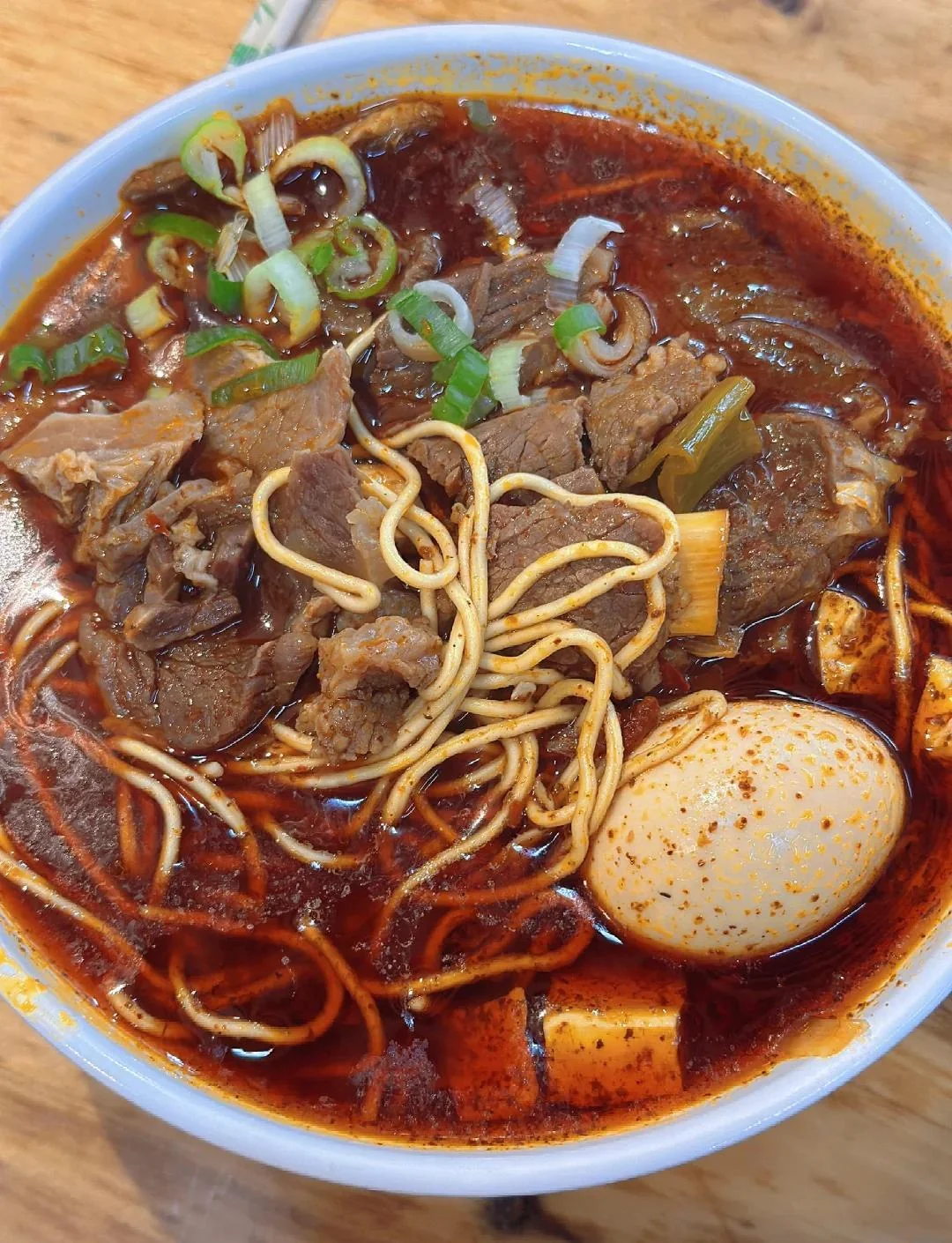
襄阳牛肉面, the beef tallow one
If you eat one dish from this article, eat this one, and understand that what you are eating is not the same object as the beef noodle soup you have had elsewhere.
Xiangyang beef noodles come from Xiangyang, three hundred kilometres up the Han River. Local sources date them to the first year of the Kangxi reign, which is 1662, and the dish became genuinely widespread in the nineteen nineties. It is listed as an intangible cultural heritage item at the city level.
The description that gets repeated, including by the Xiangyang municipal government, is 一辣二麻三鲜, one spicy, two numbing, three fresh. The spice is not chilli oil, it is 牛油, beef tallow, rendered and carried into a broth built on beef bones with a dozen or more spices. The numbing is 花椒. The freshness is the broth itself rather than anything added to it.
The noodles are firmer than you expect and the beef is sliced thin. There are two series, 牛肉面 for beef and 牛杂面 for offal, and the offal version is the more characteristically local one.
The thing that makes it a meal rather than a bowl is the drink. 襄阳黄酒, Xiangyang rice wine, is served alongside it, and the local claim is that eating the noodles without it costs you half the flavour. This is not a pairing invented for tourists. People drink it at breakfast, and a bowl of Xiangyang beef noodles with a cup of rice wine is how a large number of people in that city start the day.
It is also the one item on this list you can find in Wuhan without trying, because the population movement between Xiangyang and the provincial capital is large and continuous, and the noodle shops followed.
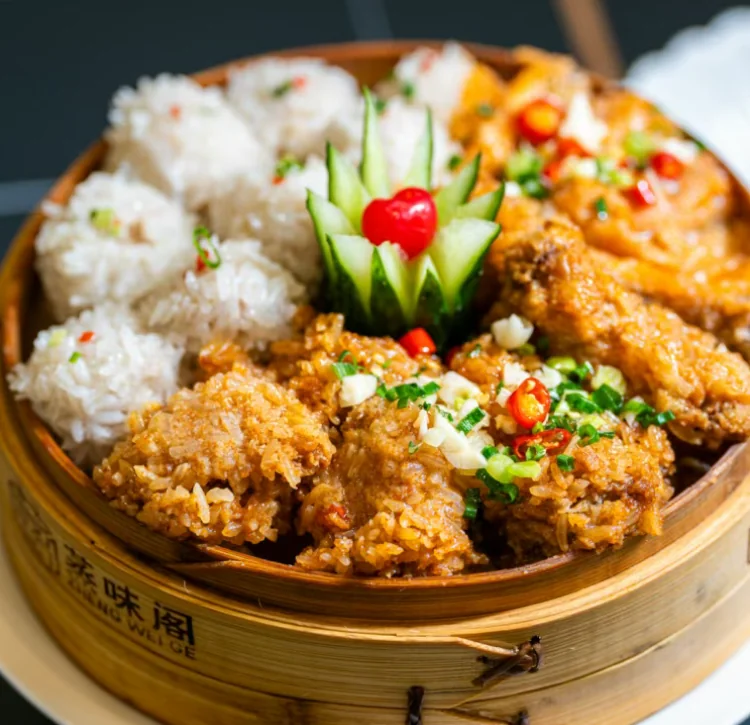
沔阳三蒸, where three is a number, not a list
The name is a trap and it is a beautiful one.
沔阳三蒸, Mianyang three steams, is from 沔阳, which is now called Xiantao. It is a provincial-level intangible cultural heritage item. But the three is not three dishes.
The original meaning, as sources describe it, was steamed fish, steamed meat, steamed vegetables. What it generalised into is steamed livestock and poultry, steamed aquatic things, and steamed vegetables, which is a classification rather than a menu. The steamer counts as a general number rather than a fixed one, and the techniques listed under it run to roughly ten: dry steaming, soup steaming, clear steaming, explosive steaming,扣蒸,酿蒸,包蒸,封蒸, shaped and moulded steaming, and more. If you arrive expecting three plates you will be told you misunderstand the dish.
The dishes people actually point at are 粉蒸肉, meat dusted in rice flour and steamed until it is fatty without being greasy, 粉蒸鱼, and 珍珠丸子, meatballs rolled in glutinous rice before steaming.
There is also a genuine dispute worth knowing about, because it tells you how local this is. Mianyang is cut into two neighbouring cities, Xiantao and Tianmen, and the two argued for years over which of them owns the authentic version. Tianmen won, on the basis that its application for heritage status succeeded. That is not misinformation, it is the actual mechanism by which the question got settled.
The steamer itself is three tiers. Vegetables go on top, which is the tier closest to the lid.
宜昌凉虾, which contains no shrimp
This is the dish I would explain to someone before they see it, because the name is a promise the food does not keep, and people have spent years assuming it is seafood.
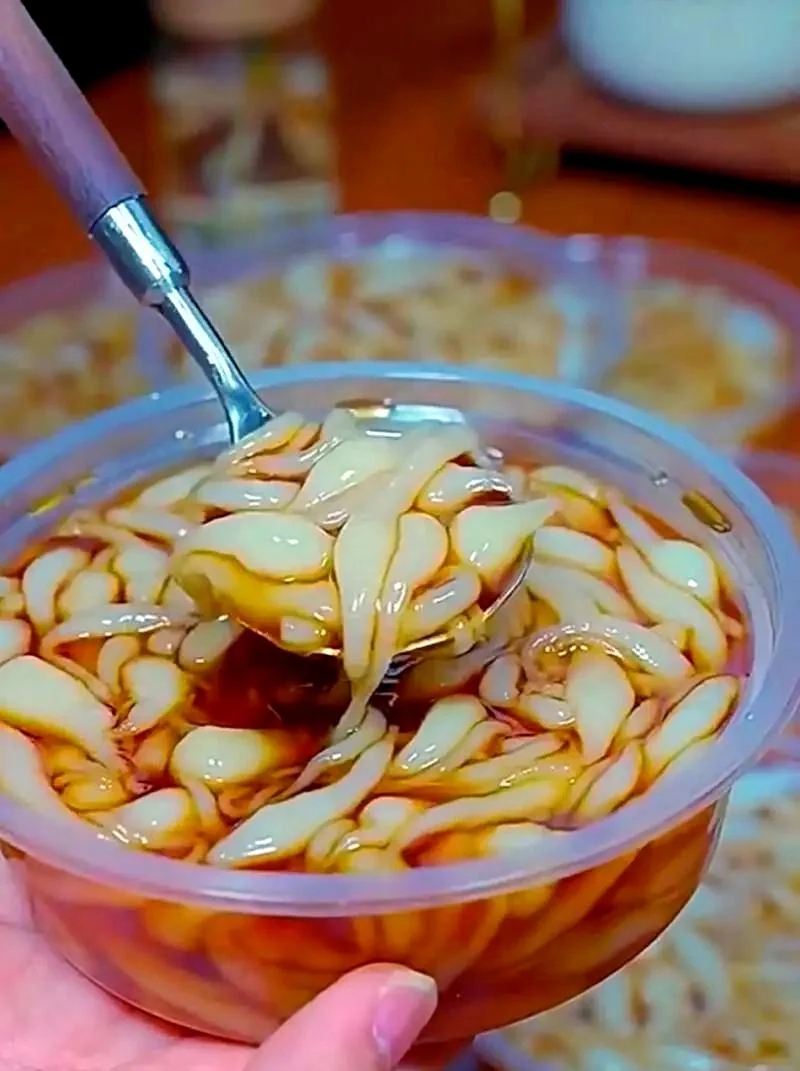
凉虾, cool shrimp, is from Yichang, and it is made from rice. Rice is ground into a slurry, the slurry is pressed through a perforated ladle into cold water, and the pieces that come out are top-heavy and tapering, so they read as small shrimp swimming in the water. That is the entire reason for the name. There is no shrimp in it, there is no connection to the sea, and in northern China the assumption that it is seafood has apparently survived a long time.
It is served in 红糖水, brown sugar water, sometimes with osmanthus juice or sour plum drink. It is nominally a summer thing, and worth ordering in autumn precisely because the seasonal version is what locals reach for as the temperature drops.
The origin story that circulates is a family at 南津关, where the Yangtze runs past Yichang, a mother and son, and a summer in which the only thing available to make food from was rice.
You will also find versions in Sichuan and Chongqing, which is what happens to anything that travels along the river.
孝感麻糖 and the water it supposedly needs
Xiaogan sesame candy is from Xiaogan, an hour or so north, and it is the one item here you are likely to be handed in a box rather than given on a plate.
Production is recorded from the Ming dynasty, which puts it at more than four hundred years old. The characteristics get summarised as 香、甜、薄、脆, fragrant, sweet, thin, and crisp, and the local pairing is not tea but 米酒, rice wine, which is why the combination shows up as a unit rather than as two separate items.
The legend attached to it is that Zhao Kuangyin, the Song founder, ate it and praised it, and that it became a royal tribute as a result. The main production area is 八埠口 in the south of the city, and there is a further claim that only water from a particular spring, 龙吐水, produces the top grade.
Treat the tribute part as legend and the four hundred years as recorded. The distinction matters here, and it is the same discipline that applies to anything a restaurant tells you about its own history, which is that a date and a story are different things.
The Tujia cluster, from the west
Everything above is from the river’s north and centre. West of Wuhan, in Enshi, the Tujia and Miao autonomous prefecture, the food changes register and stops being rice-and-beef.
合渣, hazhi, is the one worth trying first. It is tofu dregs, the pulp left after soy milk is drawn off, kept and cooked into something savoury rather than discarded. The version people name is 张关合渣, after the place.
土家酱香饼, the Tujia savoury pancake, gets called the Chinese pizza in English-language writing, and it is at least honest about being a flatbread with a strong sauce on it.
土家油茶汤, Tujia oil tea soup, is the one with a saying attached: 不喝油茶汤,心里就发慌, do not drink the oil tea soup and your heart panics. That is a local proverb rather than a health claim, and it is the sort of line that tells you something is structural rather than ceremonial.
Also from the region: 恩施豆皮, 神豆腐, 土家炕洋芋, potatoes roasted in a clay pan, and 云梦鱼面 from Yunmeng, fish noodles. I have already written about the Enshi end of this in my guide to Wuhan food beyond breakfast.
How to actually find these in Wuhan
The honest method is not a list, because none of these have a single canonical Wuhan location and any list would go stale.
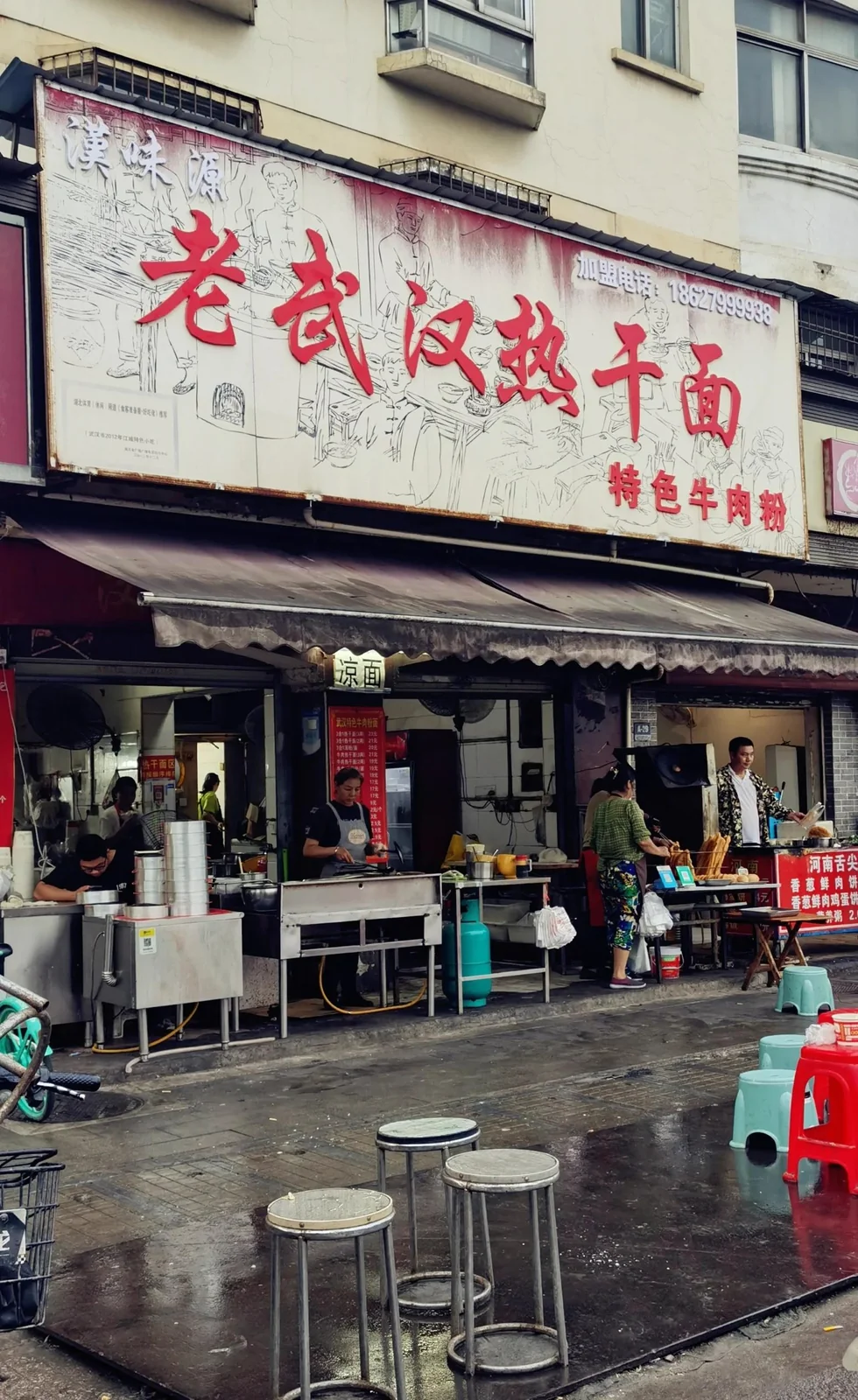
What works is knowing the city name. 说地名, say the place name. A Xiangyang beef noodle shop is not hiding, it is simply not called a Hubei restaurant. 问有没有襄阳牛肉面, ask whether they have Xiangyang beef noodles, and in Wuhan the answer is more often yes than you would expect, because the population of every other Hubei city is present here. The phrasing that opens the same door at a diudian, a sit-down place, is in my guide to how a Chinese restaurant works.
The rice-based desserts travel better than the mains. 凉虾 and 孝感麻糖 turn up in markets and in the dessert shops, and the sesame candy in particular behaves like a souvenir, which is to say it is packaged and sold everywhere and produced in one place.
The Tujia things are the hardest, because they are the furthest from the capital and the least carried. If you want 油茶汤 you may have to go to Enshi.
The honest summary
Wuhan has no regional cuisine of its own, and the food it has is the province’s, delivered by rail and river and kept alive by the fact that every Hubei city has a population living in the capital.
The dishes worth the effort are 襄阳牛肉面, which is beef tallow and rice wine at breakfast rather than beef noodle soup, and 沔阳三蒸, where the three is a classification rather than a menu and where two cities have already fought over who owns it.
The names lie more than usual here. 凉虾 contains no shrimp at all, 合渣 is tofu pulp rather than tofu, and 沔阳三蒸 is not three of anything.
The practical method is to say the city name out loud, because these places are not labelled as Hubei food and are simply called what they are.