
More than just noodles
The first time I ate reganmian, I was 19 and had just moved to Hankou. The sesame paste hit the back of my throat and I thought someone had made a mistake: too thick, too nutty, nothing like the soup noodles I grew up eating in Shanxi.
Eighteen years later, I eat it every morning. Reganmian (热干面), or hot dry noodles, is the dish Wuhan expats crave at 2:00 AM in distant cities. It’s the centerpiece of Wuhan’s breakfast culture, a daily street ritual locals call guo zao.
But most guides treat reganmian as one static dish. It’s not. The bowl you get at 6:00 AM near Hankou Station is not the same bowl you’ll get at 8:00 AM in Wuchang. Wuhan people will argue about the difference with the intensity of Italian grandmothers debating ragù.
This guide is everything I’ve learned about reganmian in eighteen years of eating it. Not from research. From standing in lines.
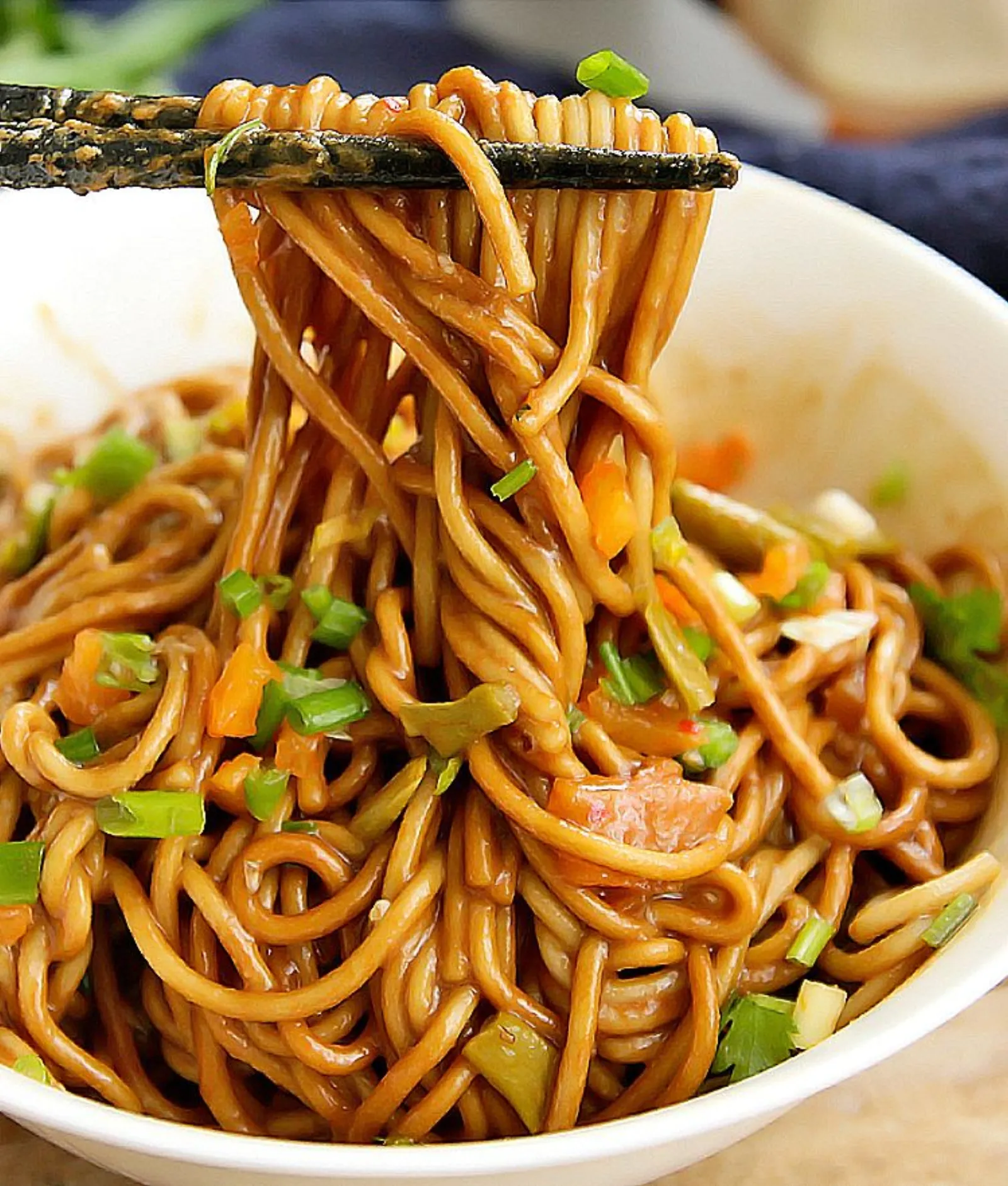
A bowl of Wuhan hot dry noodles: sesame paste, pickled radish, scallions, chili oil, and the most important breakfast in the city.
The anatomy of a perfect bowl
A bowl of reganmian has five components. Get any one wrong, and the whole thing collapses.
The noodles (jianshui mian / 碱水面): Alkaline noodles, slightly yellow, with a springy chew that regular wheat noodles can’t match. The alkaline water (jian shui) raises the pH, giving the noodles their characteristic bite and faintly mineral taste. They’re pre-boiled, tossed with oil to prevent sticking, and then flash-boiled for exactly 20 seconds before serving; overcook them and they go mushy. Undercook them and they’re stiff.
The sesame paste (zhimajiang / 芝麻酱): This is where wars are fought. The paste is made from roasted sesame seeds ground into a thick, aromatic butter. Every stall does it differently:
-
Purists use 100% sesame, dense, nutty, slightly bitter
-
Pragmatists cut it with peanut butter, smoother, sweeter, cheaper
-
Alchemists add soy sauce, sesame oil, and secret spices to thin it into a pourable sauce
The consistency matters as much as the ingredients. Too thick and it clumps. Too thin and it slides off the noodles. The ideal is a paste that coats every strand but still flows when you stir.
The chili oil (lajiao you / 辣椒油): Wuhan chili oil is not Sichuan-style numbing oil. It’s made by pouring hot oil over crushed dried chilies, extracting color and heat without the ma (numbing) sensation. It should be bright red, fragrant, and burn warm. Not aggressive.
The aromatics: Scallion (葱花), pickled radish cubes (酸豆角), and sometimes chopped cilantro. The pickled radish is non-negotiable. Its sour crunch cuts through the richness of the sesame paste.
The acid splash: a quick pour of black vinegar (醋) right before eating, which not everyone does but I do, because it brightens the whole bowl.
How to eat it (yes, there’s a technique)
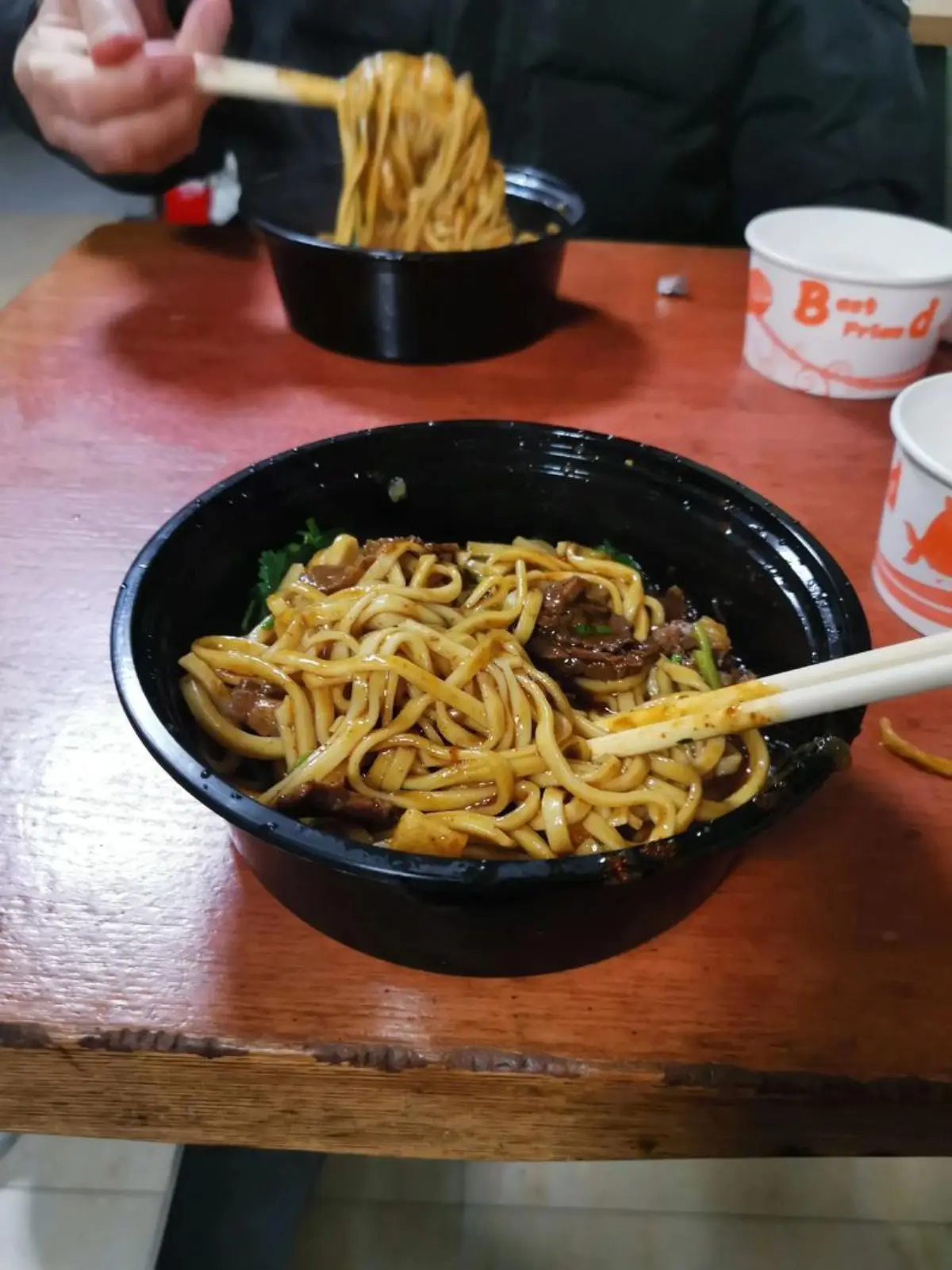
You have three minutes. Stir violently from the bottom up: the paste sinks and you need to flip everything at least four times.
First: you have about three minutes. The moment the noodles hit the bowl, the sesame paste starts cooling and thickening. Every second you wait, the noodles absorb more paste and the whole thing moves toward becoming an inedible cement block.
The sequence:
-
Grab chopsticks. Not a fork. Forks can’t grip alkaline noodles properly.
-
Stir violently from the bottom up. The paste sinks. You need to flip the entire bowl’s contents at least four times. Don’t be gentle. You’re not folding egg whites, you’re fighting cement.
-
Add chili oil to taste: two spoonfuls for beginners, four for locals.
-
Splash of vinegar, optional but correct.
-
Eat immediately. Not “in a minute.” Now. While it’s still hot and the paste is still fluid.
Never let it sit. I have watched tourists take photos of their noodles for five minutes, then try to eat what is essentially a sesame-flavored brick. They blame the stall. The stall did nothing wrong.
The three schools of reganmian
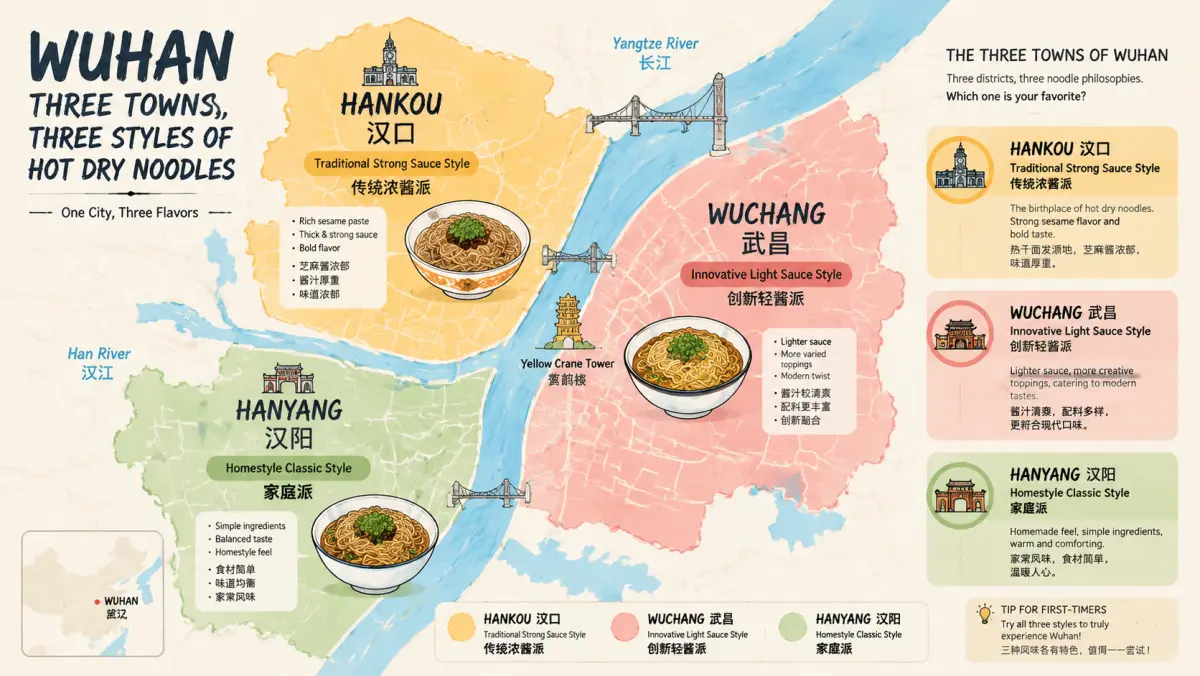
Wuhan’s three towns each have their own reganmian style: Hankou (traditional, heavy paste), Wuchang (innovative, lighter), and Hanyang (home-style, wetter).
Wuhan people don’t agree on much, but they agree that reganmian has three distinct regional styles. Understanding these will make you sound like you’ve lived here.
Hankou school (汉口派): the purists
Hankou is the old merchant quarter, and its reganmian reflects that heritage: heavy on sesame paste, traditional in execution, unforgiving of shortcuts. The paste here is thick, almost too thick for a first-timer. The bowls are bigger. The portions are heavier. If reganmian had a capital, it would be Hankou.
Representative stall: Cai Lin Ji (蔡林纪) on Zhongshan Avenue. The original branch, not the chain. Go before 7:30 AM.
Wuchang school (武昌派): the innovators
Wuchang is the university district, younger, more experimental. The sesame paste here is often thinner, sometimes cut with peanut, sometimes enhanced with soy. Portions are slightly smaller, spice levels higher. This is where you’ll find “new wave” stalls adding things like beef brisket or crispy fried shallots.
Representative stall: The unnamed cart outside Huazhong Normal University’s east gate. 5:30 AM to 9:00 AM. Cash only. 6 yuan.
Hanyang school (汉阳派): the home style
Hanyang is the quietest of the three towns, and its reganmian feels homemade: less oil, more vinegar, a wetter bowl. It’s the style most likely to be replicated in Wuhan kitchens because it’s the most forgiving. If a Wuhan friend invites you to their home for breakfast, this is what you’ll get.
Representative stall: There are no “famous” Hanyang stalls, and that’s the point. Walk down any street near Guiyuan Temple before 8:00 AM and follow the steam.
What not to do
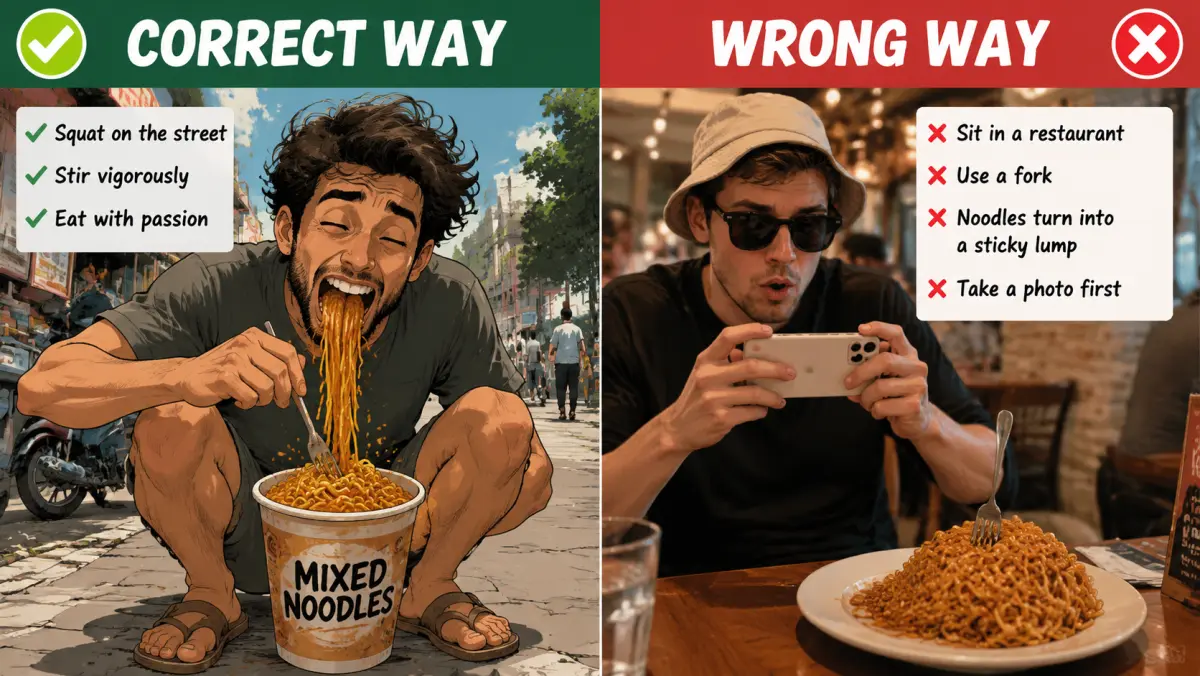
The clock is ticking. Photograph your noodles after eating, not before.
-
Don’t order it in a restaurant. Reganmian in a sit-down restaurant is a photocopy of a photocopy. The dish was born on the street, and it is at its best eaten on the street.
-
Don’t ask for it “not spicy.” The chili oil is part of the architecture, and without it the sesame paste is too heavy and cloying.
-
Don’t share a bowl. The portion is calibrated for one person’s three-minute window. If you split it, by the time the second person eats, it’s cement.
-
Don’t eat it with soup. Some restaurants serve a “soup version” (热干面带汤), which is just noodle soup with sesame paste. It exists for people who gave up on the real thing.
-
Don’t buy the instant version. The pre-packaged reganmian from supermarkets is to real reganmian what instant coffee is to a hand-poured single origin. It exists. It’s not the same thing.
Practical info
| Item | Details |
|---|---|
| Price | 6-10 yuan per bowl (under $1.50 USD) |
| Best time | 5:30-8:00 am |
| How to order | Say “一碗热干面” (yī wǎn rè gān miàn) or just point |
| Payment | WeChat Pay or Alipay at most stalls; cash at some |
| Vegetarian? | Technically yes (no meat), but contains sesame and wheat |
| Gluten-free? | No. The noodles are wheat-based and the alkaline water is essential |
Have a favorite reganmian stall I didn’t mention? Think Wuchang style is better than Hankou? Email me. I will genuinely fight you about this, but respectfully.
More from Wuhan:
-
Wuhan Breakfast Culture: A Local’s Guide to ‘guo zao’: the full breakfast ritual, six dishes, where to find them
-
Wuhan After Dark: Night Markets: when the street food moves to Hankou’s back alleys
-
3 Days in Wuhan: A Local’s Itinerary: how to fit it all into a weekend