
What is “guo zao”?
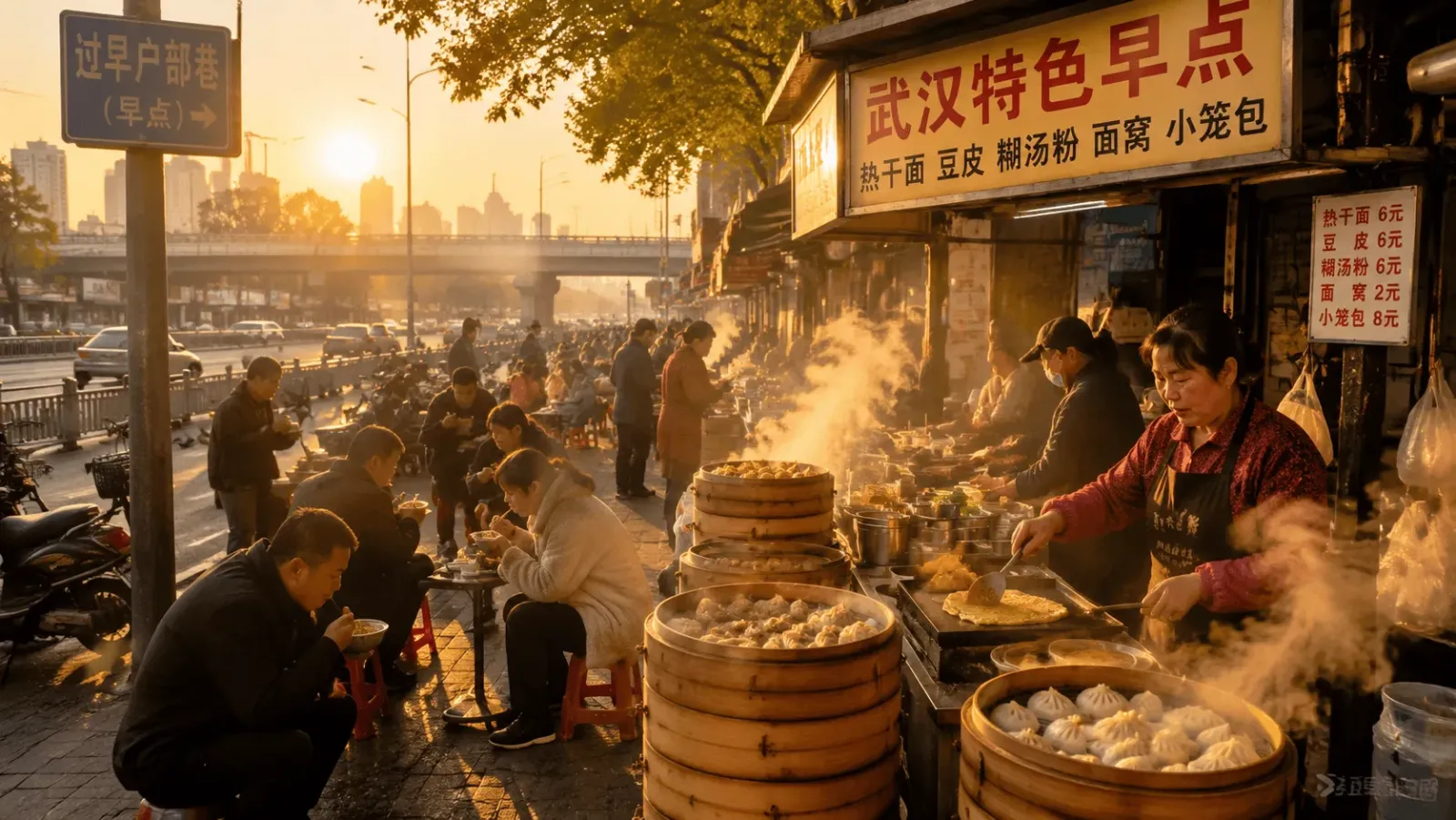
A typical Wuhan morning: steam, noise, and noodles before 7:00 AM.
In Wuhan, breakfast is an event.
The local dialect calls it 过早 (guo zao), which means “passing the morning”, and no English version lands cleanly. “Doing breakfast” is close, but it misses the weight Wuhan people give it.
In most Chinese cities, breakfast is something you rush through on the way to work. A steamed bun, a soy milk, done. Wuhan is different. Ask a local what they had this morning and they’ll tell you in detail: the type of noodles, the stall, the auntie who makes it, whether the sesame paste was thick enough. That’s not small talk. That’s how we locate each other.
I’ve lived here nearly two decades: same breakfast stall, same corner, eight years running. The auntie knows my order before I open my mouth. That’s how this city works.
Why Wuhan’s breakfast culture is different
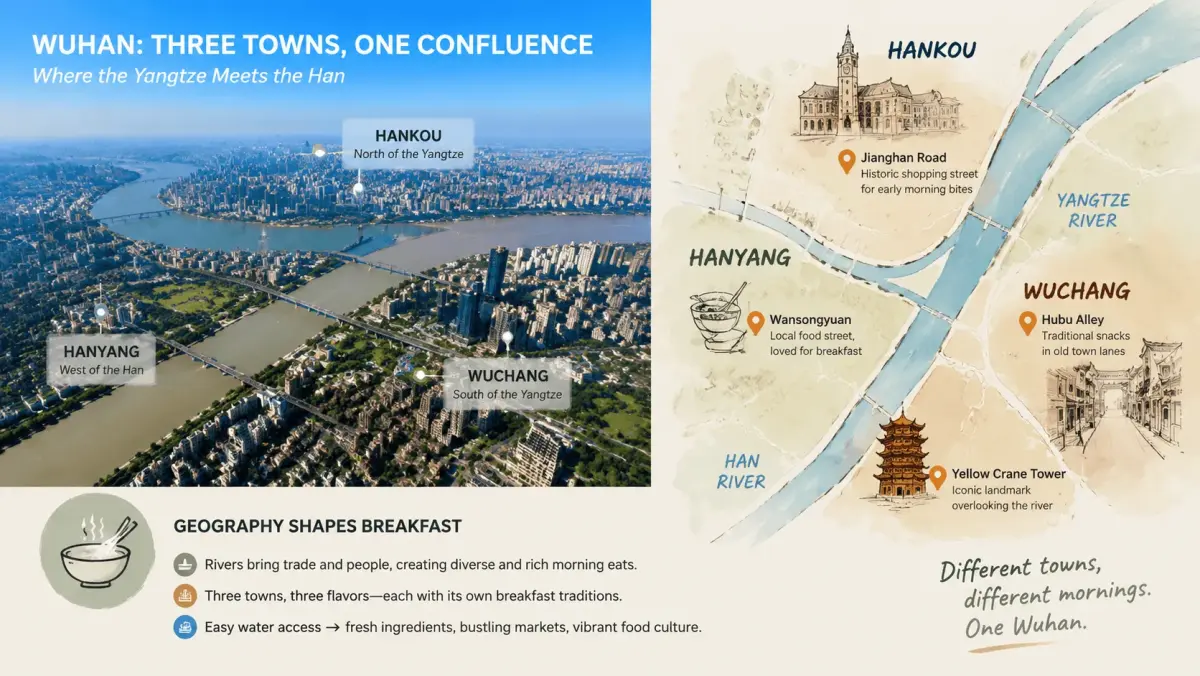
Wuhan is three cities in one, split by two rivers. Geography shaped everything about how this city eats.
China has famous breakfast traditions everywhere: Shanghai’s shengjianbao, Guangzhou’s dim sum, Tianjin’s jianbing. But Wuhan is the only city where breakfast is a daily street ritual rather than a weekend indulgence.
Geography is the first reason. Wuhan is three towns stitched together by the Yangtze and Han rivers. It was a trading hub: docks, merchants, stevedores. Dock work starts before dawn and burns calories. You needed a heavy, cheap breakfast that could feed a working man until noon. Hot dry noodles, carbs and sesame paste, were built for this.
Climate plays a part too. Wuhan summers are brutal (it’s one of China’s “furnace cities”), winters are damp and bone-cold. Both push people toward food that’s pungently seasoned and eaten scalding. Bland congee doesn’t survive here.
And stubbornness. Wuhan people are proud, but not in the Beijing way or the Shanghai way. They refuse to let outside trends erase local habit. KFC and McDonald’s arrived in the 90s. We have them. Nobody goes there before 10:00 AM. The street stalls won.
The six things you have to eat
These are the six things a Wuhan local will actually eat on an actual morning, in order of how often they appear in our weekly rotation.
1. Hot dry noodles (热干面, reganmian)
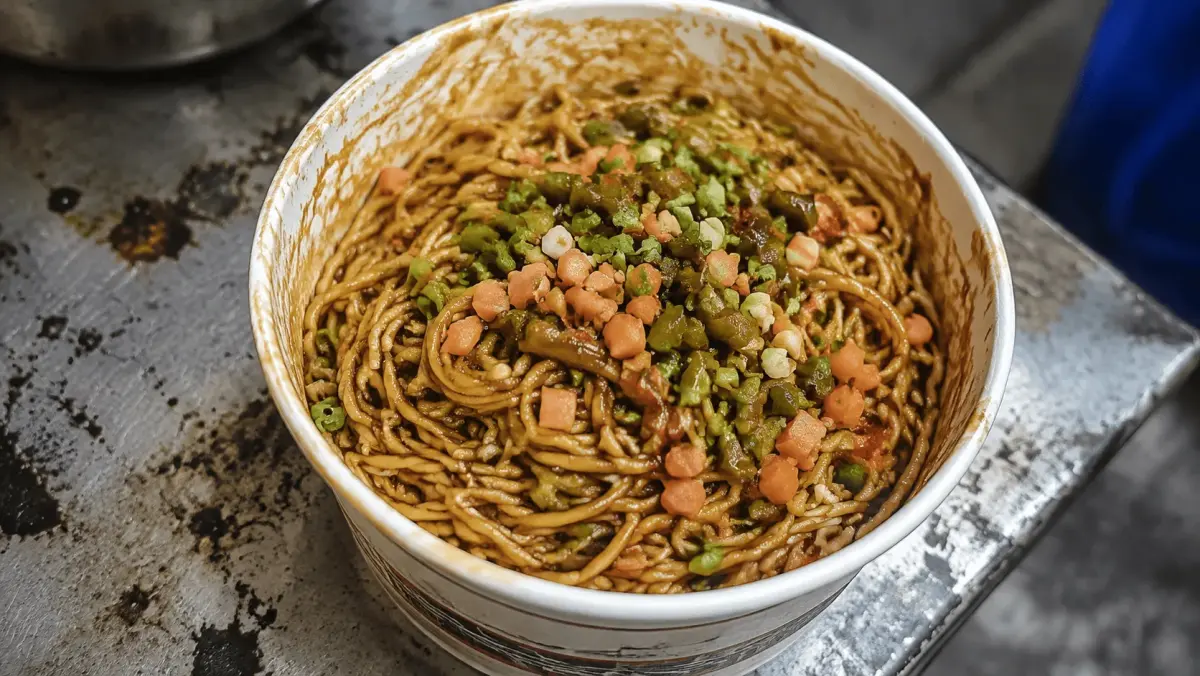
Hot dry noodles: Wuhan’s breakfast icon. Stir aggressively, eat immediately.
The icon. The thing every Wuhan breakfast guide talks about, usually badly. They treat it as one dish. It’s a category. I wrote a complete guide to hot dry noodles if you want to go deep.
The base is alkaline noodles (jianshui mian) boiled for 20 seconds, drained, then tossed with sesame paste, chili oil, pickled radish, scallion, and sometimes a splash of vinegar. The sesame paste is where stalls distinguish themselves. Some use pure tahini-thick sesame, some cut it with peanut, some add a secret soy-based blend. The ratio of paste to noodle matters more than the noodle itself.
Where I eat it: The stall outside Hankou Railway Station, on the Jianguo Avenue side. 6:00 AM start. The auntie’s name is apparently “Ayi” (auntie) because I’ve never heard anyone call her anything else. 7 yuan. Cash or WeChat.
First-time tip: Eat it within three minutes of being served. The noodles absorb the paste and clump into an unmossable brick if you let it sit. Stir aggressively. Don’t be polite about it.
2. Bean pan with egg (豆皮, doupi)
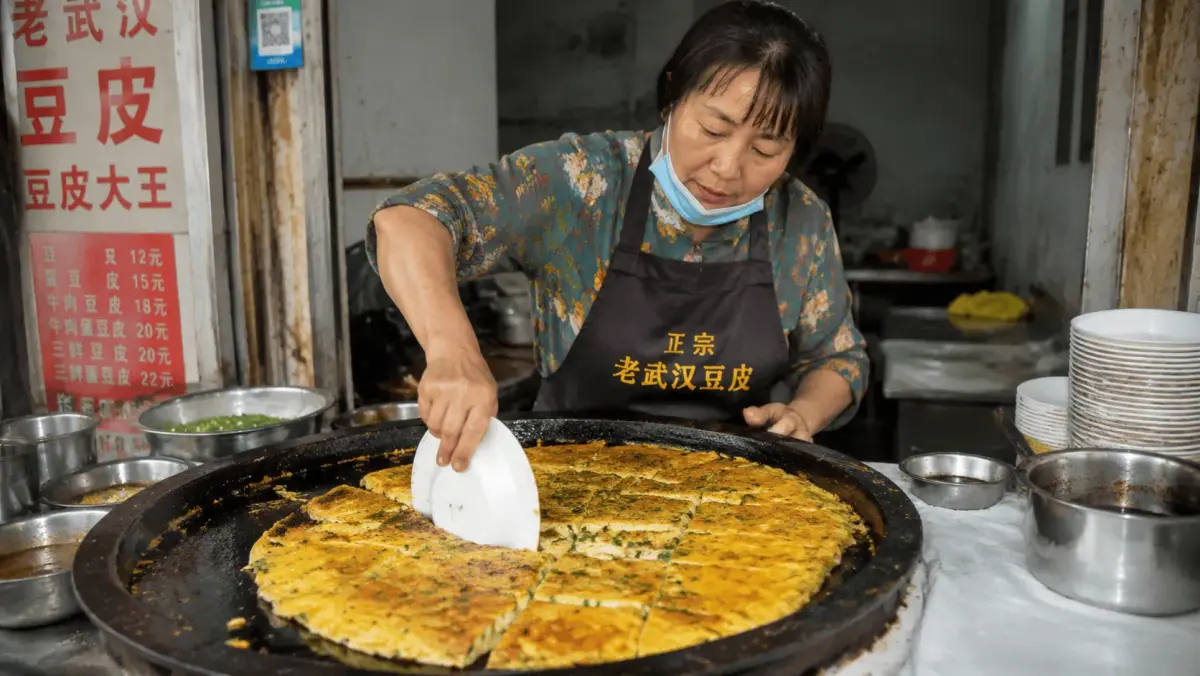
Doupi being made on a flat pan: the egg goes on last, then it’s cut into squares with a shovel.
Doupi doesn’t photograph well. It looks like a flat, golden-brown rectangle of something. But it’s one of the best things you can eat in Wuhan, and most tourists never find it.
The outer layer is a thin sheet of mung bean batter crisped on a giant flat pan. Inside: sticky glutinous rice, diced pork, mushrooms, sometimes bamboo shoots. A fresh egg gets cracked on top in the last 30 seconds and spread thin. The whole thing is cut into squares with a shovel and served scalding.
Where I eat it: Lao Tong Cheng on Zhongshan Avenue is the famous name and it’s good, but the better version is at the unmarked stall inside Hubu Alley before 8:00 AM. After that, the line gets stupid and the quality drops because they start rushing.
3. Soup dumplings (汤包, tangbao)
Yes, Shanghai has xiaolongbao. Wuhan’s tangbao are bigger, soupier, and less delicate. I’ll fight anyone who says that’s a flaw. The wrapper is thicker, the soup is pork-bone-rich, and you eat them with a spoon, not chopsticks, because they’re too heavy to lift by the skin.
Where I eat it: Si Ji Mei on Jiefang Avenue. They’ve been doing it since 1997. The crab-roe version (秋季蟹黄汤包) is seasonal. October only. Don’t miss it.
4. Noodles with sesame sauce and beef (牛肉拌面, niurou banmian)
This is what you order on day two, after you’ve had hot dry noodles once and want to branch out. Wheat noodles, sliced beef braised in five-spice, sesame sauce, chili oil, and a handful of cilantro. Heavier than reganmian and spicier.
Where I eat it: Any stall in Wansongyuan Road food street after 7:00 AM. The competition there is brutal, which means the average quality is high. Pick the one with the longest line of locals. Not tourists, locals. You can tell by whether they’re eating standing up.
5. Fried dough sticks with soy milk (油条豆浆, youtiao doujiang)
The simplest breakfast in Wuhan, and sometimes the best. Youtiao, long golden fried dough sticks, torn into pieces and dunked into a bowl of hot sweet or savory soy milk. That’s it. It costs 5 yuan. It’s what I eat when I’m not hungry enough for noodles but need something in my stomach before coffee.
Where I eat it: There’s a stall on the corner of Jianghan Road and Zhongshan Avenue, next to the convenience store. The youtiao is made to order, not pre-fried and reheated like the ones at tourist traps. You’ll know it’s fresh because the oil smells clean and the stick springs back when you bend it.
6. Steamed buns with meat filling (包子, baozi)
Every city has baozi. Wuhan’s version runs larger than Shanghai’s, with a thicker skin and a pork-and-onion filling that’s more heavily spiced. The vinegar you dip it in matters. Ask for the black rice vinegar (黑米醋), not the white.
Where I eat it: Hu Ming Sheng Baozi on Dazhi Road. The line starts at 5:30 AM. Yes, 5:30. I’ve stood in it. The pork bun is the order; the vegetable one is fine but you’re not here for fine.
How to actually do it
When to go
Before 7:30 AM. Non-negotiable. The best stalls sell out by 9. The ones that don’t sell out lower their standards after 8 because the morning rush is over and they stop caring. If you’re jet-lagged and wake up at 10, you’ve already missed it. Reset your clock.
Where to go
Three neighborhoods, in order of authenticity:
-
Hankou (江汉路 / Wansongyuan area): the old merchant quarter. Highest density of legacy stalls. If you only have one morning, come here.
-
Wuchang (around Hubu Alley / Simenkou): more tourist-known, but the old stalls still exist if you walk two blocks past the souvenir shops.
-
Hanyang (around Guiyuan Temple): the quietest of the three towns. Fewer English speakers, fewer tourists, equally good food.
How to order
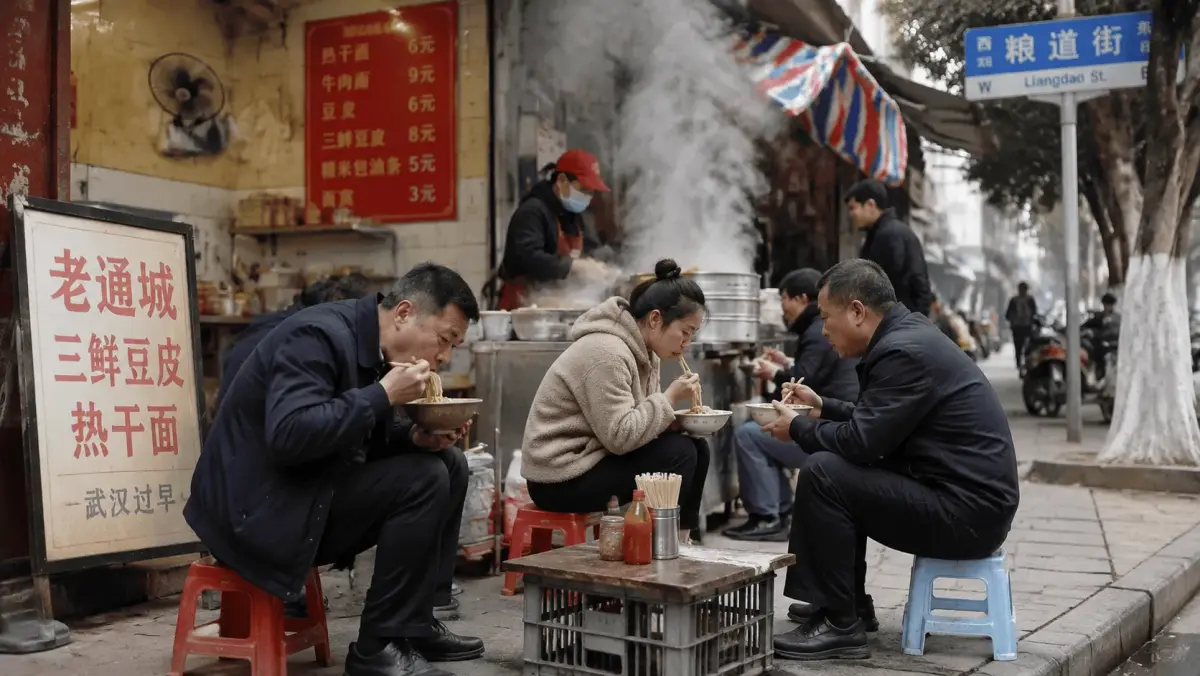
This is how Wuhan does breakfast: no tables, no chairs, just a stool and a bowl.
Most stalls have no English menu. Here’s what you do:
-
Point at what the person ahead of you is eating. This works 95% of the time.
-
Have WeChat Pay or Alipay set up. Cash works at some stalls but not all, and coins confuse everyone because nobody uses them.
-
Eat where you stand. Wuhan breakfast is not sit-down. There are tiny plastic stools on the sidewalk. Sit on one. Hold your bowl in your hand. Don’t look for a table.
What not to do
-
Don’t ask for “less spicy” or “no chili.” You can ask, but the auntie will ignore you, or she’ll do it and the dish will taste wrong. Trust the recipe.
-
Don’t take a photo of the cook without buying something. This isn’t a museum. Buy noodles, then photograph.
-
Don’t go to the stalls with English menus near Yellow Crane Tower. Those exist for tourists. The food is twice the price and half as good. Walk 10 minutes in any direction and you’ll find better.
Why this matters
I’m writing this because the English-language content about Wuhan breakfast is almost universally bad. It’s either:
-
Translated listicles that get the dish names wrong and recommend restaurants that closed in 2019
-
Travel blog filler where someone spent 48 hours in Wuhan, ate hot dry noodles once at their hotel, and declared it “an interesting local specialty”
-
Academic anthropology that explains the cultural significance of guo zao in language no actual Wuhan person would use
None of that helps you. What helps you is knowing that the stall outside Hankou station opens at 6:00 AM, that you should stir your noodles violently, that the line at Hu Ming Sheng starts before dawn, and that you should never let hot dry noodles sit for five minutes.
This is the stuff I’ve learned by living here. Not by researching it. By eating it, 7,000 mornings in a row.
Practical info
| Item | Details |
|---|---|
| Best time | 6:00-7:30 am (stalls open as early as 5:30) |
| Budget | 5-15 yuan per person (under $2 USD) |
| Payment | WeChat Pay or Alipay (cash at some stalls, coins useless) |
| Language | Pointing works. Bring a translation app for anything complex. |
| Dietary notes | Most dishes contain gluten, soy, and sesame. Pork is ubiquitous. Vegetarian options exist but are limited: doupi without pork, youtiao, some baozi. |
Have a question about Wuhan breakfast, or disagree with my stall picks? Email me. I genuinely want to hear from you, especially if you’ve found a stall I don’t know about yet.
Related:
-
How Wuhan Talks: A Survival Guide to the City’s Impossible Dialect: the word “guo zao” is pure Wuhan dialect
-
Hot Dry Noodles: Ultimate Guide: the dish you’ll order at every guo zao
-
Wuhan Night Markets: After Dark: the other side of Wuhan’s food culture
-
3 Days in Wuhan: A Local’s Itinerary: Day 1 starts with guo zao
-
Wuhan Survival Language: Every Phrase a Foreigner Actually Needs: learn to say “guo zao” and 40 other phrases that actually work
-
76 Days: What the Wuhan Lockdown Actually Looked Like from Inside: the stall that reopened on April 8