
The poem that made a building immortal
Every Chinese person knows this poem. It’s drilled into them in elementary school:
Old friends bid farewell at Yellow Crane Tower, Westward to Yangzhou through misty March blossoms. A lone sail’s distant shadow vanishes into the blue void, Only the Yangtze River flows toward the horizon.
Li Bai wrote this in the 8th century, watching a friend’s boat disappear downriver. The poem is four lines. It made the tower famous forever.
But the tower Li Bai stood in doesn’t exist. Neither does the one before it, or the one before that. The Yellow Crane Tower has been destroyed seven times by fire, war, and revolution, and rebuilt seven times across 1,800 years. The building you visit today was constructed in 1985, with reinforced concrete and an elevator.
Does that make it less real? I’ve thought about this a lot, standing on the top floor at sunset. I don’t think so. The tower was never about the building. It was about the view: the Yangtze curving below, the city spreading in every direction, the feeling of standing at the crossroads of a civilization. That view hasn’t changed.
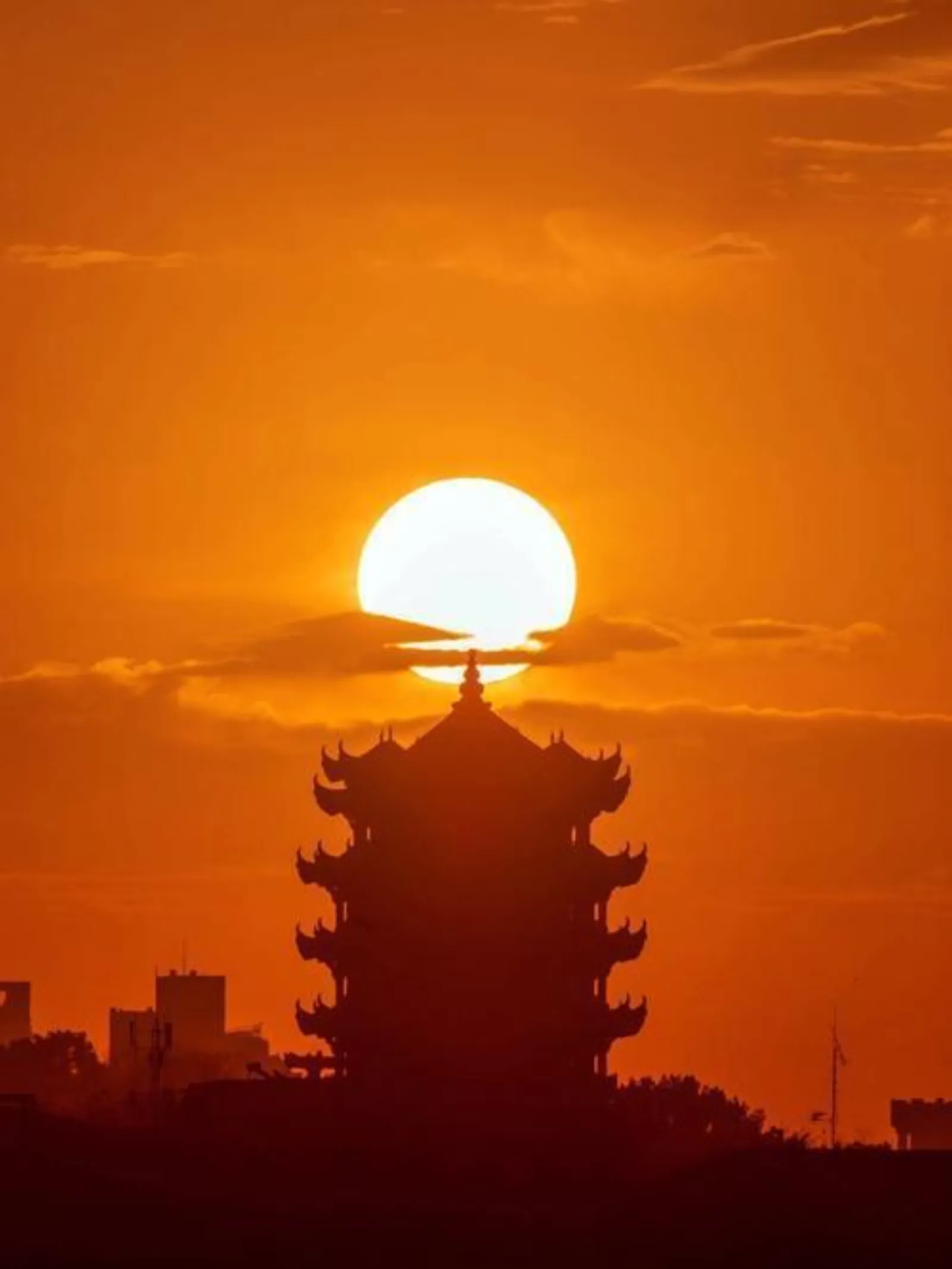
Yellow Crane Tower at sunset: 1,800 years of poetry, fire, and reconstruction on Snake Hill.
1,800 years in five minutes
The tower’s history is a timeline of catastrophe and stubbornness:
223 AD: Sun Quan, ruler of the Eastern Wu kingdom, builds a military watchtower on Snake Hill (蛇山) overlooking the Yangtze. It’s a strategic lookout, not a tourist attraction, and the Yangtze was the front line between rival kingdoms.
Tang Dynasty (618-907): The tower becomes a cultural landmark. Poets visit, drink, and write. Cui Hao’s poem “Yellow Crane Tower” becomes so famous that Li Bai himself supposedly refused to write about the tower after reading it, saying “Cui Hao has already written everything worth saying.”
Song to Qing (960-1911): The tower is destroyed and rebuilt multiple times. Fire is the main enemy. Wooden towers and lightning don’t mix. Each reconstruction adds floors, changes the style, and claims to be the “real” version.
1884: The last imperial-era tower burns down. A lamp fire spreads through the wooden structure. For the next century, the tower exists only in paintings, poems, and memory.
1985: The current tower is built. Reinforced concrete disguised as wood, five stories, 51.4 meters tall. An elevator runs through the middle, officially for disabled visitors and used by everyone. Traditional Song Dynasty architecture on the outside, 1980s museum on the inside.
What you’ll actually see
The building itself
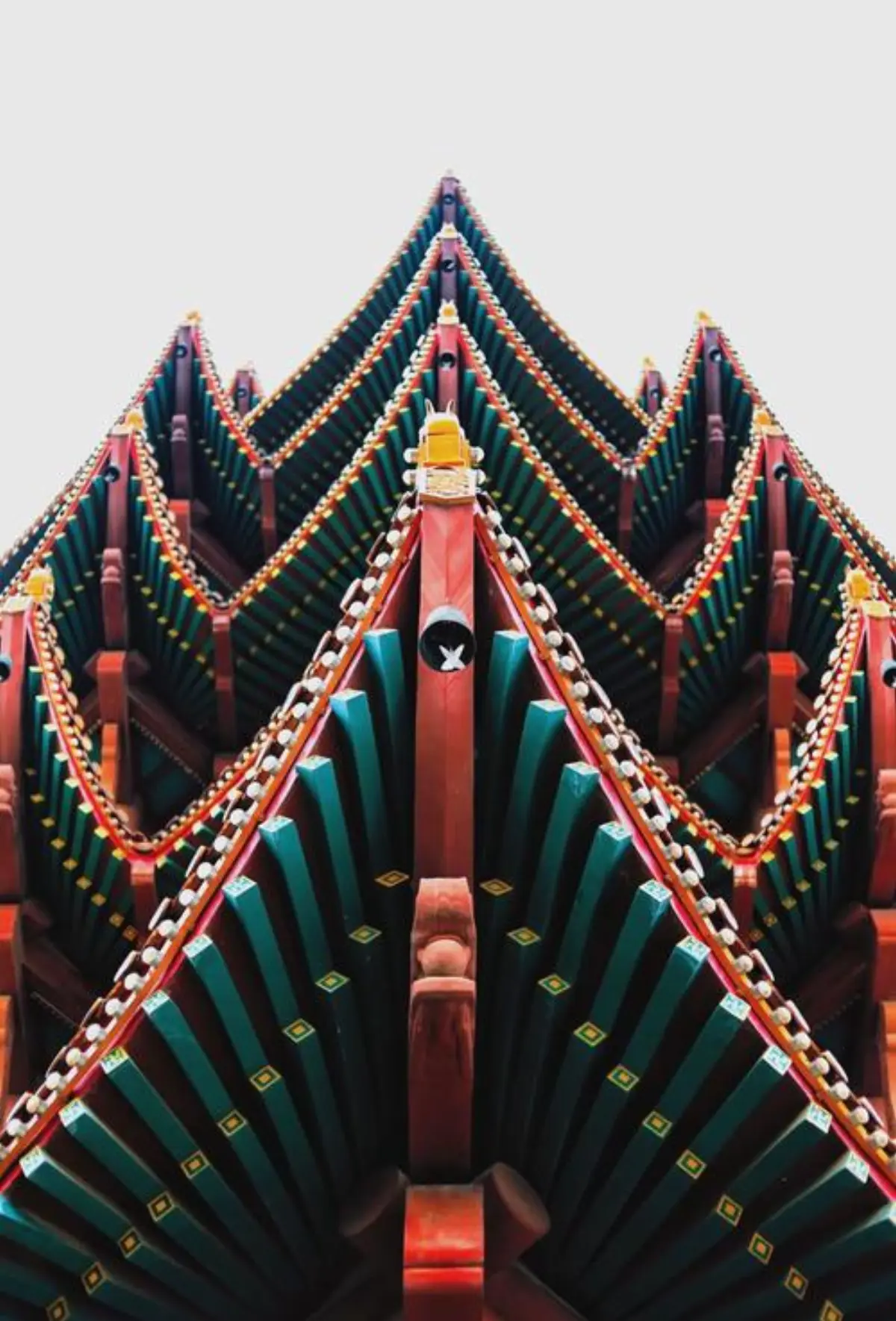
The tower’s flying eaves and yellow glazed tiles: Song Dynasty style, reinforced concrete structure, built in 1985.
Five stories, each with a different theme:
-
Floor 1: A 9-meter-tall ceramic mural of clouds and cranes, the mythological origin story.
-
Floor 2: Historical records and paintings of previous towers, where you realize how many times the tower’s been rebuilt.
-
Floor 3: Calligraphy and poetry, the cultural heart of the tower. Cui Hao’s and Li Bai’s poems are carved into stone here.
-
Floor 4: Temporary exhibitions, usually Wuhan-themed art.
-
Floor 5: The view. This is why you came.
The view from the top
Stand on the top floor and look in four directions:
-
North: The Yangtze River Bridge, stretching across the water to Hanyang. Cargo ships and passenger ferries. The river is wider than you expect, about 1.2 kilometers at this point.
-
East: Wuchang district, a dense grid of streets, universities, and the shimmer of East Lake in the distance.
-
South: Snake Hill Park, with its old trees and smaller pavilions.
-
West: The confluence of the Yangtze and Han rivers, the exact spot where three cities became one.
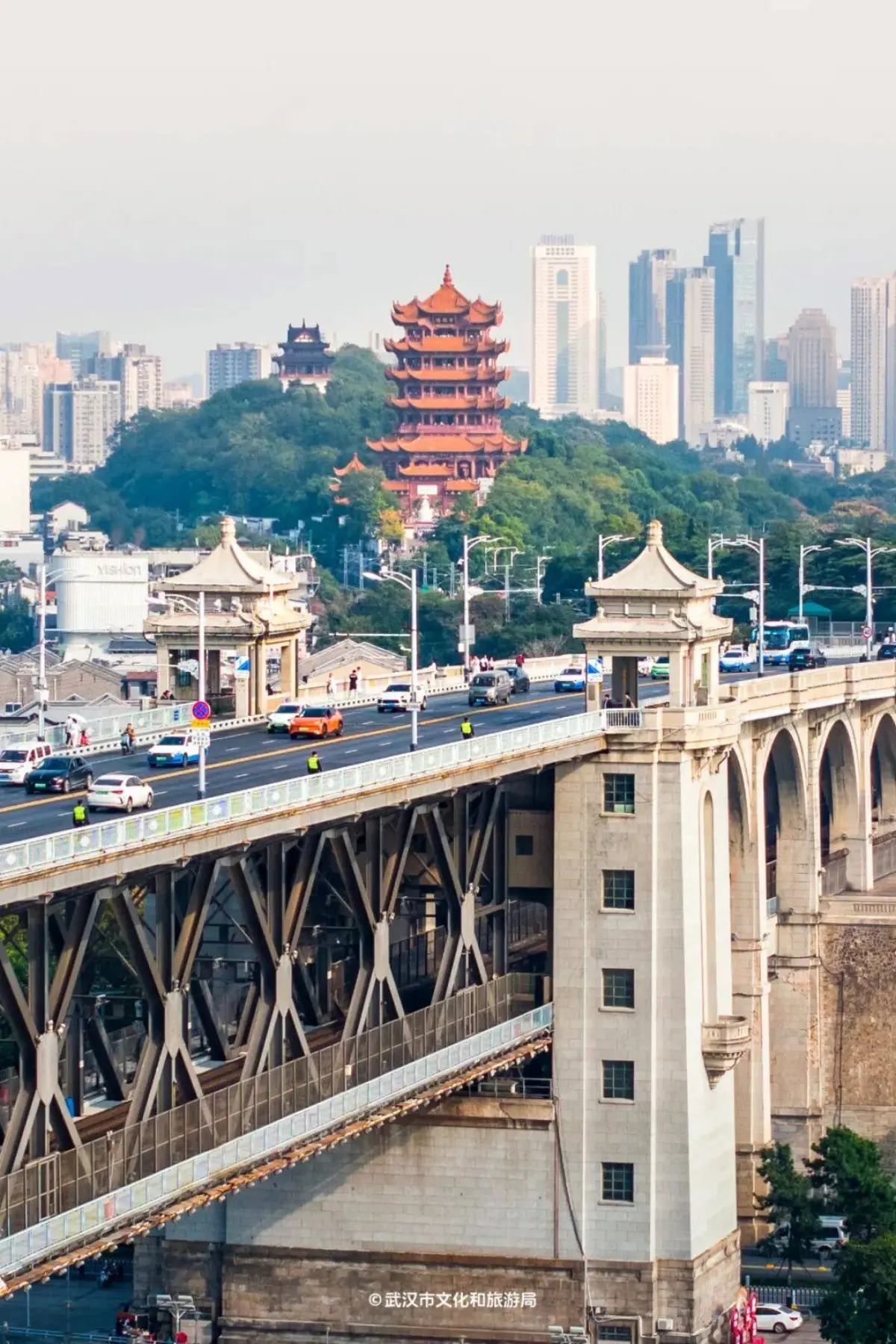
From the top floor: the Yangtze River Bridge stretching across the water. Li Bai saw this same river 1,200 years ago.
The legend
The tower’s name comes from a Daoist legend. A wine shop owner on Snake Hill once gave free wine to a poor Taoist priest every day for months. In gratitude, the priest drew a yellow crane on the wall with an orange peel. “When you clap,” he said, “the crane will dance.”
It did. The dancing crane drew crowds, and the wine shop prospered.
Ten years later, the priest returned. He played a flute, the crane flew down from the wall, and the priest rode it into the sky. The shop owner, grateful, built a tower on the spot to commemorate the miracle.
It’s a nice story. It’s also probably invented by a Tang Dynasty marketing team to attract tourists. Some things never change.
When to go
Best time: October-November, 4:00-5:30 pm. The autumn light hits the yellow tiles at the perfect angle, and if you time it right, you’ll see the sunset from the top floor. The tower faces west, so the sunset over the Yangtze is the money shot.
Worst time: Summer weekends, 10:00 AM-3:00 PM. It’s 38°C, there are 8,000 people, and the air conditioning in the tower can’t keep up. Also, Chinese national holidays (October 1-7, May 1-7). Avoid completely.
Shoulder time: Weekday mornings, 8:00-9:30 am, when there are fewer people and the light is cooler and softer. The tower opens at 8:00 am in summer, 8:30 in winter.
Practical info
| Item | Details |
|---|---|
| Entry | 70 yuan (adults), 35 yuan (students with ID) |
| Hours | 8:00 am-6:00 pm (summer), 8:30 am-5:00 pm (winter) |
| Getting there | Metro Line 4, Wuchang Railway Station, then 15-min walk |
| Elevator | Available, officially for disabled/elderly, but no one checks |
| Time needed | 1.5-2 hours |
| Nearby | Hubei Provincial Museum (15 min by metro), Hubu Alley (breakfast), Wuhan Yangtze Bridge (walk after) |
Did you memorize the poem in school? Have a different take on the tower? Email me.
Related:
-
3 Days in Wuhan: A Local’s Itinerary: the tower is Day 2
-
Hubei Provincial Museum: Home of the 2,400-Year-Old Bells: 15 minutes away, same cultural lineage
-
Walking the Yangtze Bridge at Night: walk from the tower to the bridge
-
Wuhan Breakfast Culture: Guo Zao: eat at Hubu Alley first
Sources
The tower’s chronology and dimensions follow the standard historical record.