
The bridge that united a city
Before 1957, Wuhan was three cities that couldn’t reach each other.
Wuchang, Hankou, and Hanyang sat at the confluence of the Yangtze and Han rivers, separated by water. To cross, you took a ferry, slow, crowded, and useless in fog or flood. In summer, when the Yangtze surged, ferries stopped entirely. The three towns were islands.
The Wuhan Yangtze River Bridge (武汉长江大桥) changed that. Completed in 1957 with Soviet engineering assistance, it was the first bridge ever built across the Yangtze, a 1.6-kilometer double-deck structure carrying trains on the lower level and cars on the upper. Mao Zedong swam across the Yangtze to celebrate its completion (or at least, that’s the official story; the swimming may have been metaphorical).
The bridge is not beautiful in the way that suspension bridges are beautiful. It’s a steel truss structure, functional, heavy, industrial. But at sunset, with the Yangtze turning gold and the city lights flickering on, it becomes something else entirely. It becomes the best free experience in Wuhan.
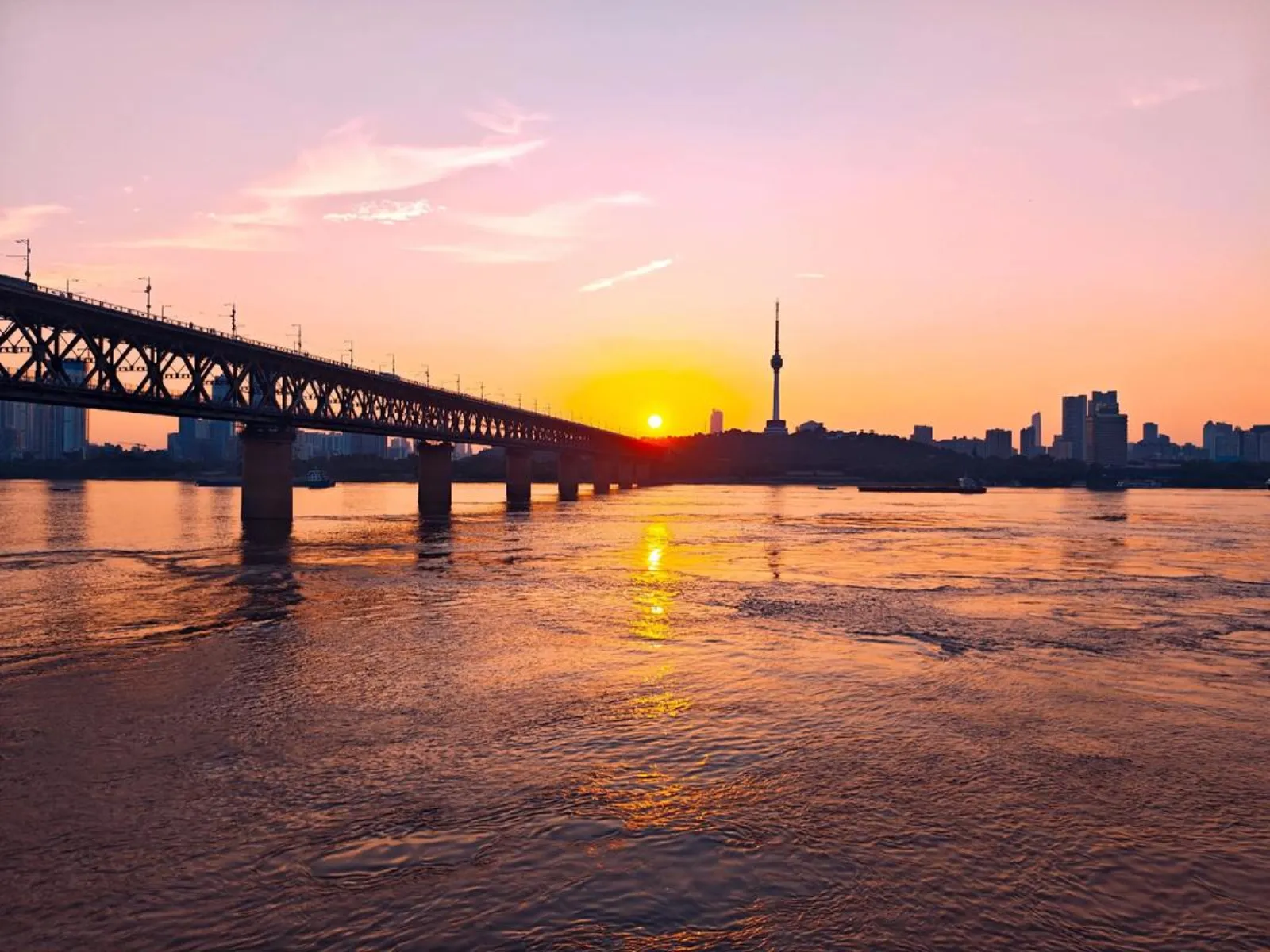
The Wuhan Yangtze River Bridge at sunset: 1.6 kilometers of steel, completed in 1957, the first bridge ever across the Yangtze.
The walk
Most tourists take a taxi across the bridge. That’s wrong. The bridge is meant to be walked.
Start: Hanyang side (汉阳), at the bridge’s western terminus, near Guiyuan Temple. End: Wuchang side (武昌), at the bridge’s eastern terminus, near Yellow Crane Tower. Distance: 1.6 kilometers. Time: 35-45 minutes at a leisurely pace. Cost: Free.
There’s a pedestrian walkway on both sides of the upper deck. Take the south side (right when facing Wuchang). It has the better views, looking upstream toward the river’s source.
What you’ll see walking across
Minute 0-5: The Hanyang approach. You climb a ramp and suddenly you’re above the river. The noise of traffic is constant but the view opens up. Below you, the Han River meets the Yangtze, two colors of water merging, the Han clearer, the Yangtze murkier.
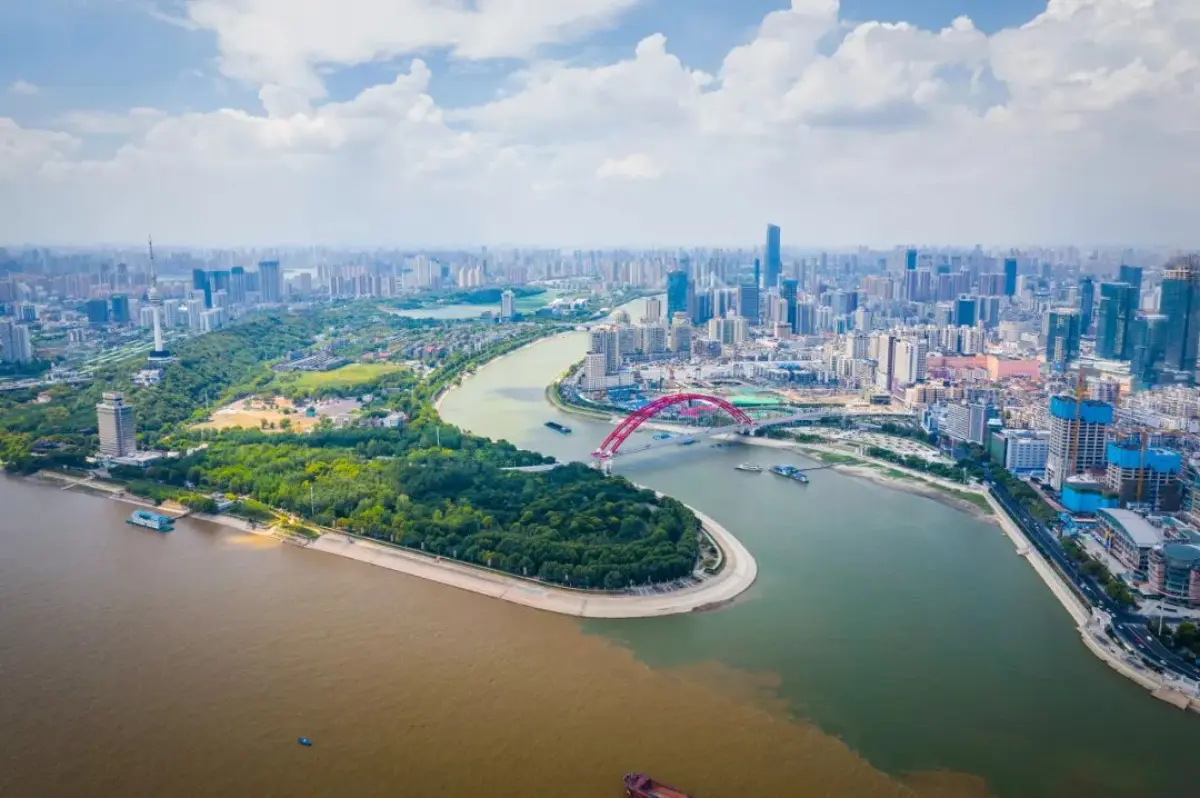
Where two rivers meet: the Han (clearer) and the Yangtze (murkier) merge below the bridge. This is how three towns became one city.
Minute 5-15: The middle of the bridge, with the road deck rumbling beside the walkway. This is where it hits you. The Yangtze is wide. At this point, it’s about 1.2 kilometers across. Cargo ships, fully loaded barges carrying coal, sand, containers, pass beneath you. The river is not a decoration. It’s a working highway, and it’s been one for 2,000 years.
You’ll see fishermen in small wooden boats, dwarfed by the cargo ships. You’ll see the whole Wuhan skyline from a vantage point that no building on either bank can give you. Hankou to the north, Wuchang to the south, and the river connecting them.
Minute 15-25: The sun drops. If you’ve timed it right (start at 5:00 pm in summer, 4:00 pm in winter), the entire river turns gold. The bridge’s steel structure casts long geometric shadows. The city lights start coming on, first the office towers in Hankou, then the street lights along the riverbank, then the Yellow Crane Tower, illuminated on the hill above you.
Minute 25-35: The Wuchang approach. You descend toward Snake Hill and the Yellow Crane Tower. The bridge’s ramp curves down, and suddenly you’re back at street level, in the middle of a night market that has set up under the bridge’s approach.
The best spot for photos
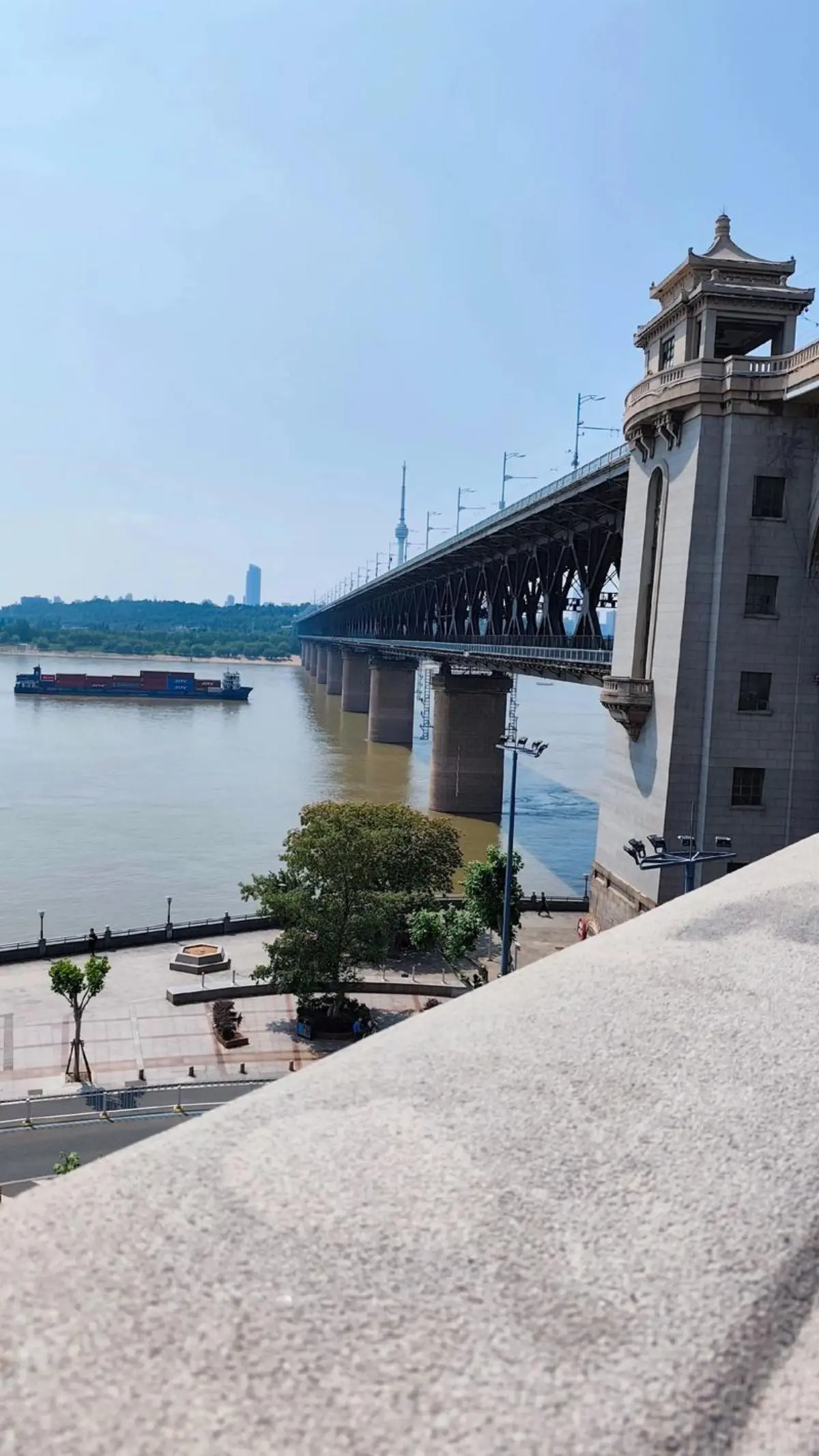
Blue hour from the Wuchang end: the bridge lights, the Hankou skyline, and the river in between.
Not the middle of the bridge. The best photo spot is the pedestrian viewpoint at the Wuchang end, where the bridge meets the riverbank. From here, you can photograph the entire bridge stretching across the river, with the Hanyang skyline behind it. Come back here after your walk, at 6:30-7:00 pm in summer, when the sky is deep blue and the bridge lights are on.
The bridge at different times
| Time | Experience | Rating |
|---|---|---|
| Sunset (5-6 pm summer) | Golden river, city lights coming on | ★★★★★ |
| Night (7-9 pm) | Fully lit bridge, reflecting on water | ★★★★☆ |
| Dawn (5-6 am) | Empty bridge, fishermen below, soft light | ★★★★☆ |
| Midday | Hot, bright, pedestrian: skip this | ★★☆☆☆ |
| Foggy day | Eerie, atmospheric, bridge disappears into mist | ★★★☆☆ |
The second bridge (and the third, and the fourth…)
Wuhan now has 11 bridges across the Yangtze. The 1957 bridge is the oldest and most iconic. I wrote about the full history of all the bridges separately, but if you’re a bridge person:
-
Second Bridge (1995): A cable-stayed bridge, more photogenic than the first. Lights up in rainbow colors at night.
-
Parrot Island Bridge (2014): Bright orange suspension bridge, the most colorful crossing. Visible from the first bridge.
Practical info
| Item | Details |
|---|---|
| Cost | Free |
| Hours | Pedestrian walkway always open |
| Start point | Hanyang end (near Guiyuan Temple) |
| End point | Wuchang end (near Yellow Crane Tower) |
| Time needed | 45 minutes |
| Safety | Guardrails are high; traffic noise is loud but safe |
| Best combo | Walk bridge at sunset → dinner at night market → Yellow Crane Tower at night |
Walked the bridge? Have a photo to share with me? Email me.
Related:
-
Bridges Over the Yangtze: How Wuhan Stitched Itself Together: the full history of every Yangtze crossing in Wuhan
-
The River Is the City: Wuhan’s Yangtze Culture: the river you’ll be walking over
-
Yellow Crane Tower: Beyond the Poem: the tower is right at the bridge’s Wuchang end
-
3 Days in Wuhan: A Local’s Itinerary: the bridge walk is Day 3 finale
-
Wuhan After Dark: Night Markets: the night market starts under the bridge approach
-
The 1.5-Yuan Ferry: Wuhan’s Cheapest River Crossing: the other way to cross, on the water instead of above it