
The city that eats twice
Wuhan’s breakfast culture gets all the attention. But the city doesn’t stop eating when the sun goes down. It shifts. The morning stalls close at 10:00 AM, and the night markets open at 6:00 PM. In between, there’s a lunch scene. Wuhan is a city that eats four times a day, and the night version is where the social energy lives.
Breakfast is a solo act: you grab a bowl and go. Night markets are communal. You sit on a plastic stool, order too many skewers, drink beer from bottles that have been in a bucket of ice, and talk until midnight. The night market is Wuhan’s living room.
I’ve been eating at these markets since I moved here. Here are the ones that matter.
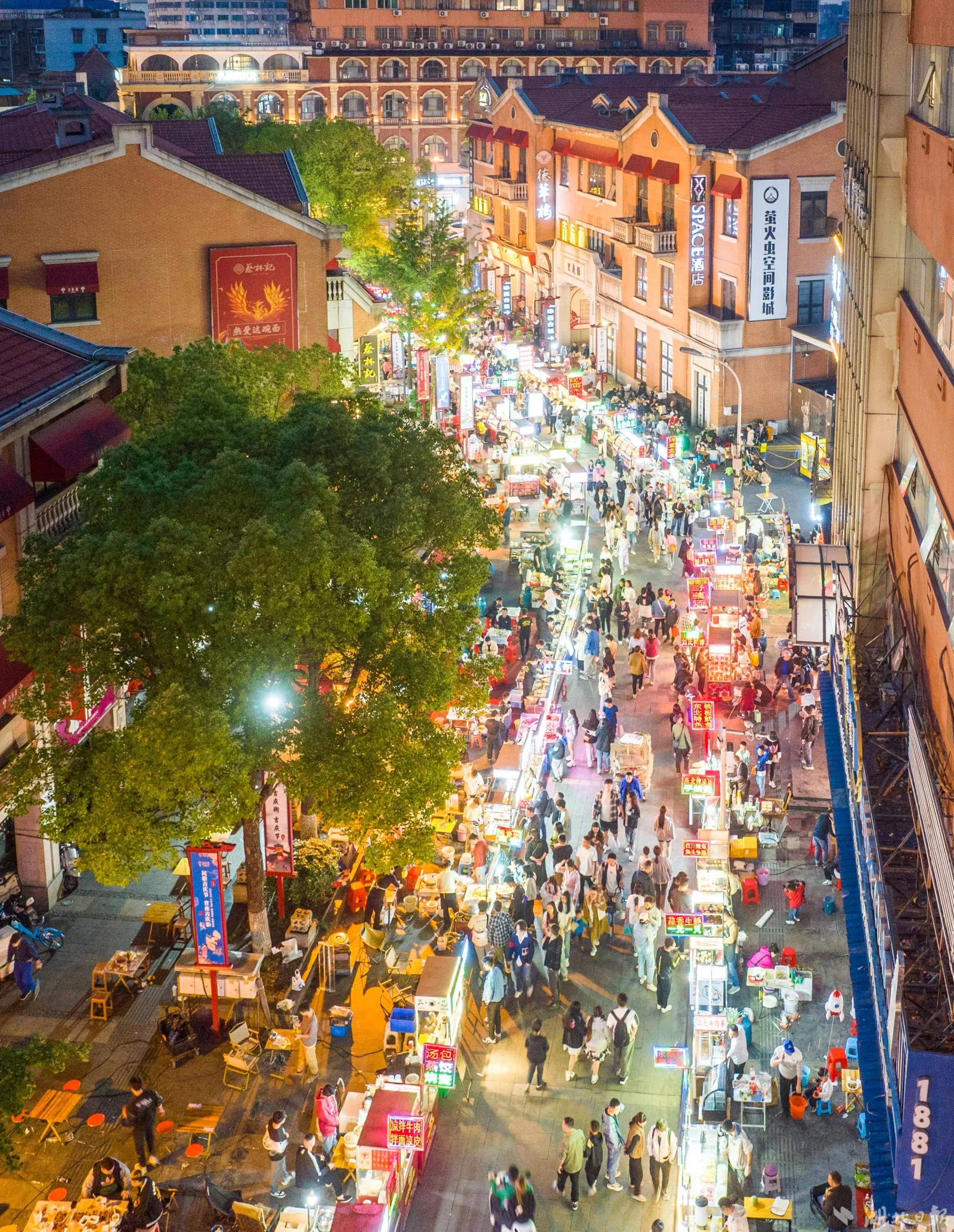
Wuhan night markets after dark, the city’s living room. Plastic stools, ice-cold beer, skewers grilled over open flame.
The four night markets that matter
1. Jiqing Street (吉庆街): the classic
Jiqing Street is the most famous night market in Wuhan, and for once, the fame is justified. It’s a 200-meter street in Hankou lined with open-air food stalls, each one claiming to have the best version of something. The competition is visible. Stall owners will literally call out to you as you walk past.
What makes Jiqing Street different from other night markets is the performers. Between the food stalls, roving musicians, storytellers, and magicians work the crowd: you eat, they perform at your table, and you tip them 5-10 yuan. It’s chaotic, loud, and uniquely Wuhan.
What to eat:
-
Kao rou (烤肉): grilled lamb skewers, cumin-heavy, 2 yuan each
-
Dou pi (豆皮): crisper than the morning version
-
Xia (虾): crayfish in spicy broth, 60-80 yuan per kilo, messy and worth it. Read more about Wuhan’s crayfish culture
-
Pi jiu (啤酒): local Snow Beer, served ice cold
Budget: 50-80 yuan per person. Best time: 8-10 pm.
2. Baohua Street (保华街): the local’s choice
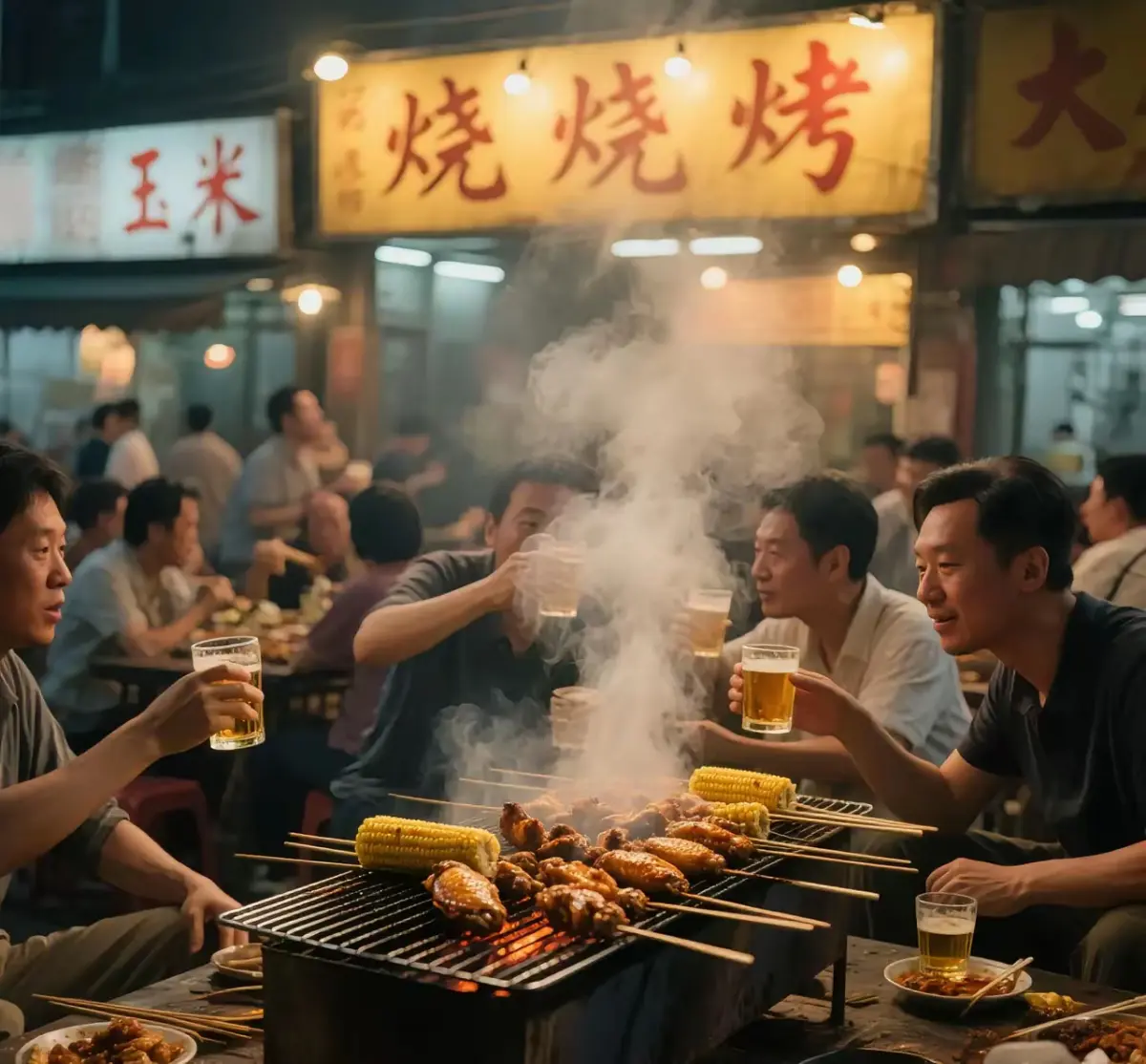
Grill grill (烤烤): the Wuhan approach to barbecue. Everything on a skewer: lamb, eggplant, lotus root, even sticky rice cakes.
This is where I actually go. Baohua Street is in the old Hankou concession area, a narrow lane that turns into a food street after 7:00 PM. No performers, no English menus, no tourists. Just food.
The specialty here is kao kao (烤烤), literally “grill grill,” the Wuhan approach to barbecue. Everything goes on a skewer: lamb, chicken wings, fish, eggplant, lotus root, steamed buns, even sticky rice cakes. The seasoning is cumin, chili powder, and Sichuan peppercorn, a hybrid that’s distinct from both Xinjiang barbecue and Sichuan cooking.
What to eat:
-
Kao yang rou (烤羊肉): lamb skewers, 3 yuan each, get 10
-
Kao qie zi (烤茄子): grilled eggplant split open with garlic sauce
-
Kao yu (烤鱼): whole fish grilled in foil with chili and herbs, 40-60 yuan
-
Chao fen (炒粉): stir-fried rice noodles, 8 yuan, the night version of reganmian
Budget: 40-60 yuan per person. Best time: 9-11 pm.
3. Hubu Alley night shift (户部巷夜场)
Hubu Alley is a tourist trap during the day. But after 8:00 PM, the day stalls close, the tourists leave, and a different set of vendors appear: the night shift. The night version of Hubu Alley is smaller, quieter, and better.
The thing to get here is stinky tofu (臭豆腐), not the Taiwanese version (fried cubes with pickled cabbage), but the Wuhan version (fried in a wok with chili oil and garlic sauce). It’s crunchy, sulfurous, and addictive. If you’ve never had it, the smell will warn you from 20 meters away. Push through. It’s better than it smells.
Budget: 20-40 yuan, and come around 8:30-10 pm.
4. Guanggu Street (光谷步行街): the student market
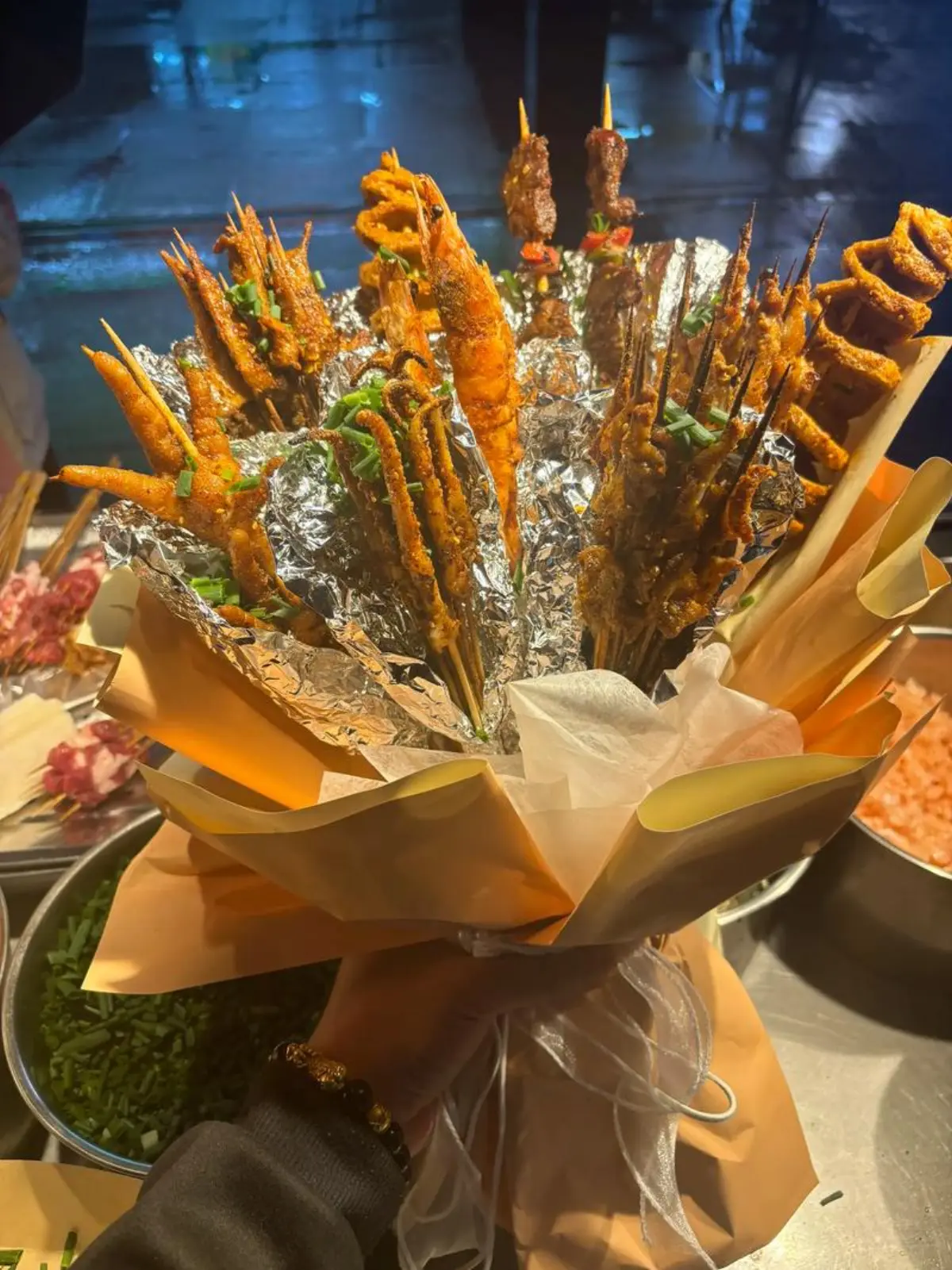
Guanggu night market, where university students eat cheap, drink cold, and stay out until 2:00 AM.
Guanggu is the “Optics Valley” district, Wuhan’s tech hub and university area. The night market here caters to students, which means: cheaper prices, bigger portions, and more experimental food.
This is where you’ll find fusion skewers, things like grilled cheese-stuffed sausages, spicy chicken feet, and durian pastries that would never survive in the traditional markets. It’s also where you’ll find milk tea shops open until 2:00 AM, because university students don’t sleep.
What to eat:
-
Kao ji zhua (烤鸡爪): grilled chicken feet, gelatinous and spicy, 5 yuan each
-
Lu wei (卤味): braised duck necks, wings, and feet in spice broth
-
Shao xian cao (烧仙草): grass jelly milk tea, the student drink of choice
Budget: 25-40 yuan. Best time: 10 pm - 1 am.
Night market etiquette
-
Sit where there’s space. Tables are communal. If you see an empty stool at a table with people, ask “有人吗?” (yǒu rén ma?, “is someone sitting here?”). They’ll say no. Sit down.
-
Order at the stall, not at the table. You walk up to the stall, tell them what you want, they cook it, you carry it back to your table. Multiple stalls, one table, which is normal here.
-
Pay when you order. There are no tabs and no bills at the end, because each stall transaction is separate.
-
Drink beer from the bottle. Wuhan doesn’t do craft beer at night markets. You drink Snow Beer or Yanjing, cheap, cold, and refreshing in 35°C heat. It costs 5 yuan a bottle. There is always a bucket of ice.
-
Don’t be afraid of the spice, but don’t be a hero either. If you can’t handle it, say “微辣” (wēi là, mild spice), and nobody will hold it against you.
Practical info
| Item | Details |
|---|---|
| Budget | 25-80 yuan per person depending on market |
| Payment | WeChat Pay or Alipay everywhere |
| Best night | Thursday-Saturday (Sunday is quieter) |
| Hygiene | Look for stalls with high turnover. Busy means fresh |
| Language | Pointing works; bring a translation app for specific requests |
| Afterward | Walk it off along the riverbank. Hankou Riverfront is best, or walk the Yangtze Bridge |
Found a night market I missed? Have a favorite stall? Email me. I’m always looking for new ones.
Related:
-
Wuhan Breakfast Culture: Guo Zao: the morning version of this story
-
Walking the Yangtze Bridge at Night: the night market starts under the bridge approach
-
Wuhan’s Crayfish Summer: The Social Ritual: the summer food that takes over the city
-
3 Days in Wuhan: A Local’s Itinerary: Day 1 ends at the Hankou riverfront night stalls
-
Wuhan Bars and Craft Beer: Where the City Drinks After Dark: bar districts, craft beer taps, and drinking culture explained