
A creature nobody asked for
Crayfish are not native to China. They arrived in the 1930s, probably from Japan, probably as accidental stowaways in rice shipments. They spread into the Yangtze floodplain, multiplied in the lakes and ditches, and for decades nobody ate them. Chinese farmers considered them pests. They burrowed into rice paddy walls and caused levee damage. The government had eradication campaigns.
Then, sometime in the late 1980s, someone in Wuhan figured out that if you boil them in chili and spice, the pests taste good. Really good.
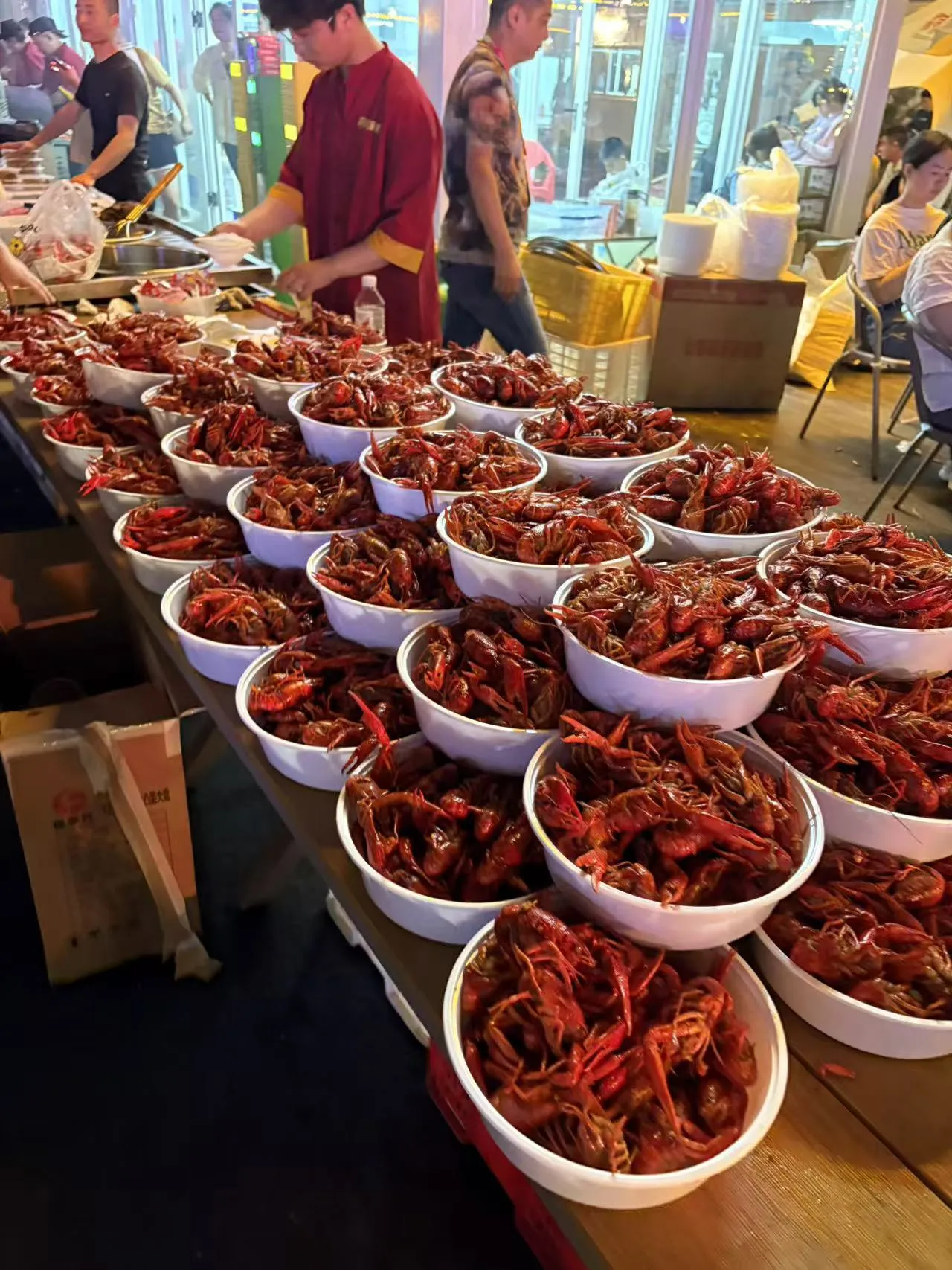
A Saturday night in June. Three kilos of crayfish, two buckets of beer, four people, three hours.
I wasn’t here for the beginning. I arrived in Wuhan in 2006, and by then the crayfish scene was already fully formed. What I walked into was a city that had spent 15 years perfecting a food ritual around an invasive species. The restaurants had menus, the street stalls had signs, and the locals had opinions. Strong ones.
What I’ve watched since is the expansion. Crayfish season used to be June and July. Now it’s May through September. The price has tripled and the dishes have multiplied. But the core ritual hasn’t changed. You sit outside, you put on plastic gloves, you peel crayfish with your hands, you drink cold beer, and you talk until midnight. Nobody goes for the food alone. They go because peeling crayfish takes three hours, and three hours with friends is the point.
The season
Crayfish season in Wuhan starts when the temperature hits 30°C and ends when it drops back below. That’s roughly late May to mid-September. The peak is June and July, when the furnace heat is at full force and the idea of eating indoors feels like a punishment.
The season matters because crayfish is a social food. You don’t eat it alone. You don’t eat it quickly. You don’t eat it in a quiet restaurant with air conditioning and cloth napkins. You eat it at a folding table on the sidewalk, with a fan blowing hot air at you, surrounded by other tables of people doing the same thing. The heat is part of the ritual. Eating crayfish in October is technically possible but feels wrong, like wearing shorts in December.
The season also matters economically. Wuhan consumes an estimated 150,000 tons of crayfish per year. That’s not a typo. A city of 14 million people eats 150,000 tons of a swamp crustacean every year, most of it in four months. The supply chain is vast. Crayfish farms in the Jianghan Plain, two hours west of Wuhan, ship live crayfish to the city every morning. The Xinhua Road seafood market receives 200 tons per day during peak season. Restaurants pre-order. Street stall owners show up at 5:00 AM to pick through the morning catch.
The price follows the season. In late May, when the first big batch hits the market, crayfish costs 30-40 yuan per kilo at the market, 60-80 yuan per kilo at restaurants. By July, when supply is at peak, it drops to 25 yuan per kilo at the market. By September, as the season fades, the price doubles. The last crayfish of the year, in late September, costs 80 yuan per kilo at the market. They’re big, they’re expensive, and the people who buy them are the ones who can’t let go of summer.
How Wuhan eats crayfish
There are two main styles in Wuhan, and the division between them is cultural.
Spicy Boiled (麻辣蒸虾)
The Wuhan original. Live crayfish are washed, soaked in salt water to purge the digestive tract, then steamed with a mound of Sichuan peppercorn, dried chili, ginger, and garlic. No sauce. The heat comes from the spice rubbed directly onto the shell.
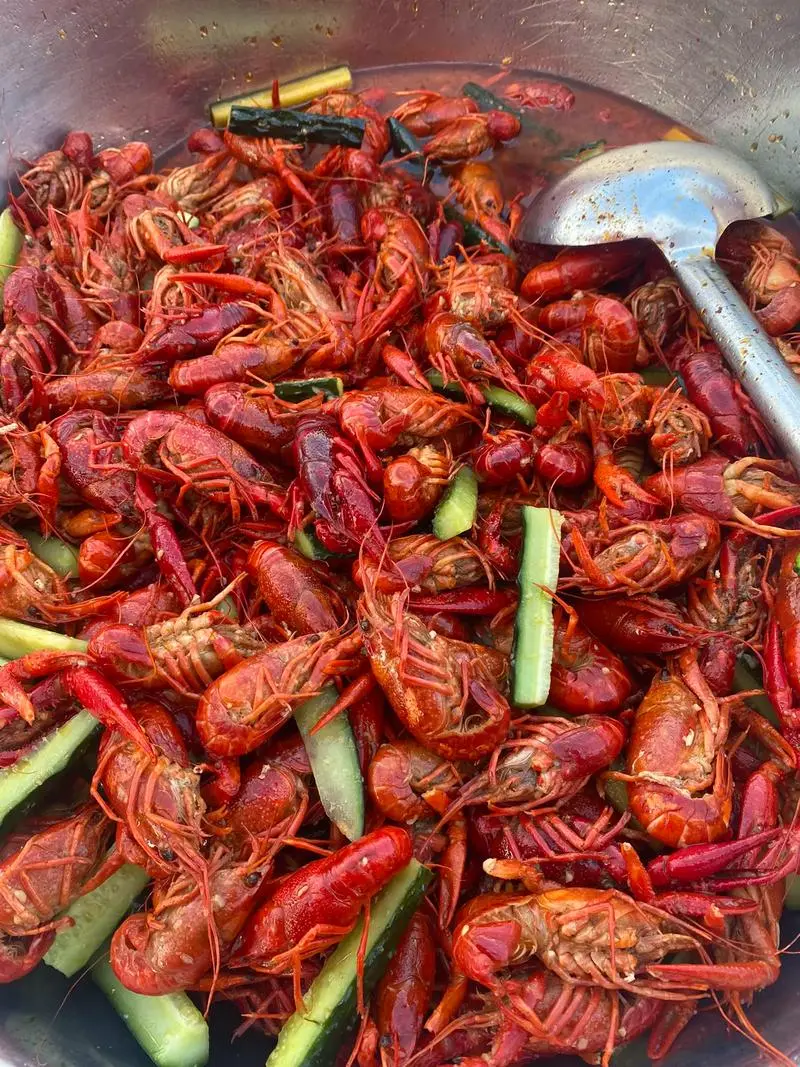
Mala zheng xia: steamed with Sichuan peppercorn and chili. The Wuhan original, no sauce needed.
This is the purist’s version. The crayfish must be alive when they go into the steamer, because dead crayfish release toxins that no amount of spice can mask. A good crayfish restaurant has tanks of live crayfish by the door. You point at the tank, they scoop out your kilo, and 15 minutes later it’s on your table.
The flavor is clean. The spice sits on the shell, not inside the meat. When you peel the crayfish, the meat is white, firm, and sweet, with a faint tingling from the peppercorn that touched the shell. The spice is a surface experience, and the meat is the point.
This is the version I eat. It’s the version most Wuhan natives over 40 prefer. It’s the version you get at the old crayfish restaurants in Hankou, the ones that have been open since the 1990s.
Thirteen Spice (十三香)
The challenger. This style came from Jiangsu province, specifically from Xuyi county, and arrived in Wuhan about 10 years ago. Instead of steaming, the crayfish are stir-fried in a wok with a complex sauce made from 13 or more spices. The sauce is thick, dark, and slightly sweet. The crayfish soak in it, and the flavor penetrates the meat.
This is the version younger people prefer. It’s heavier, more flavorful, and easier to eat because the sauce does the work. You don’t need good crayfish for thirteen spice. The sauce covers everything. This is also why purists dismiss it. If you can’t taste the crayfish, you might as well eat tofu.
Both styles coexist in Wuhan, and most restaurants offer both. Friends argue about which to order, and the argument is part of the ritual.
Oil Braised (油焖大虾)
A third style, heavier than the other two. Crayfish are braised in oil with garlic, chili, soy bean paste, and sugar until the sauce reduces to a sticky glaze. This is the version you find at night markets and street stalls. It’s the messiest, the most addictive, and the cheapest. A plate costs 40-60 yuan, serves two, and comes with a stack of wet wipes because your hands will be covered in oil and chili.
I order this version at street stalls and the steamed version at restaurants. The street stall version is about the sauce. The restaurant version is about the crayfish itself.
The ritual
Here is what actually happens when you eat crayfish in Wuhan.
You arrive at the restaurant or street stall at 7:00 PM. It’s already full, so you wait. While waiting, you order the crayfish. This takes time because you need to choose the size.
Crayfish are sold by weight, but the size matters more than the weight. Small crayfish (4-5 cm) are cheaper and the meat is more tender, but there’s less of it and the peeling ratio is bad. Medium (6-7 cm) is the standard. Large (8+ cm) looks impressive but the meat gets tough. The old debate: do you want more meat or better meat? I order medium. Always medium.
You order by the kilo. For four people, three kilos is the minimum. Five kilos is normal. Seven kilos means someone is showing off. At 60 yuan per kilo for medium, that’s 180 to 420 yuan just on crayfish. Add beer, side dishes, and rice, and the total for a table of four is 300-500 yuan. Expensive by Wuhan standards, cheap by Western standards. Nobody complains about the price. Crayfish season is short, and the experience is worth paying for.
The crayfish arrive in a metal basin or on a large plate, piled high, still steaming. The server hands you a pack of plastic gloves. You put them on. These gloves are thin, transparent, and reach to your elbow. Without them, your hands would be stained red and smell like chili for three days.
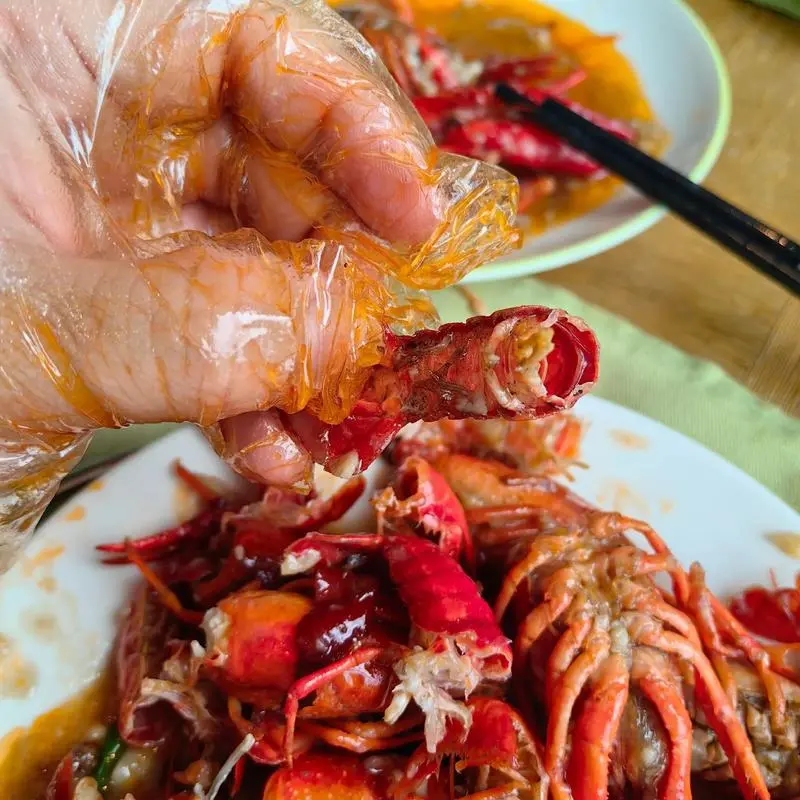
The ritual: plastic gloves, cold beer, pile of shells. Three hours, four people, five kilos.
The peeling technique is specific: twist the head off, then squeeze the tail and pull the meat out. If the crayfish is good, the meat slides out whole. If it’s overcooked, it breaks and you dig it out with your fingers. The head contains the yellow fat, called “xia huang” (虾黄), which some people suck out and some people discard. I suck it out. The fat is the best part. It tastes like concentrated crayfish, rich and slightly bitter.
You peel. You eat. You drink beer. You talk. The pace is slow. Three kilos of crayfish takes two hours to eat because each one requires 15 seconds of manual labor. That’s the whole appeal. You can’t rush. You can’t check your phone because your hands are gloved and covered in chili oil. You have to talk to the people at your table.
By 9:00 PM, the table is covered in shells. The beer is working. The heat has dropped from 38°C to 33°C, which in Wuhan counts as relief. Someone orders another kilo. Someone else orders grilled eggplant or stir-fried noodles. The night extends. The conversation moves from work to family to gossip to politics to nothing in particular. You leave at 10:30 or 11:00. You walk home through streets that smell like chili and beer. Your hands still smell like crayfish even after washing them twice.
Where to eat crayfish in Wuhan
Donghu Road (东湖路)
The highest density of crayfish restaurants in Wuhan is on Donghu Road, near East Lake in Wuchang. This stretch of 500 meters has six large crayfish restaurants, all competing, all open until 2:00 AM in summer. The most famous is Bashu Fengwei (巴蜀风味), which has been serving spicy steamed crayfish since 1998. They process two tons of crayfish per night in peak season.
The restaurants here are established, the supply chain is direct, and the crayfish are fresh from the lake. You’ll pay for it: 80-120 yuan per kilo.
Jiqing Street (吉庆街)
Jiqing Street in Hankou has crayfish, but it’s the version for visitors. The price is higher, the portions are smaller, and the atmosphere is more performance than food. If you want the full Wuhan night market experience with music and chaos, eat here. If you want the best crayfish, go elsewhere.
Xinhua Road Seafood Market (新华路水产市场)
If you want to cook crayfish yourself, or if you want to buy them live and take them to a restaurant that charges a cooking fee, go to Xinhua Road. This is the wholesale market. At 6:00 AM, the market floor is covered in crates of live crayfish. You pick, you negotiate, you carry home 3 kilos in a plastic bag. The price is half of what restaurants charge.
I did this once, and my wife prepared them at home. The crayfish were good. The process of washing 3 kilos of live crayfish in the kitchen sink, watching them crawl over each other and try to escape, was an experience I don’t need to repeat. We go to restaurants now.
Street stalls everywhere
The crayfish experience you want isn’t at a famous restaurant. It’s at the unnamed street stalls that appear on every corner in summer. A folding table. A wok. A propane tank. A hand-written sign that says “油焖大虾 50元/份.” These stalls are where the working-class crayfish culture lives.
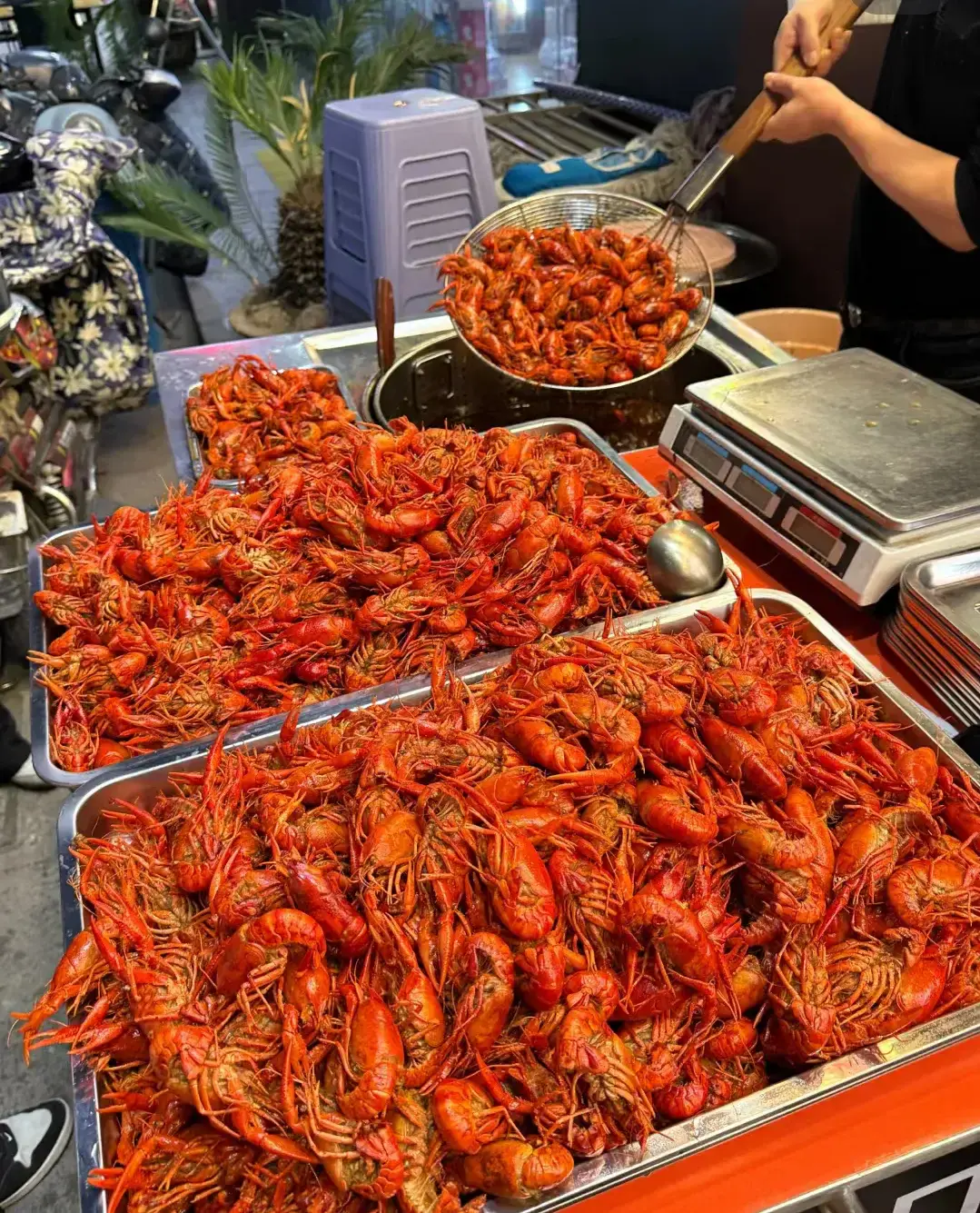
The real crayfish culture: a wok, a folding table, no name, no menu, 50 yuan a plate.
The oil-braised crayfish at these stalls costs 40-50 yuan per plate. The crayfish are smaller, the sauce is heavier, the beer is cheaper. The tables are communal. You sit next to strangers and compare peeling techniques. The stall owner cooks in a wok the size of a satellite dish, flipping three kilos of crayfish at once with a spatula that looks like a shovel.
If you’re a visitor and you want to experience crayfish the way locals do, find a street stall near your hotel. Look for the one with the most shells on the ground. That’s the one where people have been eating longest.
Crayfish vs. everything else
I’ve written about hot dry noodles and lotus root soup and the full range of Wuhan dishes. Crayfish doesn’t fit neatly into the Wuhan food canon. It’s not a traditional Hubei dish, and it’s not something grandmothers make. And it has nothing to do with breakfast culture.
Crayfish belongs to the post-1990s city. The city of night markets and beer streets and summer heat that drives everyone outdoors. It’s the food of people who work all day in offices and shops and construction sites and need four hours on a Saturday night to sit with their friends and do nothing but peel and talk.
The older food traditions belong to families and morning stalls. Crayfish belongs to the evening, to the social Wuhan that comes alive after sunset, when the furnace heat finally drops enough to sit outside.
What crayfish costs
| Item | Price Range |
|---|---|
| Live crayfish at market (per kilo) | 25-80 yuan depending on season and size |
| Restaurant spicy steamed (per kilo) | 60-120 yuan |
| Street stall oil-braised (per plate) | 40-60 yuan |
| Beer (Snow Beer, per bottle) | 5-8 yuan |
| Plastic gloves (per pack) | 1 yuan, sometimes free |
| Total for 4 people, 3 kilos + beer + sides | 250-450 yuan |
The price has gone up significantly since I started eating crayfish in 2006. Back then, a kilo of medium crayfish at a restaurant was 30 yuan. Now it’s 60-80. The inflation is partly demand, partly the commercialization of crayfish farming, and partly the fact that Wuhan’s middle class has grown and more people can afford to eat out every weekend in summer.
The foreigner’s guide to crayfish
If you’ve never eaten Chinese-style crayfish, here are a few things to know.
The gloves are not optional. You will see locals wearing them. Wear them. Crayfish spice is made of chili oil and Sichuan peppercorn. If you touch your eyes with bare hands after peeling crayfish, you will regret it for several hours.
The head is edible, sort of, though you don’t eat the shell. You suck the yellow fat out of it. This requires putting your mouth on a crayfish head and sucking. If this sounds unappetizing, skip it. But you’ll be missing the best part.
The black vein on the tail is the digestive tract. Remove it. Good restaurants purge the crayfish in salt water before cooking, which empties the tract, but you should still check. Pull it out with your fingers or the tip of a toothpick.
Order more than you think you need. A kilo of crayfish sounds like a lot. It’s not. After peeling, the edible meat from a kilo of medium crayfish is about 200 grams. For a satisfying meal, plan on 750 grams to 1 kilo of crayfish per person.
Drink beer. Not because it’s required, but because the combination of spicy crayfish and cold beer is one of the few food pairings that genuinely works better than either element alone. The carbonation cuts the oil. The cold temperature counters the spice. The alcohol takes the edge off the Sichuan peppercorn numbness. Local Snow Beer is fine. Tsingtao is fine. Don’t order anything expensive or craft. This is not a craft beer occasion.
Don’t wear nice clothes. The chili oil will find a way onto your shirt. It always does.
The end of season
Every year the same thing happens, and by mid-September the nights get cooler. The crayfish stalls start closing earlier. The restaurants put up signs reading “最后两周” (last two weeks), and people who haven’t had their fill make one last trip. The final kilo of the season feels different. You eat it slower. You know it’s ending.
Then October comes, and the best weather in Wuhan arrives, and nobody thinks about crayfish anymore. The tables on the sidewalk get replaced with hot pot pots. The beer stays cold, but the food shifts. Crayfish season is over.
Until next May, when the temperature hits 30°C again, and the first crates of live crayfish arrive at Xinhua Road, and the street stalls set up their woks, and someone you know texts you: “虾子开了,今晚走起?” (“Crayfish is back. Tonight?”)
You go.
Crayfish is just one part of Wuhan’s summer food culture. Read more: the night markets where it all happens, why summer in Wuhan drives everyone outdoors, and the full range of Wuhan dishes.
Related:
-
Wuhan After Dark: A Guide to Night Markets: the ecosystem that crayfish stalls belong to
-
Wuhan in Summer: Surviving the Furnace City: why the heat makes outdoor eating necessary
-
Wuhan Food Beyond Breakfast: 10 Dishes: the traditional food canon that crayfish sits alongside
-
Best Time to Visit Wuhan: crayfish season means summer, but better months exist
-
Wuhan Bars and Craft Beer: Where the City Drinks After Dark: the bars and craft beer that pair with crayfish season
-
Hot Dry Noodles: Ultimate Guide: the other food Wuhan is famous for