
The soup that isn’t for tourists
If you come to Wuhan and eat only hot dry noodles and breakfast street food, you’ll leave thinking you know Wuhan cuisine. You don’t. You know Wuhan street food. The real food is at home, and the dish that matters most is not on any restaurant menu that tourists find.
It’s paigu ouan tang (排骨藕汤), pork rib and lotus root soup. And it’s not a quick bowl of noodles. It’s a four-hour Sunday afternoon. The whole house ends up smelling like pork bone and lotus.
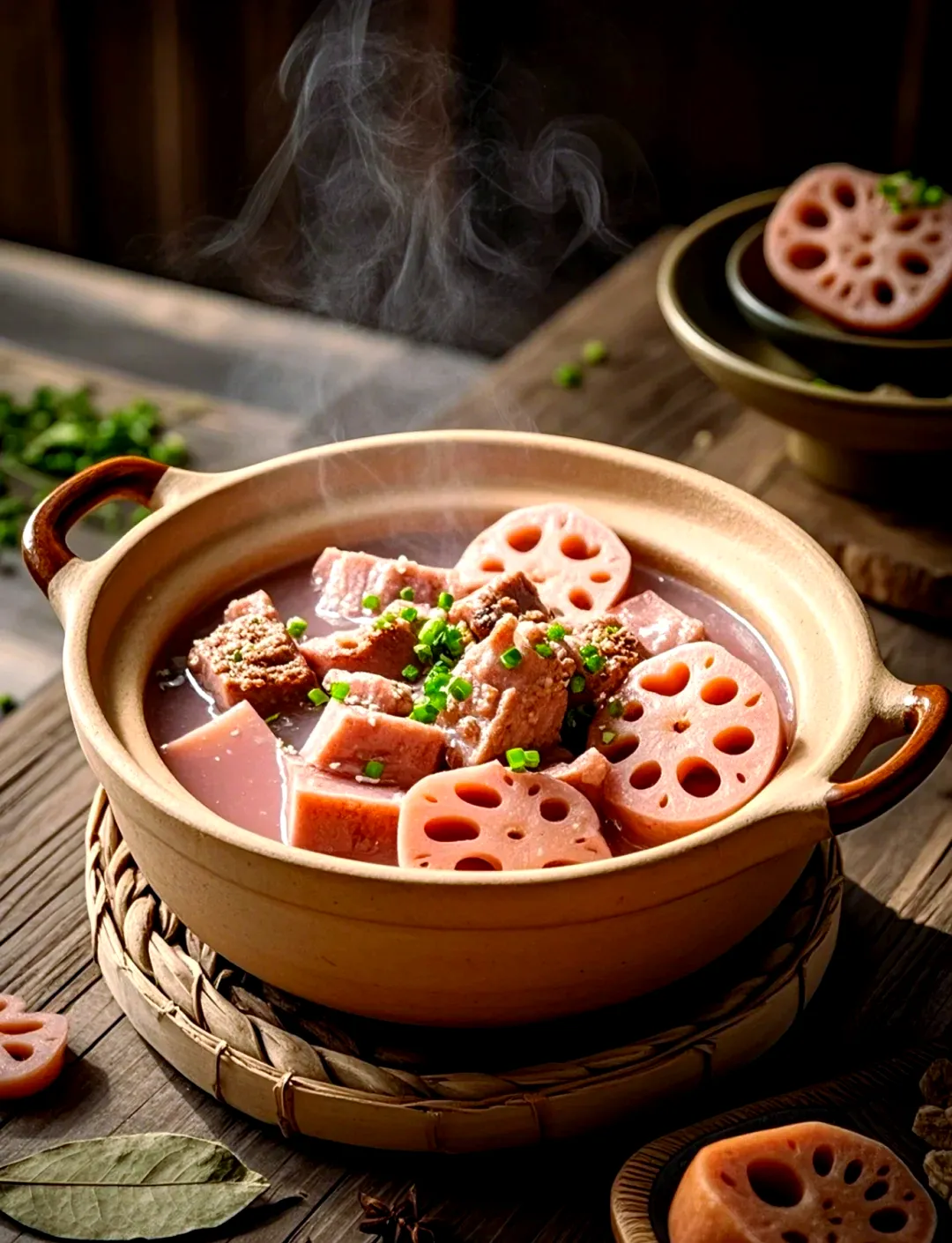
Pork rib and lotus root soup (排骨藕汤): four hours in a clay pot, milky white, the taste of every Wuhan winter.
I’ve written about Wuhan’s restaurant dishes before. I mentioned this soup there, gave it two paragraphs. Two paragraphs isn’t enough. This soup is the reason my wife calls her mother every November to ask if the lotus root is in season yet. It’s the reason my neighbor, a 72-year-old man who rarely cooks anything, spends an entire Sunday morning preparing it. It’s the reason you can walk down any residential street in Wuhan on a winter Sunday at 4 PM and know what every kitchen is making.
Why the Lotus Root Matters
The key ingredient is not the pork. It’s the lotus root, and not just any lotus root.
Wuhan sits on 166 lakes. Lotus grows in nearly all of them. The root, which is technically a rhizome, grows underwater in the mud at the bottom of the lake. It’s harvested by hand, often by farmers who wade into the mud and feel for it with their feet, then pull it up. It looks like a pale, segmented sausage, 30 to 60 centimeters long, with air channels running through it that form a pattern when you slice it crosswise.
Not all lotus root is the same. The stuff from Wuhan’s lakes, particularly from the Honghu Lake area two hours south, has a starch content that makes it uniquely suited to slow cooking. When you simmer it for hours, it doesn’t turn to mush. The outside gets soft and creamy, almost like a potato that’s been cooked in broth. But the center holds a slight crunch, a texture that is impossible to describe if you haven’t eaten it. It’s tender and firm at the same time. This only works with high-starch lotus. Low-starch lotus, the kind you find in southern China, stays crunchy and never absorbs the broth.
My wife’s aunt lives near Honghu. Every October, she drives to the lake, buys 20 kilograms of freshly harvested lotus root from a farmer she’s known for 30 years, and distributes it to family members. This is the annual lotus root run. We get five kilograms, and it lasts through January.
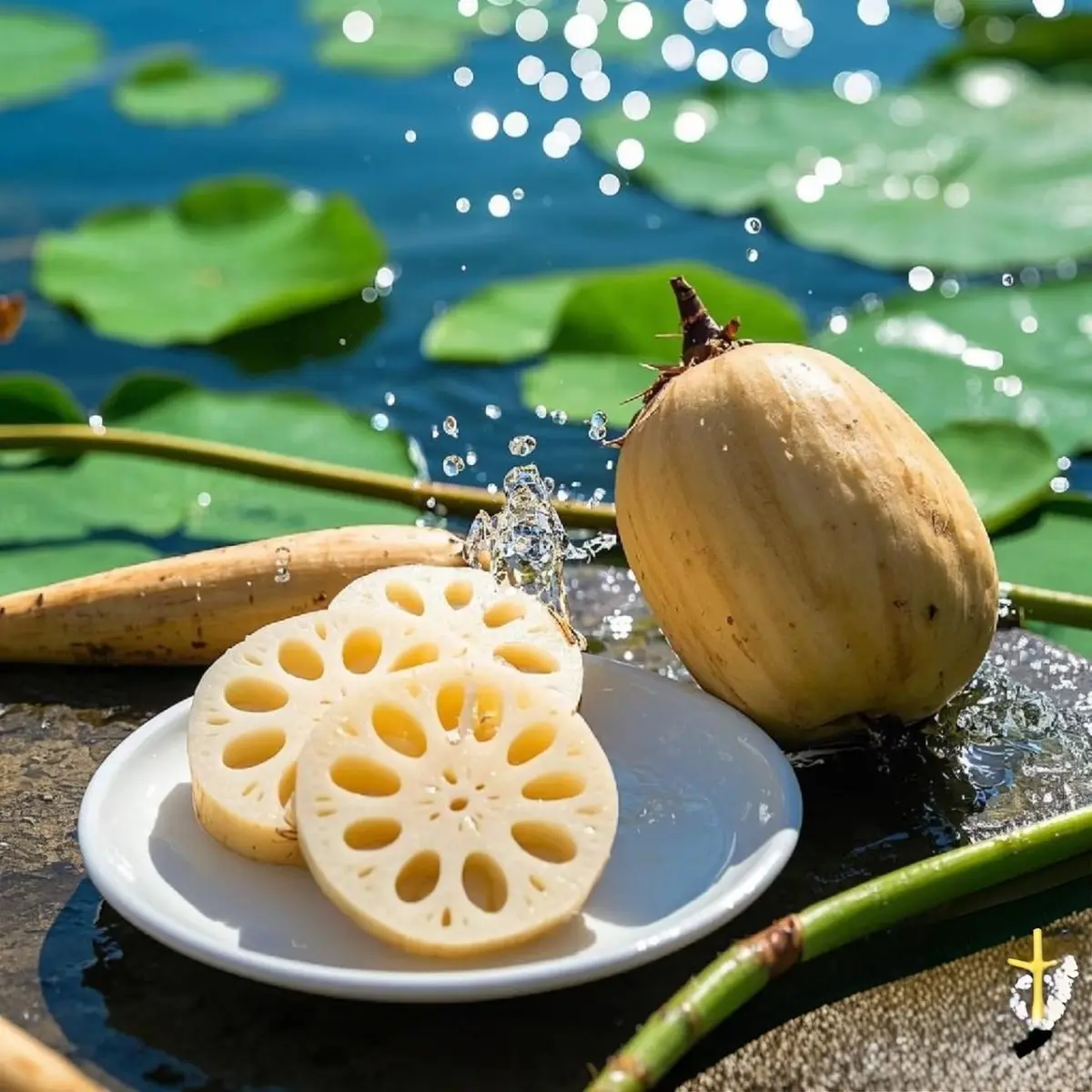
Fresh lotus root from Wuhan’s lakes. The high-starch variety turns creamy outside, firm inside, after four hours of simmering.
How my wife makes it
There are recipes online for this soup. They’re all wrong. Or rather, they’re all incomplete, because they describe the mechanics without the timing and the judgment you learn by watching someone who has done it 500 times.
Here’s what actually happens in my kitchen on a Sunday in November.
Saturday evening. My wife takes the lotus root out of the refrigerator and peels it with a vegetable peeler, removing the thin brown skin. She cuts it into chunks, large, about 5 centimeters each. She soaks them in water overnight. This removes some of the surface starch and keeps them from discoloring.
Sunday 8:00 AM. She goes to the morning market for pork ribs. Not the supermarket. The morning market, where the butcher cuts to order. She asks for ribs with the bone in, cut into 4-centimeter pieces. The butcher knows her. He selects ribs with a bit of meat and a lot of bone. Too much meat and the soup is greasy. Too little and it’s bland. Getting that ratio right is the whole trick.
9:00 AM. She blanches the ribs. Puts them in cold water, brings it to a boil, skims the foam, drains them. This removes the blood and impurities. Skip this step and your soup will taste like metal.
9:30 AM. The clay pot goes on the stove. She has a specific pot for this, a sandy-colored clay pot (砂锅) that she’s used for 12 years. It has a crack on the handle that she’s afraid to fix because the pot has “settled in.” Clay pots hold heat differently than metal. The soup simmers more gently, and the lotus root cooks more evenly. You can make this in a metal pot. It won’t be the same.
She layers the ribs and lotus root in the pot, adds water to cover, throws in a thumb of ginger, and brings it to a boil. Then she turns the heat down to the lowest possible flame and puts the lid on.
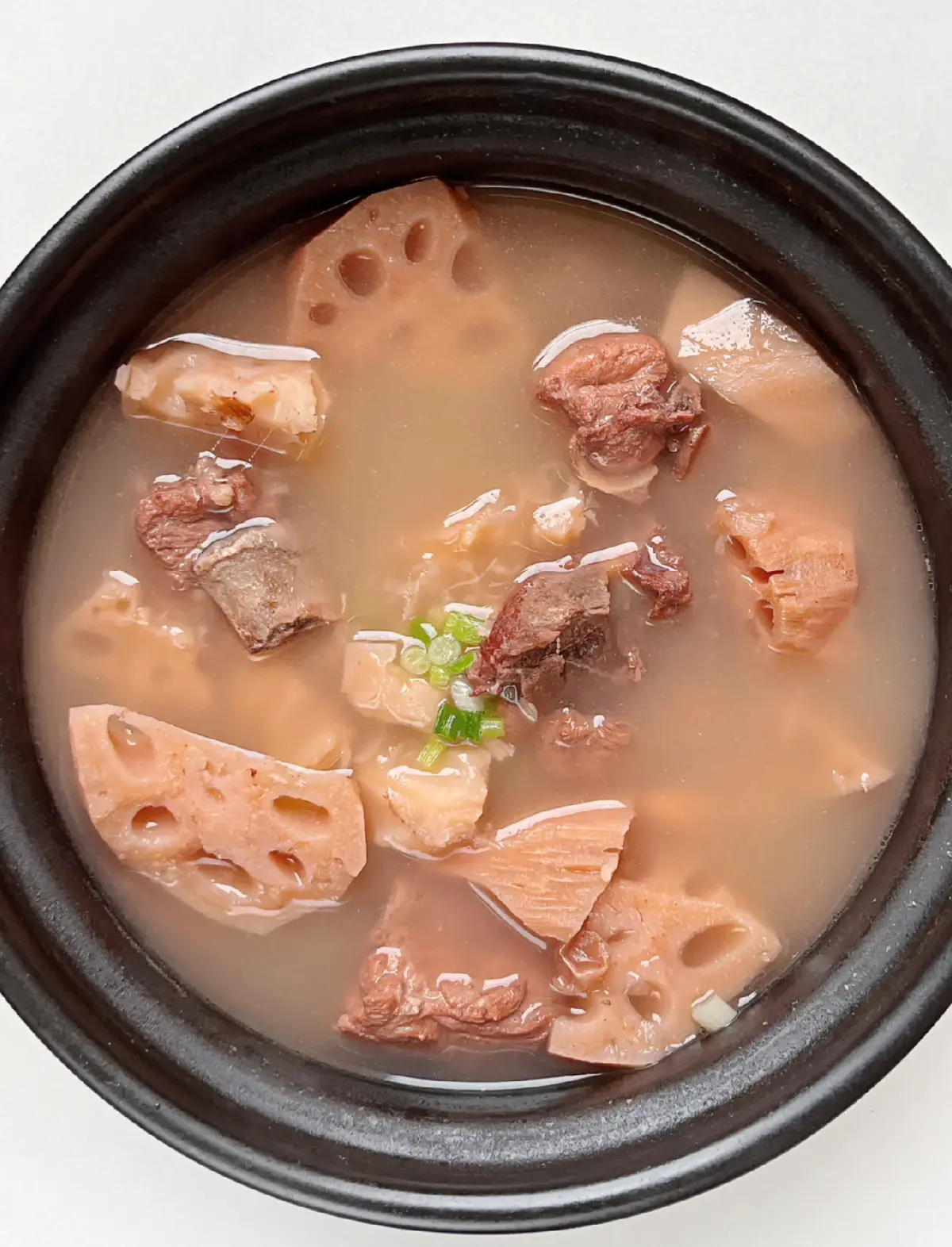
The clay pot sits on the lowest flame for four hours. Do not lift the lid.
10:00 AM to 1:00 PM. Nothing happens. The pot simmers away on its own for hours. The house fills with a smell that is hard to describe. It’s not the sharp smell of stir-frying. It’s a round, warm smell, like a kitchen in a farmhouse in winter. By noon, the smell has reached every room. The cat sits near the stove, and so do I.
1:00 PM. She lifts the lid. The soup has turned milky white. The lotus root has darkened to a pinkish brown. The ribs have shrunk. She tests a piece of lotus root by pressing it with a chopstick. If the chopstick goes through easily but there’s a slight resistance at the center, it’s done. If it’s still hard, she simmers another 30 minutes.
She adds salt. That’s it. Salt. No soy sauce, no cooking wine. The soup doesn’t need seasoning because the lotus root and the pork bone have spent four hours creating their own flavor. Anything else you add is taking away from that.
1:30 PM. We eat. She serves it in large bowls, with the lotus root and ribs still in the soup. We eat it with rice and a simple stir-fried vegetable, usually Hongshan caitai in winter. The soup is hot, thick, and quiet. The lotus root melts on the outside and bites on the inside. The pork falls off the bone. The broth is sweet from the lotus starch and savory from the bone.
This is lunch. It’s also dinner, because she makes enough for two meals.
What the soup means
I’ve been trying to work out why this dish matters to me. It’s not the taste, although the taste is excellent. It’s the fact that you can’t rush it. In a city where everything is fast, the breakfast takes three minutes, the shopping takes an hour, the metro crosses the river in four minutes, this soup takes four hours and cannot be shortened. You can’t pressure-cook it or buy it on the street. It requires patience, and patience, in Wuhan, is reserved for the things that matter most.
My neighbor, the 72-year-old man, makes this soup every other Sunday. He lives alone since his wife passed. He told me once: “I make it the way she made it. Same pot, same timing, same salt. The taste of it isn’t the same as hers. But the house smells the same. That’s what I want. The smell.”
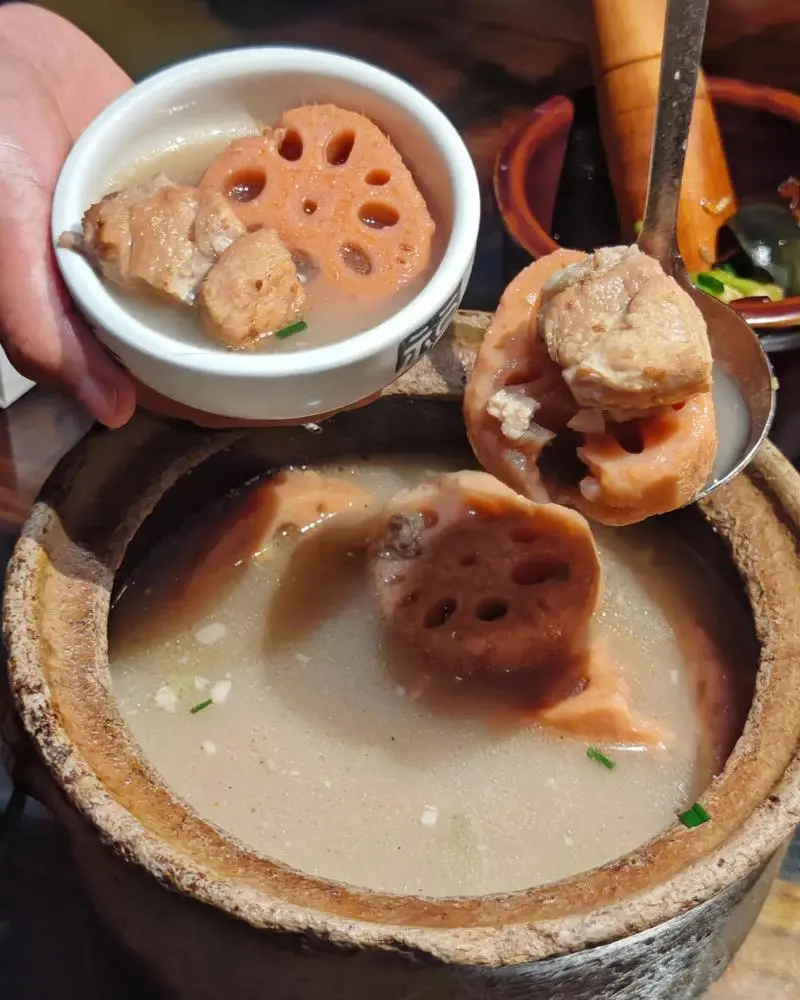
Sunday lunch. The soup that a Wuhan mother makes every winter, and the house smells the same every year.
My wife’s mother is 74. She lives in Hankou, 40 minutes by metro from our place in Hongshan. Every November, she calls to say the lotus root is at the market. She’s already bought some, and when are we coming over? She doesn’t ask if we want soup. She assumes we do. She’s right.
When we arrive, the pot is already on the stove. The house smells like it did last year, and the year before, and every year since I first visited in 2008. My mother-in-law doesn’t eat much herself. She makes the soup for us, then sits and watches us eat it. She says: “Is the lotus root soft enough? Last year’s was a bit hard, but the farmer said this year’s crop is better.”
It’s always better than last year. That’s the tradition.
Can you eat it in a restaurant?
Yes, but with caveats.
Many Hubei restaurants serve paigu ouan tang. It’s on the menu at 粗茶淡饭 in Hankou, at 楚灶王 in Wuchang, at any restaurant with 鄂菜 on the sign. The restaurant version is good. The broth is rich, the lotus root is properly soft, and the portion is large enough to share.
But restaurant soup is a different animal. Restaurants use commercial lotus root, which is lower in starch. They cook it faster, under pressure, to turn tables over. The broth is often thickened with cornstarch to simulate the milky color that comes naturally from four hours of slow simmering. You won’t notice unless you’ve had the home version. If you haven’t, the restaurant version is fine. If you have, you’ll taste the difference and feel slightly cheated.
The best restaurant version I’ve found is at 艳阳天 in Hankou, a mid-range Hubei chain that’s been around since the 1990s. They cook the soup in individual clay pots, which means they can’t shortcut the timing. It’s 48 yuan for a pot serving two. It’s the closest thing to home I’ve found in a restaurant.
If you’re visiting Wuhan in winter (November through February), order it. If you’re here in summer, skip it. Cold lotus root soup is not a thing. This is a winter dish. It exists because the winter in Wuhan is cold, wet, and has no heating. The soup warms you from the inside.
The recipe, if you want to try
If you can find high-starch lotus root (look for “粉藕” at a Chinese grocery), here’s what to do:
-
Buy 500g of pork ribs, bone in, cut into 4cm pieces. Buy 1 large lotus root (about 500g).
-
Peel the lotus root, cut into 5cm chunks, soak in water 30 minutes.
-
Blanch the ribs in cold water, bring them to a boil, skim off the foam, and drain.
-
Put ribs and lotus root in a clay pot (or any heavy pot). Add water to cover by 2 inches. Add 3 slices of ginger.
-
Bring to boil, then reduce to lowest possible heat. Cover.
-
Simmer 3.5 to 4 hours without lifting the lid. Do not add water.
-
After 4 hours, test the lotus root with a chopstick. It should go through with slight resistance.
-
Add salt. Nothing else.
-
Serve in large bowls, with rice.
If your lotus root stays crunchy after 4 hours, you bought the wrong kind. Next time, look for lotus root that feels heavy for its size and has a dull, not shiny, surface. That’s the high-starch kind.
Why I’m writing about soup
I’ve written about noodles, night markets, and restaurant dishes. This article is about the dish you’ll never find as a tourist unless a local family invites you to their kitchen. I’m writing about it because it’s the dish that taught me what “home” means in Wuhan.
I’m not from here. I moved to Wuhan 18 years ago. For the first five years, I ate hot dry noodles and thought I understood the food. Then I married a Wuhan woman, and her mother made this soup on a November Sunday, and I realized I’d been eating the city’s surface.
This is the food that Wuhan families eat. Read more: the restaurant dishes you should try, the 166 lakes that grow the lotus, and the breakfast culture on the street.
Related:
-
Wuhan Food Beyond Breakfast: 10 Dishes You Must Try: where this soup sits among the city’s restaurant dishes
-
Wuhan’s 166 Lakes: The City on Water: the lakes that grow the lotus root
-
Hot Dry Noodles: Ultimate Guide: the street food that made Wuhan famous
-
Wuhan Breakfast Culture: Guo Zao: the morning ritual
-
Wuhan Night Markets After Dark: where the street food continues
-
Best Time to Visit Wuhan: come in winter for this soup
-
3 Days in Wuhan: A Local’s Itinerary: Day 2 lunch mentions this soup