
The city you can drown in
The first time I flew into Wuhan, I pressed my face against the airplane window and thought we were landing on water. The city below was broken up by so many lakes, some huge, some small, some barely more than ponds, that the ground looked like a crossword puzzle where half the squares were blue.
I’d grown up in Shanxi, a province defined by mountains and dust and a chronic shortage of water. Landing in Wuhan felt like landing on a different planet.
Seventeen years later, I still notice the water, not because it’s unusual anymore but because it’s everywhere. Wuhan has 166 lakes within its administrative area. Combined, they cover about 2,100 square kilometers, roughly 25% of the city’s total area. One quarter of Wuhan is water. Not rivers. I’ve already written about the Yangtze and the two rivers that divide the city. I’m talking about lakes. Still water, the kind that doesn’t flow.
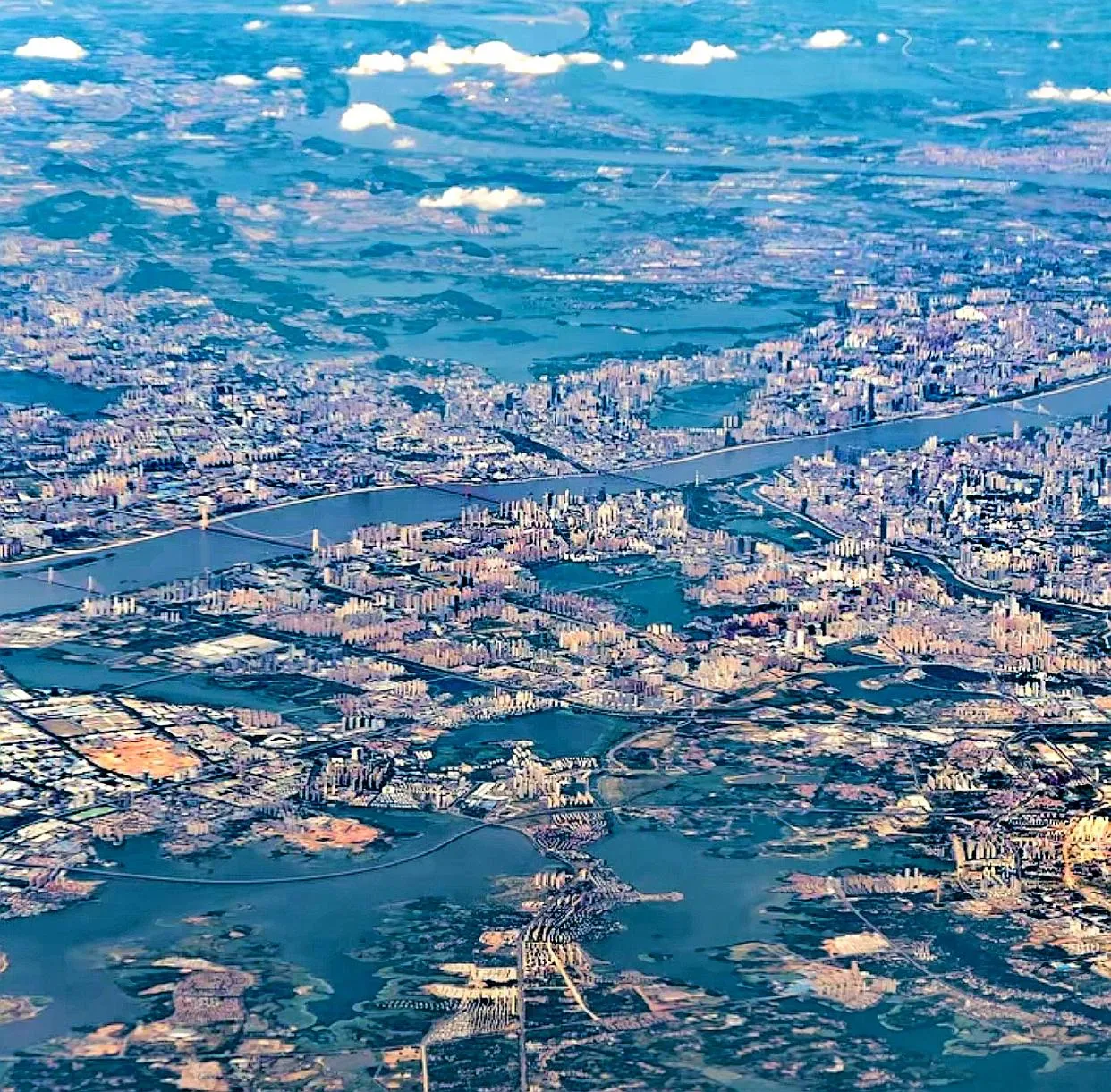
One quarter of Wuhan is water. 166 lakes, scattered across the city like dropped mirrors.
Why so many lakes?
The geography is simple, even if the result is dramatic.
Wuhan sits at the confluence of two major rivers, the Yangtze and the Han. Over millions of years, these rivers shifted course, flooded, receded, and left behind shallow basins that filled with water. The city sits on the Jianghan Plain (a flat, low-lying alluvial floodplain between the two rivers). When the rivers changed course, old channels became oxbow lakes. When floodwaters receded, depressions became permanent lakes.
The result is a landscape that’s less “city beside a lake” and more “lakes with a city built between them.” If you look at a satellite map of Wuhan, the urban areas are the gaps between water. Not the other way around.
This created problems. A city built on a floodplain is a city that floods. The Yangtze has devastated Wuhan repeatedly. Most catastrophically in 1954, when the river rose to record levels and the entire city fought to hold the levees (full flood history here). Lakes don’t help with flooding. They make it worse. When the rivers rise, the lakes overflow. When the lakes overflow, the neighborhoods around them go underwater.
For decades, the city’s approach was to fill lakes in: reclaim the land, build on it, reduce the water surface area. Between the 1950s and the 2000s, Wuhan lost dozens of lakes to land reclamation. The city’s lake area shrank by nearly 40%.
That changed. The strategy now is the opposite: protect the lakes, use them as flood reservoirs, and build parks around them. It’s a slow shift, and it’s not always popular. Real estate developers still eye lakefront land hungrily, but the policy is clear: the lakes stay.
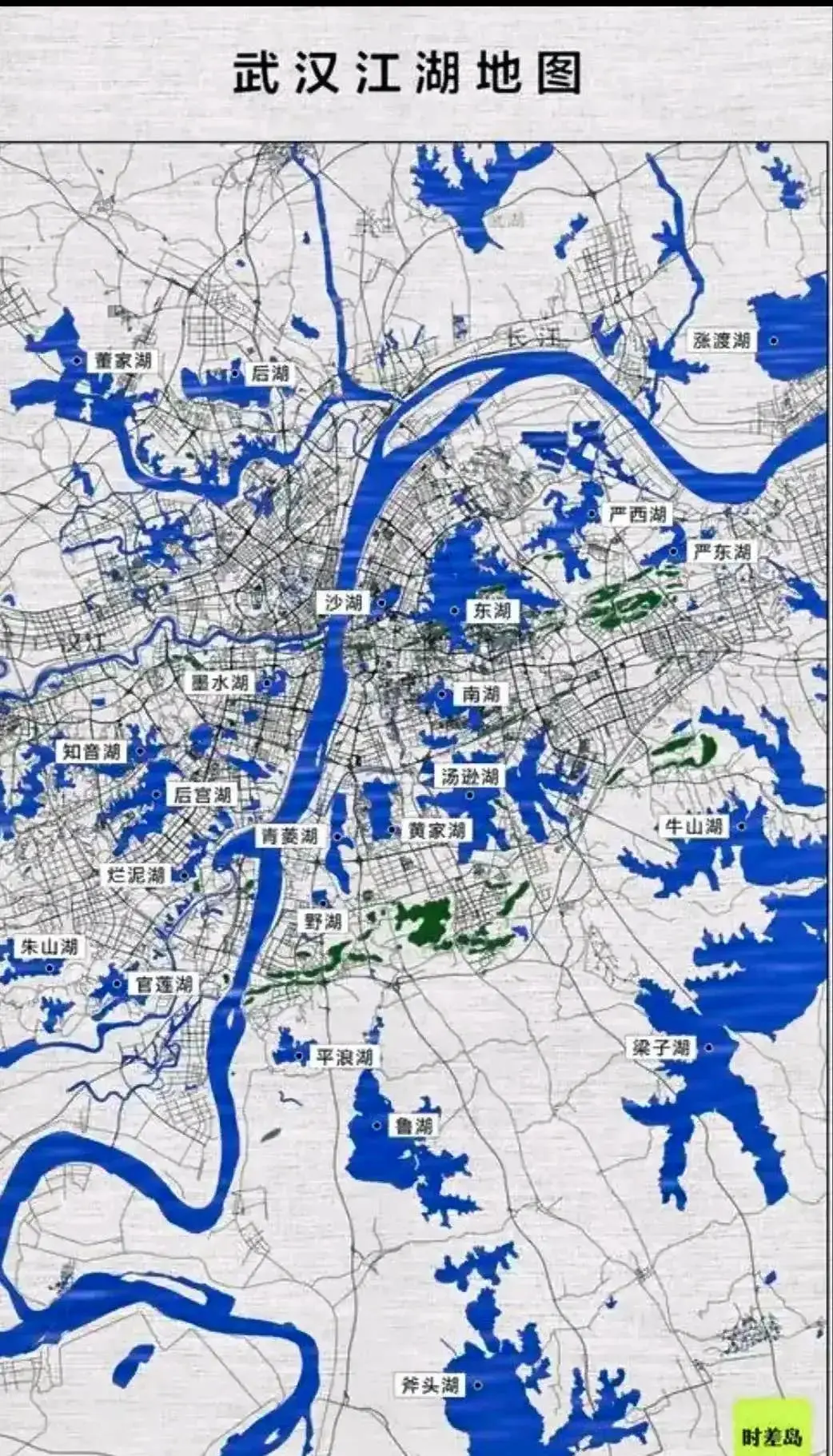
Wuhan’s major lakes: Tangxun, East Lake, South Lake, Sha Lake, and dozens more, woven through the urban grid.
The Big Five
Everyone knows East Lake, the one tourists visit, with cherry blossoms, cycling paths, and teahouses. But East Lake is just one of 166. Here are the lakes that shape daily life in Wuhan:
Tangxun Lake (汤逊湖) is the largest urban lake in China by surface area. 47 square kilometers of water, sitting in the southern part of the city between Wuchang and Jiangxia. Most foreigners have never heard of it. Most locals haven’t been there; it’s not a tourist destination, it’s just… there. A massive body of water that you drive past on the highway, barely noticing. But when you look at it on a map, you realize it’s bigger than many Chinese cities’ entire lake systems combined.
South Lake (南湖) is the lake that every student at Wuhan University of Technology knows, because the main campus sits on its shore. South Lake is about 8 square kilometers, not huge by Wuhan standards, but deeply embedded in the university district. Student dormitories face the water. The evening walk around South Lake is a ritual for tens of thousands of students. The lake has had pollution problems (it was severely degraded in the 2000s), but recent cleanup efforts have improved the water quality significantly.
Sha Lake (沙湖) is an urban lake in central Wuchang, surrounded by apartment towers and shopping malls. Sha Lake is what happens when a city grows around a lake instead of over it. The eastern shore is a public park with a running track, exercise equipment, and elderly people doing tai chi at 6 AM. The western shore is high-rise residential, some of the most expensive apartments in Wuhan, because everyone wants a lake view.
Hou Lake (后湖): a cluster of smaller lakes in Hankou, on the north side of the city. The Hou Lake area was historically farmland and wetland. Now it’s one of Hankou’s major residential districts, with the lakes converted into park spaces. The metro Line 3 runs through the area, and the lakeshore has become a popular jogging route.
East Lake (东湖): the one I’ve already written an entire article about. 87 square kilometers, six times the size of West Lake in Hangzhou, with cherry blossoms, lotus gardens, and cycling paths. If you only visit one lake in Wuhan, make it this one.
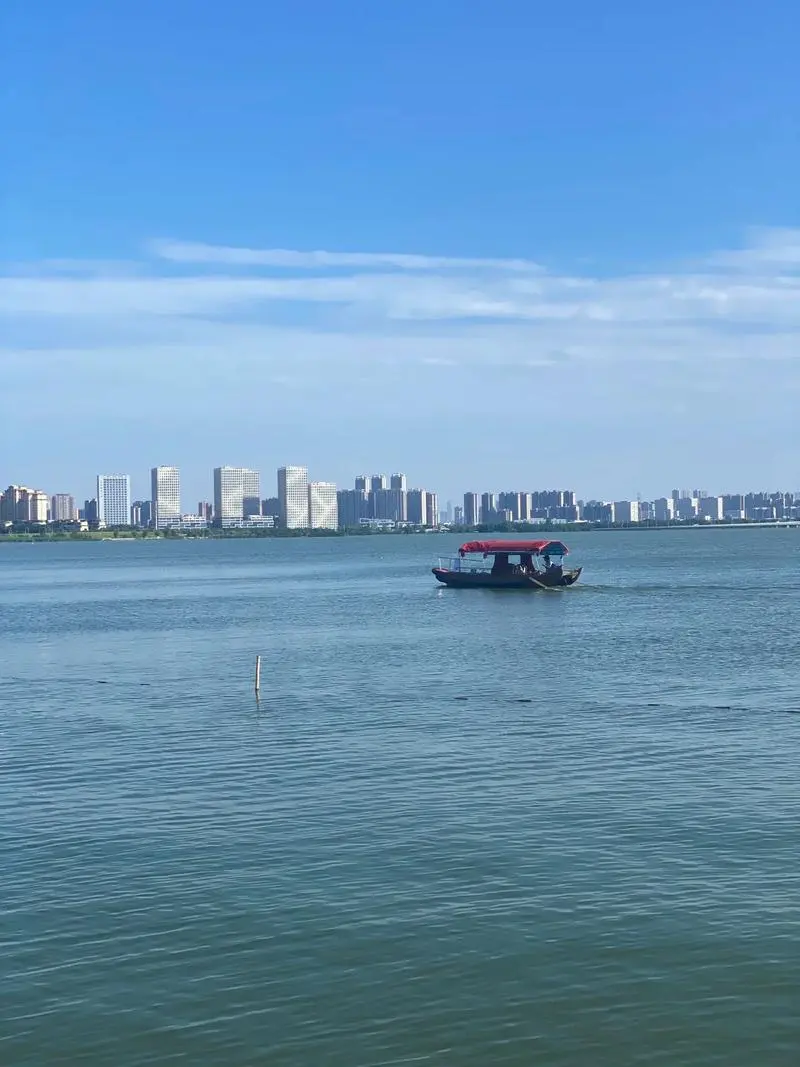
Tangxun Lake: 47 square kilometers of water inside the city limits. China’s largest urban lake. Most tourists never see it.
Living with lakes
Here’s what having 166 lakes does to a city.
First, the air is different. Wuhan is famously hot in summer. The summer heat here is oppressive, with temperatures regularly above 38°C and humidity that makes your shirt stick to your back within minutes of stepping outside. The lakes don’t cool the city. They make the humidity worse, actually, but they do create microclimates. The air near a large lake is 2-3 degrees cooler than the air two kilometers inland. In August, that difference matters.
Second, the mosquitoes. I won’t dwell on this, but if you visit Wuhan in summer, bring repellent. The lakes breed mosquitoes the way the universities breed engineers: relentlessly and in staggering numbers.
Third, the real estate. Every new apartment development in Wuhan advertises its proximity to water. “Lake view” (湖景房) is the magic phrase that adds 30% to the price. The irony is that many of these “lake view” apartments are built on land that was itself a lake 30 years ago, filled in during the reclamation era, then built up, now sold at a premium for its proximity to the water that used to be there.
Fourth, the recreation. Wuhan people live outdoors more than you’d expect for a city with this climate. The lakeshore parks are full from dawn to dusk: joggers in the morning, families at noon, couples at sunset. On weekends, the parks around East Lake and Sha Lake are so crowded that finding a parking spot takes longer than the drive there.
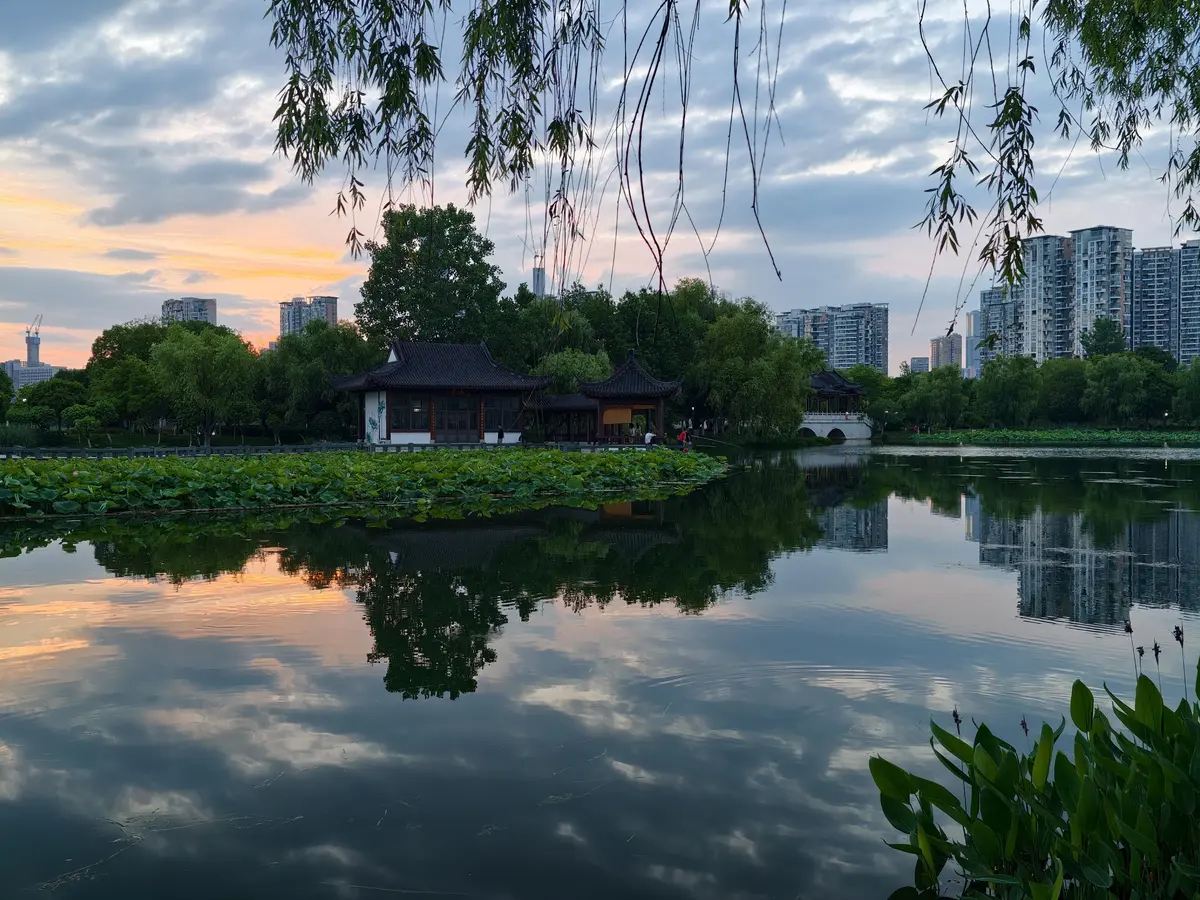
Sha Lake at sunset. The lake is the neighborhood. Joggers, tai chi practitioners, and 30-story apartment towers share the same shore.
The lotus season
If you visit Wuhan in July or August, the lakes do something extraordinary. The lotus blooms.
East Lake has a dedicated lotus garden, 70 hectares of lotus flowers that open in mid-summer, turning the lake surface into a carpet of pink and white. But you don’t need to go to the garden. Lotus grows wild in nearly every lake in Wuhan. Drive past Tangxun Lake in July, and the roadside is a wall of green leaves and pink flowers. Walk along Sha Lake in August, and the air smells like something between honey and clean linen.
The lotus isn’t just decorative. The root (莲藕) is a staple of Wuhan cuisine, sliced and stir-fried, or slow-cooked with pork ribs in soup. Lotus seeds are dried and eaten as snacks, or ground into paste for mooncakes. The leaves are used to wrap sticky rice for steaming. Nothing on the plant is wasted.
My favorite dish in Wuhan, if I had to pick one, is lotus root and pork rib soup (排骨莲藕汤). My wife makes it in winter: the lotus root from the autumn harvest, pork ribs from the morning market, slow-simmered for four hours until the broth turns milky white. The lotus root absorbs the pork flavor and becomes tender but not mushy, soft on the outside, with a slight crunch at the center. I’ve eaten this soup in other cities. It’s never the same. The lotus root is different. Wuhan’s lake-grown lotus has a starch content that makes it uniquely suited to slow cooking.
The sponge city
In 2015, Wuhan was selected as one of China’s first “sponge cities”, a national pilot program to manage urban flooding through natural water absorption. The idea is simple: instead of fighting water with concrete and pumps, let the lakes, wetlands, and permeable surfaces absorb rainfall naturally.
The sponge city initiative includes expanding lake buffer zones, creating rain gardens, using permeable pavement, and restoring wetlands that were filled in during previous decades. The goal is that 70% of rainfall should be absorbed locally rather than running off into drains and rivers.
It’s a work in progress. The 2016 floods, which inundated large parts of Wuhan, showed how far the city still has to go. But the direction is right, and the lakes are central to it. Every lake that’s protected, every wetland that’s restored, is a piece of the city’s flood defense.
This matters more than tourists realize. Wuhan’s lakes aren’t just scenery: they’re infrastructure. They’re the reason the city can exist on a floodplain between two major rivers. Without the lakes acting as natural reservoirs, every heavy rain would be a disaster.
| Lake | Area (sq km) | Location | Best For |
|---|---|---|---|
| Tangxun Lake | 47 | South Wuchang / Jiangxia | Driving past, scale appreciation |
| East Lake | 87 | Central Wuchang | Cycling, cherry blossoms, teahouses |
| South Lake | 8 | University district | Evening walks, student atmosphere |
| Sha Lake | 3 | Central Wuchang | Urban park life, jogging |
| Hou Lake | 2 | North Hankou | Residential neighborhood parks |
Wuhan’s lakes are the city’s other water story. Read more: East Lake, the green heart, the river culture, and when to visit.
Related:
-
Lotus Root and Pork Rib Soup: The Taste of a Wuhan Home, what those lakes taste like in the depths of winter
-
East Lake: Wuhan’s Green Heart, the lake everyone visits, and why it’s worth your whole day
-
The River Is the City: Wuhan’s Yangtze Culture, the other half of Wuhan’s water story
-
Two Rivers, Three Towns, how water shaped the city’s geography
-
Best Time to Visit Wuhan, lotus season, cherry blossoms, and when to see them at their best
-
Wuhan and the Floods: A City Defined by the Yangtze, how the city learned to live with water
-
Why Wuhan’s Retirees Own This City, the lakeshores are where morning exercise groups gather