
Every English guide to Wuhan University still tells you to reserve a visitor slot in advance. That advice has been wrong since 13 May 2026, when the university scrapped its booking system outright. You now need one thing to walk in: a Chinese national ID card. No quota, no reservation, no fee, no weekday closing.
Wuhan has no ginkgo peak date either. It has a slow, month-long shift that mostly tracks how fast the temperature drops, and a warm year pushes the whole thing back a fortnight.
What Wuhan University actually requires now
Two gates take visitors, and only two. Luojia Gate (珞珈门) is the main one on the campus’s southern approach, and Hongyi Gate (弘毅门) is on the west side. Every other gate stays shut to the public. The turnstiles read your national ID card and open, which is why a passport alone will not get you through.
The metro is the easy way there. Line 8 Xiaohongshan station (小洪山站) Exit A is about 500 metres from Luojia Gate, and Line 2 Jiekougkou station (街道口站) Exit C is roughly a kilometre. Line 8 was built largely to serve this campus, and Hongshan Road station on that line has a hand-painted mural of the cherry blossoms on the platform wall.
A taxi is harder. Cars cannot drop you at the gate, because vehicles are not permitted inside unless the passenger is a student or staff member who can show a campus card. Ask to be let off at the Bayi Road corner and walk the last few hundred metres. If you want to know how the rest of the city gets around in the meantime, my transport guide covers the lines and the payment setup.
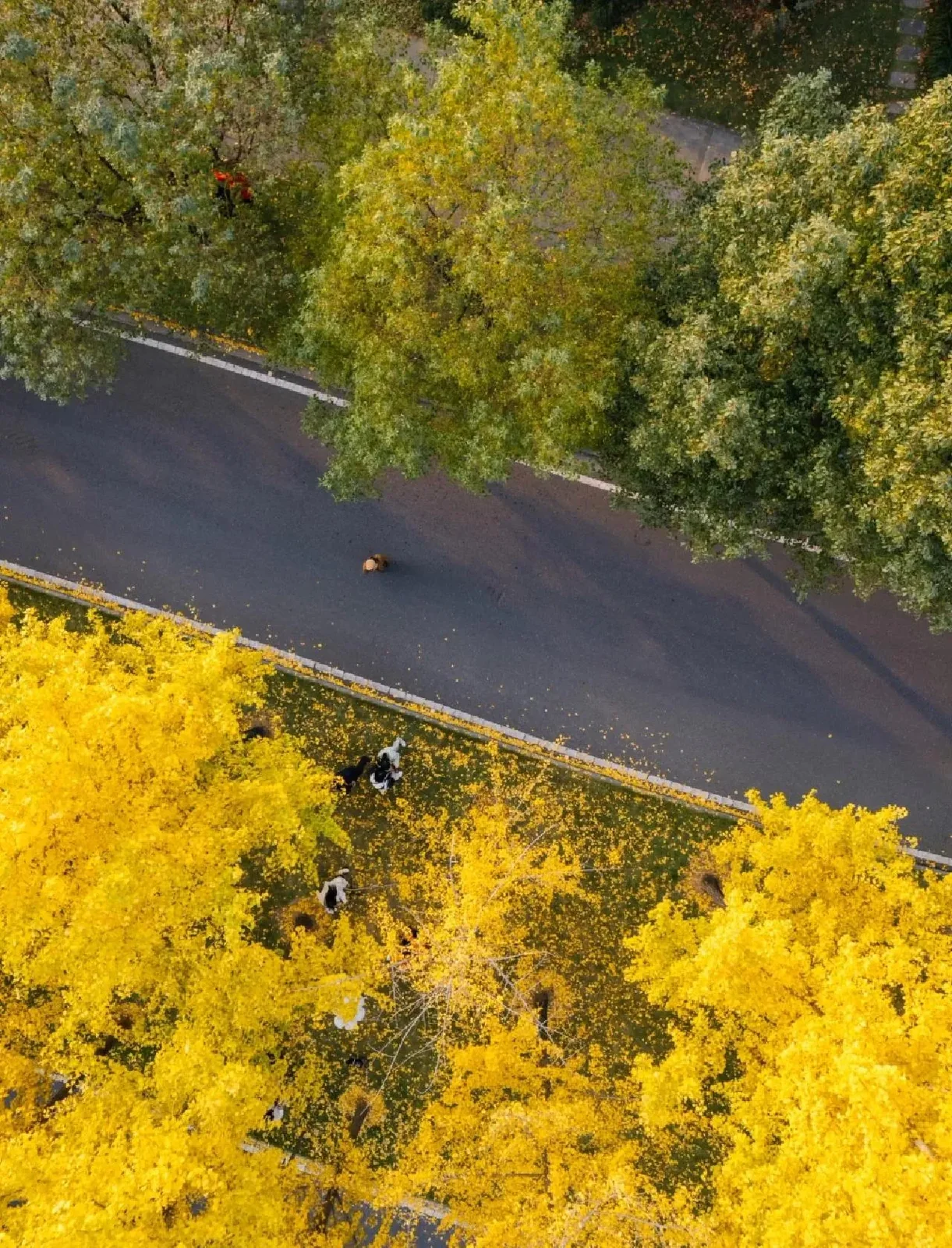
The campus holds about 150 ginkgo trees, concentrated along Yinghua Avenue (樱花大道) and in front of the new library. Eight of the avenue trees were planted in the earliest years of Luojia Mountain, and some of them are over 40 metres tall with trunks two people have to span.
When the ginkgo actually turns
Wuhan’s own parks authority puts the best viewing at late November into early December. A senior engineer at the city’s horticulture institute (武汉市园林科学研究院), Dong Likun (董立坤), told the Wuhan Evening News that the city-wide peak would arrive around then, and warned that Wuhan’s ginkgo does not turn gold overnight.
The variance between years is real, and it goes both directions. November 2024 was warm enough that the city’s parks department noted leaf colour across Wuhan was barely showing by the middle of the month. A year later the 546-year-old Hanyang Tree (汉阳树) turned later than it had in 2024, with heavier leaf cover once it did.
The urban and suburban divide matters more than any calendar. The built-up core holds several degrees more heat overnight, so suburban trees change colour and drop in one concentrated flush while the city trees go in staggered batches. Sun-facing slopes go first, and two trees on the same road can be a fortnight apart.
If you want a photo of one specific tree rather than a general golden avenue, ask locally in the week before you travel. Otherwise take the window and let the weather decide. For how the light behaves here in the colder months, my four seasons photography piece goes into it in more detail.
The chrysanthemum show is the one with a published date
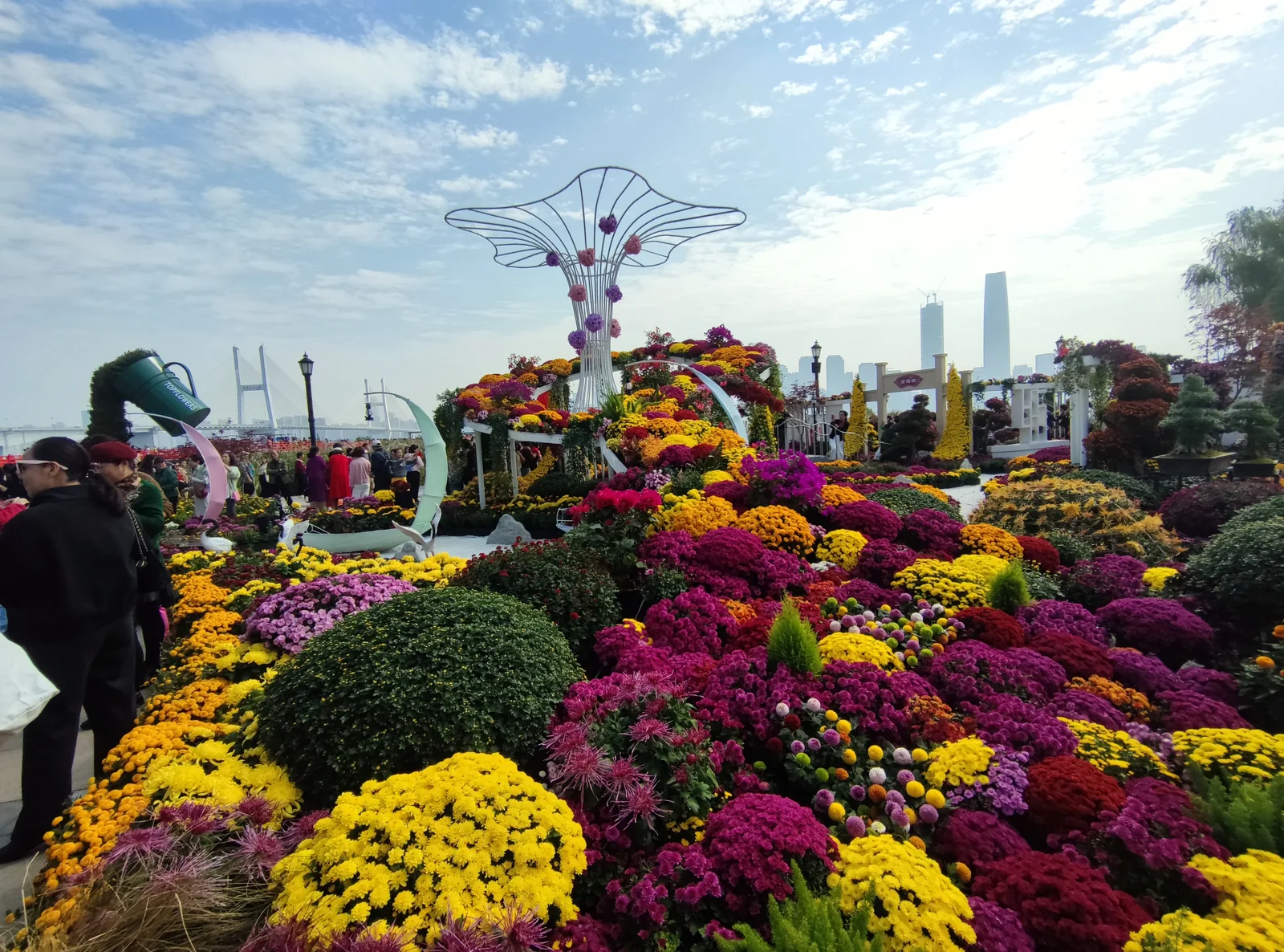
The 43rd Wuhan Golden Autumn Chrysanthemum Exhibition opens on 30 October 2026 and runs for a month. The main site is Sailboats Square (风帆广场) on the Hankou River Beach, with satellite displays at Shahu Park (沙湖公园), Zhongshan Park (中山公园) and the Wuhan Zoo. Entry is free.
This is the seasonal event that has a date attached to it, which the ginkgo does not. Last year’s edition ran 1 to 30 November and put more than 600,000 potted chrysanthemums across over 1,000 varieties on 50,000 square metres.
Chrysanthemums are also the more reliable November colour in Wuhan generally. If your trip is next week rather than next month, this is what is worth making the trip for. The autumn festival calendar I keep is in the piece on Mid-Autumn and what surrounds it.
Five ginkgo spots that hold up
The famous one is Hanyang Tree Park (汉阳树公园), at 12 Fengxiang Lane in Hanyang district. It is free, open around the clock, and holds the 546-year-old Hanyang Tree, the single ginkgo that Cui Hao’s poem about the Yellow Crane Tower is about. The park director said the 2025 peak ran about a week, and only if no strong wind came through.
Jiefang Park (解放公园), at 1861 Jiefang Avenue, is the easiest from anywhere in the city. Metro Line 8 Huangpu Road station (黄浦路站) Exit H is a 315-metre walk from the gate and the park opens at 06:00. Go to Gate 2 at Gongsun Slope (2号门公孙坪), where a stand of more than twenty ginkgo was photographed fully gold on 11 November 2025.
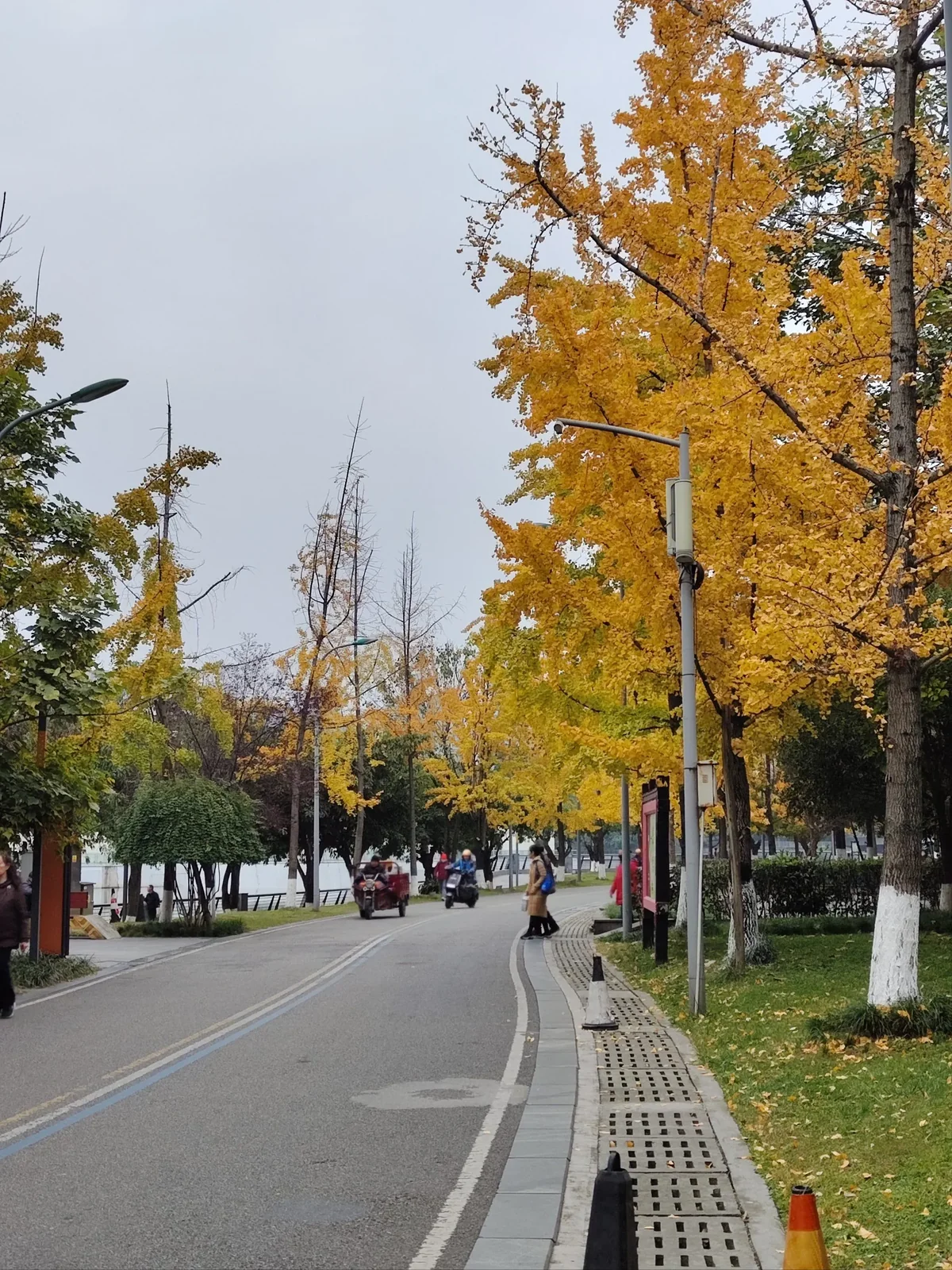
Yinwu Avenue (鹦鹉大道) in Hanyang has 990 street ginkgo between the Qintai interchange and Sixin North Road, which is more on one road than anywhere else in Wuhan. The city has planted over 40,000 along its roads, spread across at least 35 dedicated avenues, and that number went up from 27 avenues two years ago.
The White Horse Road (白马道) strip on East Lake runs about a kilometre. Sun Cheng (孙诚), who runs the East Lake greenway project, put best viewing from mid-November through the first third of December, with the 10th to the 20th most ideal. His caveat is the lakeside position: a cold snap with wind strips the leaves fast, so it may not last to the end of the month.
Wuhan Garden Expo Park (武汉园博园) has over 800 ginkgo trees, about a ten-minute walk from the East Gate. The site runs a do-not-sweep policy through peak fall, so the carpets stay on the ground and there are bins where you can toss a handful for a falling-leaf shot. My parks and green spaces guide covers the rest of the city’s parks, which is the wider version of this list.
What the weather does to a day out
November is not warm, whatever October was like. The 30-year climate normal for Wuhan puts the mean daily maximum at 16.8°C and relative humidity at 75%, with roughly eight days of measurable rain out of 60 mm for the month.
The city’s climatological date for entering winter is 24 November, which lands right in the middle of ginkgo season. Bring a jacket for the evening rather than just the morning. The parks authority also warns that fog and haze probability rises through the month, which softens the afternoon light and flattens the colour at a distance.
Is November really quieter than October
The huge October numbers are real, and they are almost entirely a National Day holiday artifact. Over the eight days of 1 to 8 October 2025, East Lake took 2.64 million visitors, the Hankou River Beach took more than 1.2 million with a single-day peak of 219,900, and the Yellow Crane Tower took over 270,000 in its first seven days.
November has no statutory holiday at all, which is the structural reason for calling it a shoulder month.
I could not find any published month-on-month visitor series for Wuhan comparing October against November. The municipal culture and tourism bureau releases annual figures only, so treat the idea that November is quiet as an inference from the holiday calendar rather than a statistic. Practically, a weekday at Wuhan University in late November is a completely different experience from a Saturday in early October. My October piece covers the crowd-heavy version if that is what you are choosing instead.
Two places to skip for ginkgo
Moshan (磨山) is on most people’s autumn lists, and it is the wrong choice if ginkgo is what you came for. Its autumn draw is osmanthus, four varieties of it, and the famous collections up there are plum, cherry and azalea. The ginkgo there is scattered.
Luoyan Scenic Area (落雁景区) is a dawn redwood wetland, not a ginkgo spot. Its November draw is birds: the cormorant island holds thousands of cormorants from November through April, and entry is 13 yuan, which makes it one of the few genuinely ticketed spots inside East Lake. The rest of the lake is covered in the East Lake guide.
What November costs and what it needs
Entry to Moshan, Tingtao and Ma’anshan Forest Park inside East Lake is free under the city’s 2026 price list. The East Lake greenway sightseeing bus is 40 yuan per person, and the sightseeing boats run 40 yuan one way and 70 yuan return. Luoyan at 13 yuan is the exception among the spots I have mentioned.
Almost everything in Wuhan takes QR code payment, so set up Alipay or WeChat Pay linked to a foreign card before you land. A taxi starts at 10 yuan for the first 3 km and then runs 1.80 yuan per km out to 10 km. Ride-hail is usually cheaper, and Wuhan has been running Baidu’s driverless robotaxi at scale since 2021, which is still rare outside a handful of Chinese cities.
Wuhan in November is short, damp and not especially photogenic on any single day. What it has over October is room to stand somewhere without a crowd, and a ginkgo season that rewards anyone willing to check the weather a week out.