
The lake no one talks about
Ask a foreigner to name a famous Chinese lake, and they’ll say West Lake in Hangzhou. It’s on every postcard, in every guidebook, and surrounded by 30 million tourists a year.
East Lake (东湖, Dōng Hú) in Wuhan is 87 square kilometers, more than six times the size of West Lake. It has cherry blossoms, lotus gardens, cycling paths, bird sanctuaries, and teahouses that have been serving tea since the Qing Dynasty. And almost no international tourists know it exists.
I’ve cycled around East Lake maybe 200 times. It’s the best free thing in Wuhan, and I’m including the things that cost money in that ranking.
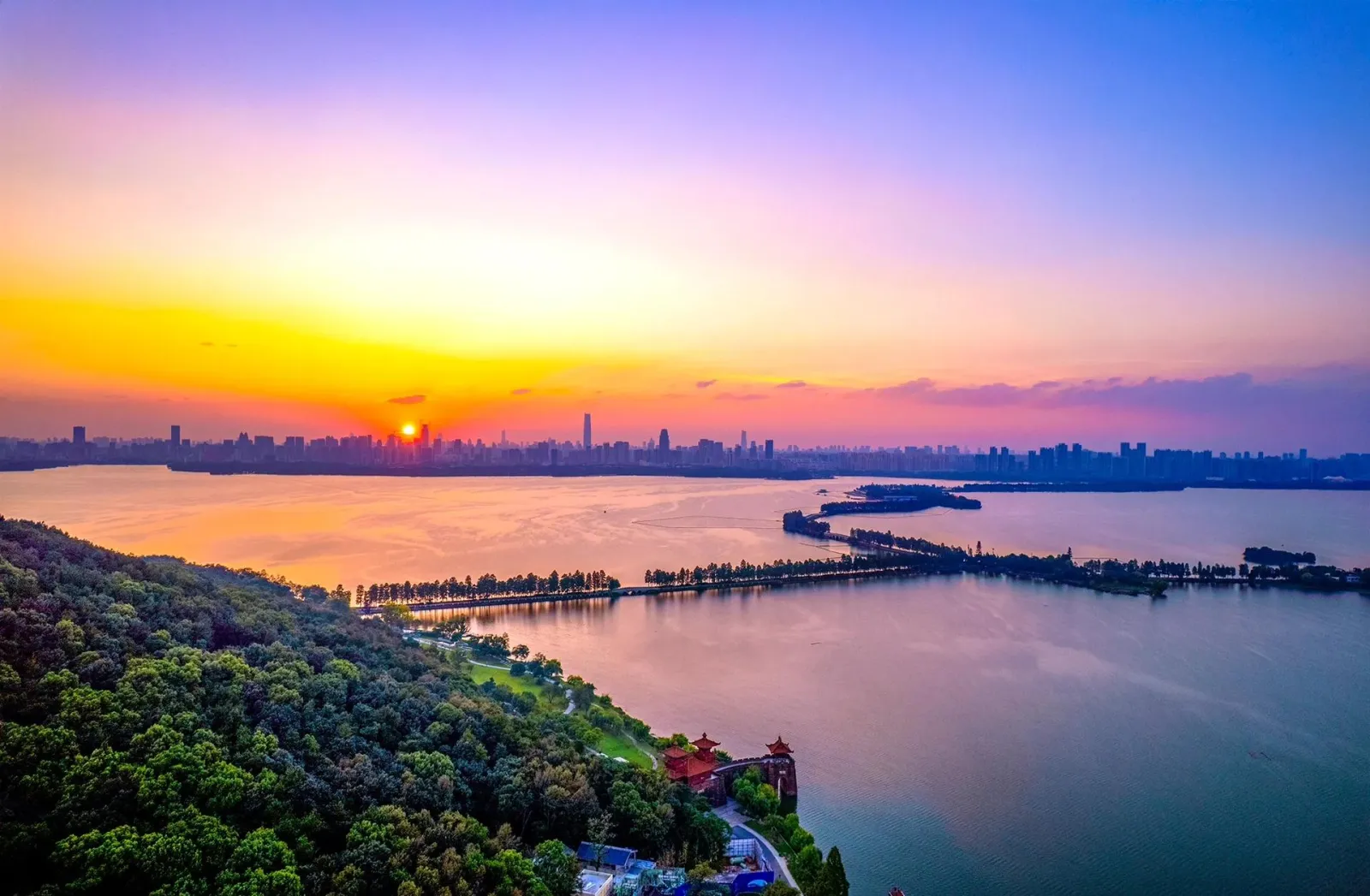
East Lake: 87 square kilometers of water inside the city. Twice the size of West Lake in Hangzhou, a fraction of the tourists.
The four scenic areas
Each zone has its own character, and picking the wrong one costs you a wasted afternoon. Here’s how to choose.
Tingtao (听涛): “Listening to waves”
The most accessible area, closest to the city center. This is where I send first-time visitors. A 2-kilometer tree-lined path follows the shore, with pavilions, stone bridges, and a open-air swimming area where locals swim year-round (yes, even in January. Wuhan people are stubborn).
Best for: First visit, walking, swimming. How to get there: Metro Line 8, Liyuan Station, exit B.
Moshan (磨山): the cherry blossom mountain
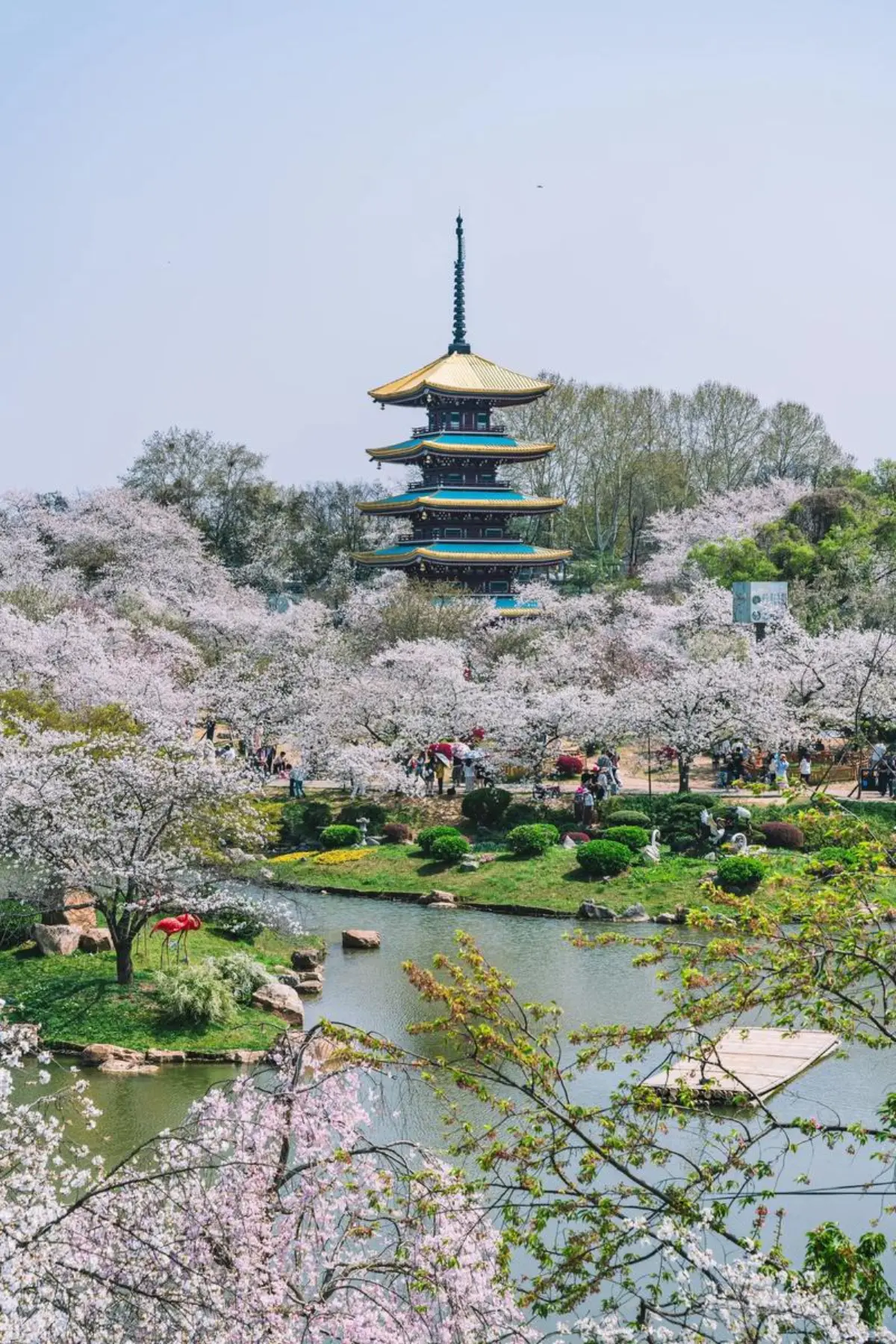
Moshan cherry blossom garden: 10,000 trees blooming simultaneously in late March, with the lake right behind them.
Moshan is a hill on the lake’s eastern shore, home to Wuhan’s famous cherry blossom garden. In late March, 10,000 cherry trees bloom simultaneously. It’s less crowded than Wuhan University’s cherry blossoms (which get national news coverage and insane crowds) and arguably more beautiful because the lake is right there.
The garden also has a lotus exhibition area, 700 varieties of lotus that bloom from June to August. The lotus flowers are enormous, some as wide as dinner plates.
Best for: Spring visits, photography, botany nerds. Entry: 60 yuan (cherry blossom season), free other times.
Luoyan (落雁): “Falling geese”
The wildest, least developed area. This is where migratory birds stop in winter, tens of thousands of them. The paths here are narrower, the trees are older, and you can walk for an hour without seeing another person. It’s the closest thing to wilderness inside a Chinese megacity.
Best for: Solitude, birdwatching, autumn walks. How to get there: Bus 350 to Luoyan Scenic Area gate.
Chuidi (吹笛): “Flute playing”
The southwestern corner, named after a hill where, according to legend, someone once played a flute so beautifully that the moon stayed up past dawn. It’s the most residential-feeling area. Old neighborhoods border the lake, and you’ll see people fishing, washing vegetables, and doing morning exercises. It’s also home to the East Lake Greenway, a 28-kilometer cycling path that loops the entire lake.
Best for: Cycling, local life, sunsets.
Cycling the Greenway
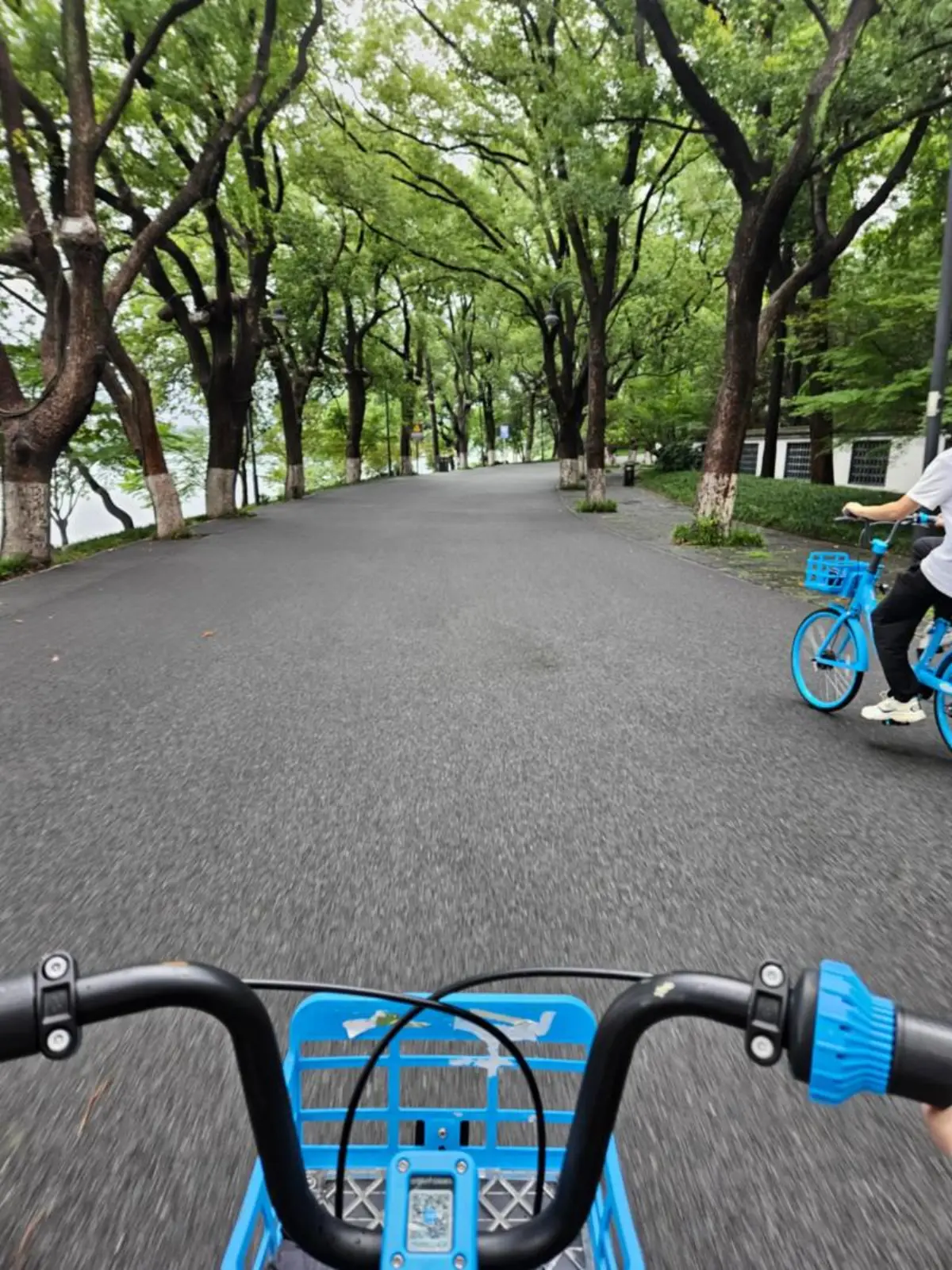
The East Lake Greenway: 28 kilometers of car-free cycling path looping the entire lake.
The East Lake Greenway (东湖绿道) is the best urban cycling path in China. I’m saying that without hyperbole.
-
Length and surface: 28 kilometers, fully paved smooth concrete, no cars allowed, fine for any bike
-
Scenery: Lake views, forests, wetlands, pavilions, tea houses
-
Difficulty: Completely flat
-
Bike rental: Shared bikes (Meituan, Hello Bike) available at every entrance. Scan QR with WeChat, 1.5 yuan per 30 minutes
My recommended route (10 km, 1 hour): Start at Tingtao Scenic Area entrance → cycle south along the west shore → cross the causeway to Moshan → loop back along the east shore. This gives you lake on both sides, forest sections, and a hill climb (gentle, 30 meters elevation) at Moshan.
The teahouses
East Lake has several teahouses hidden along its shore. These aren’t tourist attractions. They’re where Wuhan retirees spend their afternoons. You order a pot of tea (10-20 yuan), they give you a thermos of hot water, and you sit. For hours. No one rushes you.
My favorite: the unmarked teahouse at the northern tip of Tingtao, near the swimming area. It’s a concrete pavilion with plastic chairs. The tea is mediocre. The view is a 270-degree panorama of the lake. I’ve spent entire afternoons there reading, and no one has ever asked me to leave.
When to go
| Season | What you’ll see | Rating |
|---|---|---|
| Spring (Mar-May) | Cherry blossoms, fresh green, mild weather | ★★★★★ |
| Summer (Jun-Aug) | Lotus flowers, but 35°C+ and humid | ★★★☆☆ |
| Autumn (Sep-Nov) | Golden leaves, clear skies, perfect cycling | ★★★★★ |
| Winter (Dec-Feb) | Migratory birds, misty lake, few people | ★★★★☆ |
Avoid: Summer weekends. The lake is beautiful but the heat will kill you. Wuhan is one of China’s “Three Furnaces.” Summer temperatures regularly hit 40°C.
Practical info
| Item | Details |
|---|---|
| Entry | Free (except Moshan cherry blossom garden in March) |
| Hours | Always open (it’s a public park) |
| Metro | Line 8 (Liyuan), Line 4 (Wuhan Railway Station) |
| Bike rental | Shared bikes via WeChat, 1.5 yuan/30min |
| Time needed | 2 hours (walk), 1 hour (cycle), half day (full experience) |
| Food | Small restaurants near entrances; bring snacks for longer stays |
Found a quiet corner of East Lake I should know about? Email me.
Related:
-
Wuhan’s Lakes: Why China’s Biggest Lake-City Has More Water Than You Think: East Lake is just one of 166 lakes in Wuhan
-
3 Days in Wuhan: A Local’s Itinerary: East Lake is Day 3
-
Yellow Crane Tower: Beyond the Poem: visible from the lake on a clear day
-
Hot Dry Noodles: Ultimate Guide: grab breakfast on the way
-
Beyond the City: 5 Day Trips from Wuhan: Liangzi Lake has cleaner water and better crabs
-
Where to Point Your Camera: A Wuhan Photography Location Guide: East Lake’s cherry blossoms are a top photo spot
-
Why Wuhan’s Retirees Own This City: the teahouses along the shore are where retirees hold court