
Before you read this
Most Wuhan itineraries online are written by people who spent 48 hours here, ate at one restaurant their hotel recommended, and left. This one is different.
I’ve lived in Wuhan for eighteen years. This itinerary is what I’d plan if my best friend from abroad came to visit: the places I actually go, the food I actually eat, the timing that actually works. It assumes you want to see the real city, not the version curated for tour buses.
Ground rules:
-
Wake up early. Wuhan’s best hours are 5:30-9:00 am. If you’re jet-lagged, reset your clock on day one.
-
Bring WeChat Pay or Alipay. Cash works at some stalls, but not all.
-
Wear shoes you don’t mind getting dirty or scuffed. This is a street-food city.
-
Don’t over-plan. The best things in Wuhan happen between planned things.
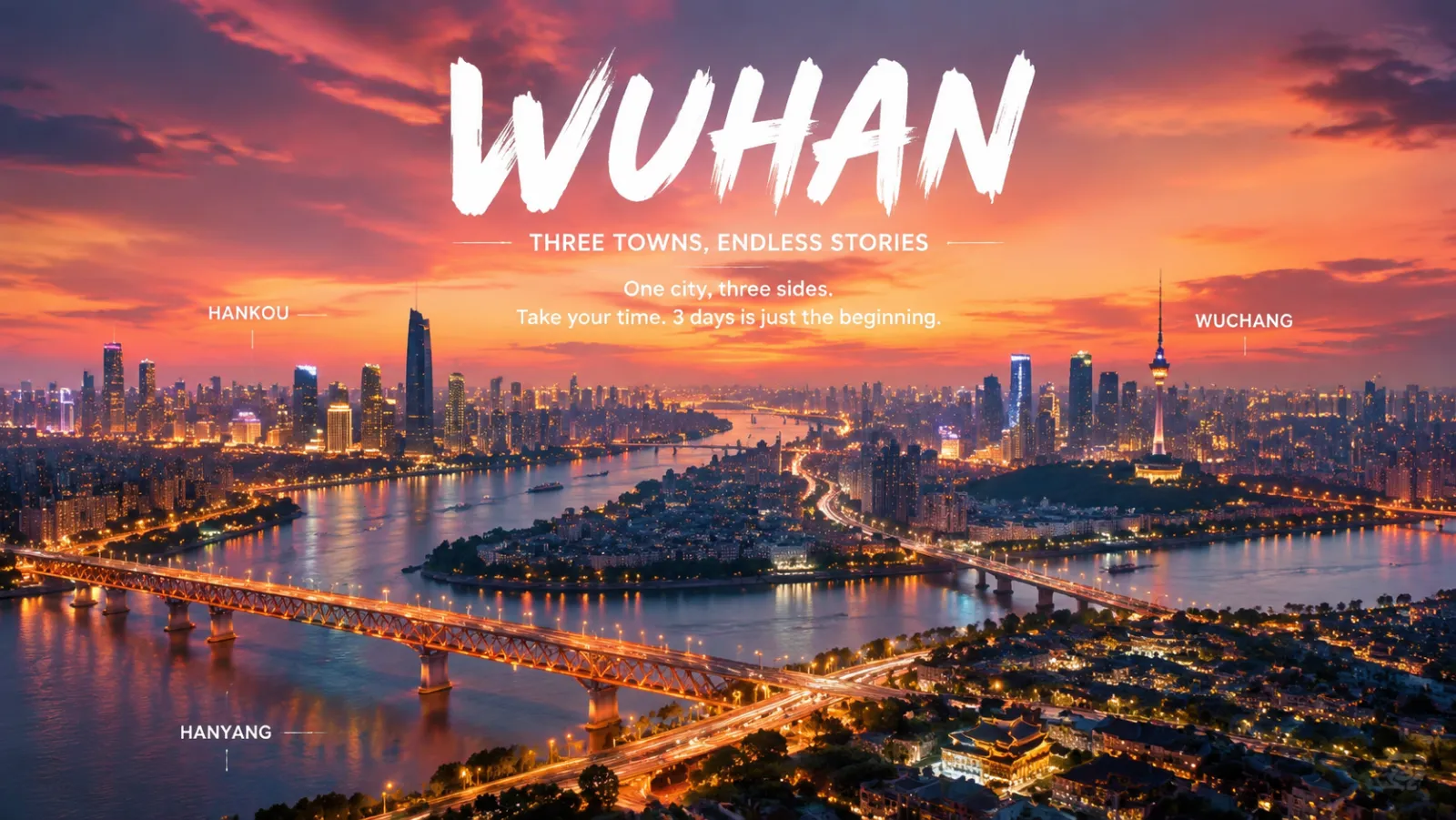
Wuhan from above. The Yangtze and Han rivers divide the city into three towns: Hankou, Wuchang, and Hanyang.
Day 1: Hankou, the old city
Hankou is where Wuhan began as a trading port. It has the old European concession buildings, the densest street food, and the most walkable streets. Spend your first day here.
6:00 am: Breakfast at the stalls
Start at Jianghan Road (江汉路) and walk west toward the old concession district. The breakfast stalls open at 5:30. By 6:00, the sidewalks are full of steam and people.
What to eat: hot dry noodles (热干面) from any stall with a line of locals. Don’t overthink it. The competition is fierce, which means the average quality is high. Add a bowl of doupi (豆皮) if you’re still hungry. For the full breakfast ritual, read my guide to guo zao.
Budget: 10-15 yuan. Time: 45 minutes.
8:00 am: Walk the Bund
Wuhan has its own Bund: the Hankou Riverfront (汉口江滩), a 14-kilometer stretch of park along the Yangtze. Walk from Jianghan Road north for about 2 kilometers. You’ll pass old colonial buildings, morning exercisers, and fishermen casting nets into the river.
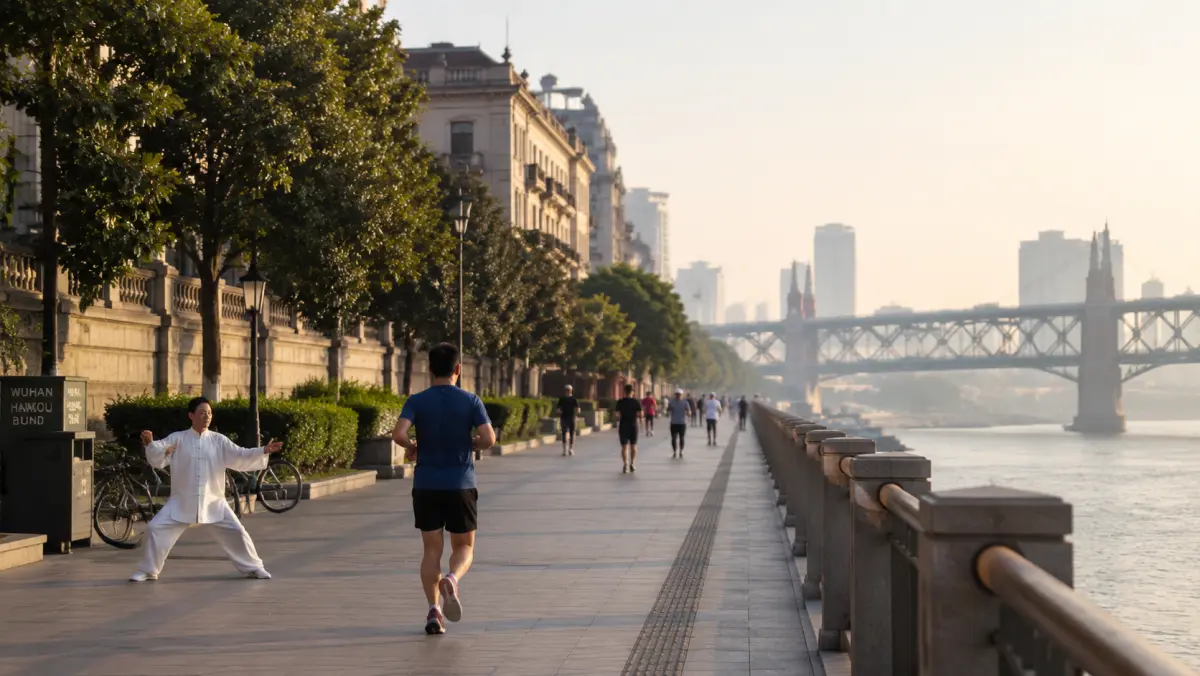
The Hankou Riverfront at 8:00 AM, where locals walk, exercise, and fish along the Yangtze.
10:00 am: Hankou’s old concession district
The Lao Han Kou (老汉口) area between Jianghan Road and the river is a grid of early-20th-century European architecture. Its former banks, trading houses, and consulates were built when Hankou was one of China’s four treaty ports. Many buildings are repurposed as cafes and shops. Walk slowly. The side streets are better than the main roads.
12:30 pm: Lunch on Wansongyuan Food Street
Wansongyuan Road (万松园路) is the best lunch street in Hankou, and it’s where the locals go to eat, not just tourists. Try niu rou ban mian (牛肉拌面), beef noodles with sesame sauce, at any stall with a line. Follow with tangbao (汤包) at Si Ji Mei, which has been making soup dumplings since 1997.
Budget: 25-40 yuan. Time: 1 hour.
3:00 pm: The Wuhan Art Museum
The Wuhan Art Museum (武汉美术馆) is in a former bank building on Baohua Road. Free entry. The building itself is worth the visit: 1930s neoclassical architecture with a modern interior renovation. Rotating exhibitions of contemporary Chinese art.
7:00 pm: Dinner and a night walk
Walk back to the riverfront. The Hankou Riverfront at night is where the city comes alive: food stalls, street performers, and the Yangtze lit up with cargo ships. Eat kao rou (烤肉), grilled skewers, from any of the dozen stalls along the path. Drink pi jiu (啤酒), local Snow Beer, cheap and cold.
Budget: 30-50 yuan. Time: 2-3 hours.
Day 1 total: about 70-110 yuan per person, including all three meals and the metro hops in between. The riverfront walk, the concession district and the art museum are all free.
Day 2: Wuchang, history and views
Wuchang is the cultural and educational heart of Wuhan: universities, museums, and its most famous landmarks. It’s more spread out than Hankou, so plan your route.
6:30 am: Breakfast at Hubu Alley
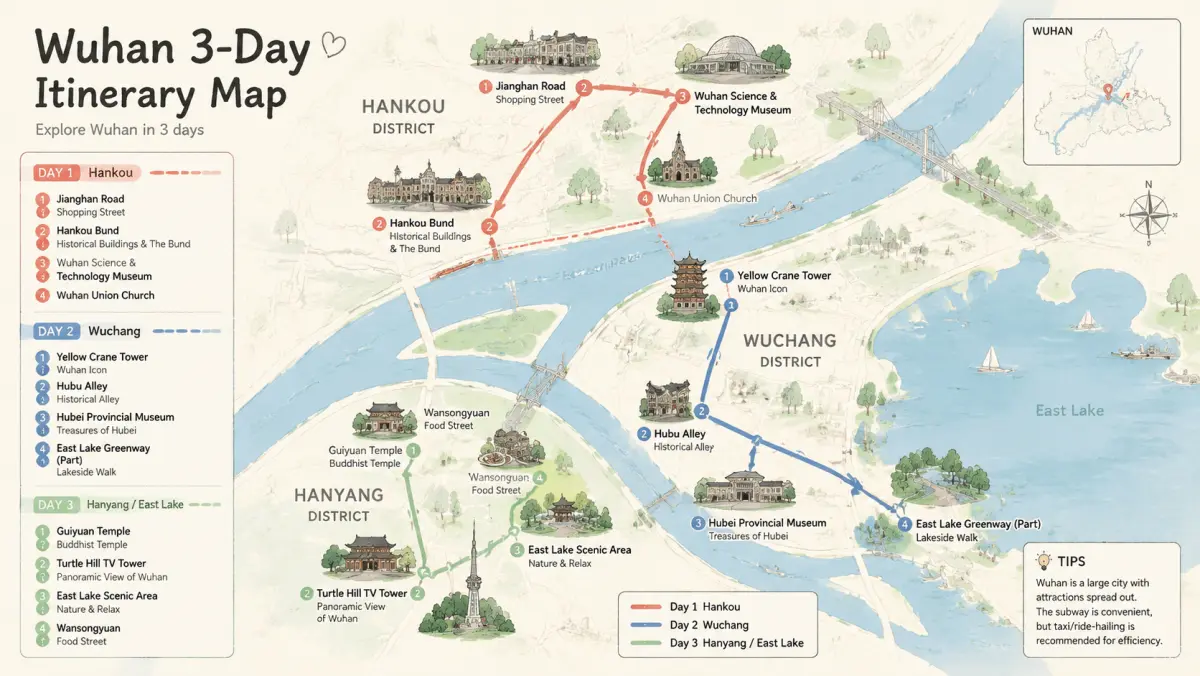
Three days, three towns. Day 1 is Hankou’s old city, day 2 is Wuchang’s history and views, and day 3 is East Lake and Hanyang.
Hubu Alley (户部巷) is touristy after 9:00 AM, but at 6:30 it’s still a local breakfast market. Get there early, eat doupi and reganmian, and leave before the crowds arrive.
9:00 am: The Yellow Crane Tower
The Yellow Crane Tower (黄鹤楼) is Wuhan’s most famous landmark, a five-story pagoda on Snake Hill overlooking the Yangtze. Yes, it’s a reconstruction (the original was built in 223 AD and has been destroyed and rebuilt seven times). Yes, there’s an elevator inside (installed in the 1980s). It’s still worth it for the view alone. On a clear day, you can see the entire city and both rivers. I wrote a separate guide to the tower if you want the full history.
Entry: 70 yuan. Time: 2 hours.
12:00 pm: Lunch near Simenkou
Walk down from the tower to Simenkou (司门口), the old commercial street. There are dozens of small restaurants here. Try paigu ouan tang (排骨藕汤), pork rib and lotus root soup, a Wuhan comfort food staple.
Budget: 20-35 yuan. Time: 1 hour.
2:00 pm: The Hubei Provincial Museum
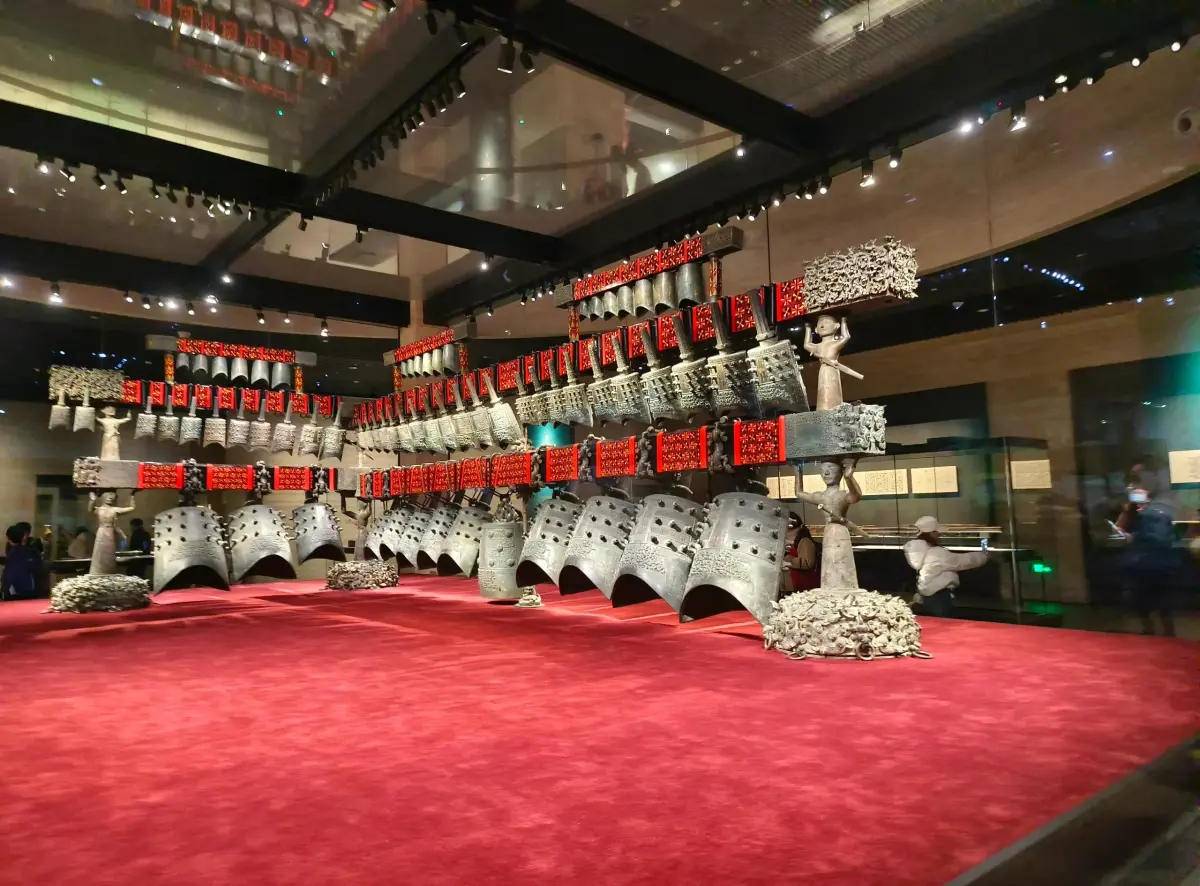
The Chime Bells of Marquis Yi of Zeng, 65 bronze bells cast 2,400 years ago that still play perfect musical notes.
The Hubei Provincial Museum (湖北省博物馆) is one of China’s best. Free entry. Its most famous exhibit is the Chime Bells of Marquis Yi of Zeng (曾侯乙编钟), a set of 65 bronze bells cast 2,400 years ago that still play perfect musical notes. There are live demonstrations three times a day. Don’t miss them.
Entry: Free, but bring your passport. Time: 2-3 hours.
6:00 pm: Dinner in the university district
Walk east to the area around Wuhan University (武汉大学), one of China’s most beautiful campuses, built on a hill overlooking East Lake. The streets around the university’s east gate are full of cheap, excellent restaurants catering to students. Try gai jiao fan (盖浇饭), rice topped with stir-fried dishes, for 12-15 yuan.
Budget: 15-25 yuan. Time: 1 hour.
Day 2 total: about 125-160 yuan per person. The Yellow Crane Tower is the expensive item at 70 and it earns that. The provincial museum is free but needs your passport, and it is the best free thing on this list.
Day 3: East Lake and Hanyang, the quiet side
Day three is for slowing down. East Lake is the green lung of Wuhan, twice the size of West Lake in Hangzhou, but with a fraction of the tourists. Hanyang is the quietest of the three towns.
7:00 am: Cycle around East Lake
Rent a shared bike (Meituan or Hello Bike) and scan the QR code with WeChat. Start at the Tingtao Scenic Area (听涛景区) and cycle south along the lake shore; the path runs about 10 kilometers, flat and tree-lined, with zero traffic. Stop wherever looks good. There are teahouses, pavilions, and empty benches.
Bike rental: 1.5 yuan per 30 minutes. Time: 2-3 hours.
10:30 am: Tea by the lake
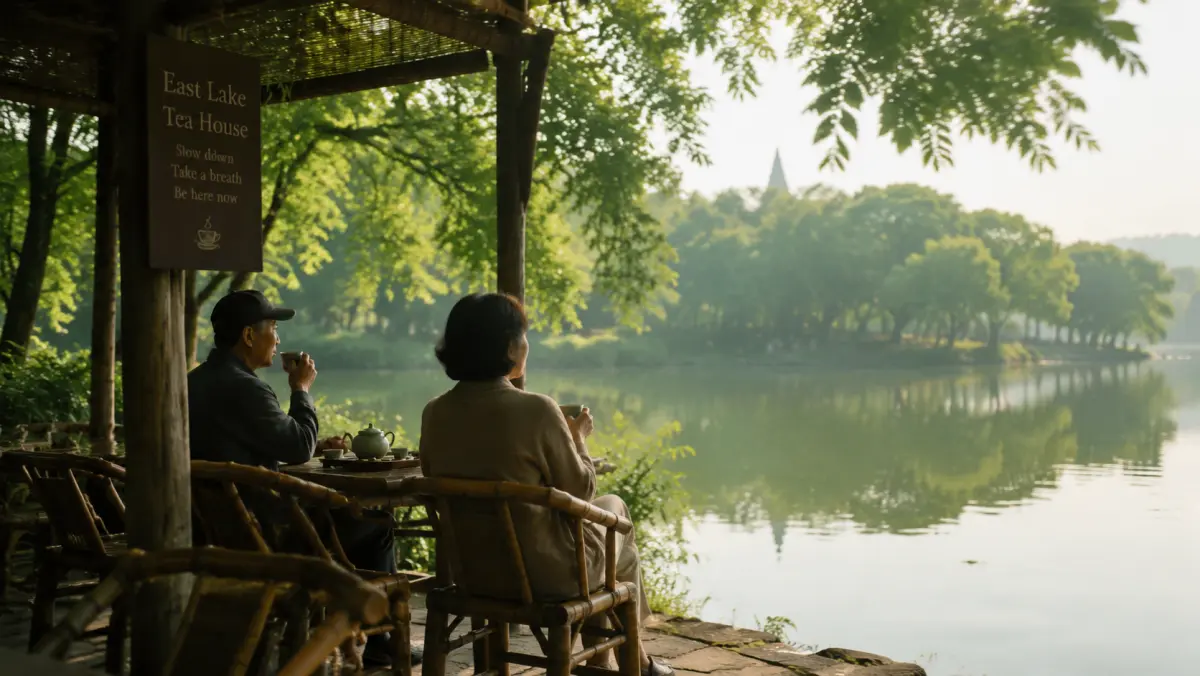
Tea by East Lake. Order jasmine tea, sit, do nothing: this is how Wuhan people process the city.
Find a teahouse along the lake. Order moli hua cha (茉莉花茶), jasmine tea. Sit. Do nothing. This is not wasted time; it is how Wuhan people process the city. The tea costs 10-15 yuan and the view is free.
1:00 pm: Lunch in Hanyang
Cross the river to Hanyang (汉阳). The area around Guiyuan Temple (归元寺) has small vegetarian restaurants, and the temple’s own canteen serves excellent Buddhist vegetarian food for 15 yuan. Even if you’re not vegetarian, eat here. The temple’s lotus root dishes are unique.
3:00 pm: Guiyuan Temple
The Guiyuan Temple (归元寺) is one of Wuhan’s four major Buddhist temples. It’s quieter and far less commercialized than the big temples in Beijing or Shanghai. The Arhat Hall has 500 golden statues, no two alike. Find your “personal” arhat by counting: start at the one labeled with your birth year, count to your age, and that’s your arhat.
Entry: 10 yuan. Time: 1.5 hours.
5:30 pm: Sunset at the Yangtze Bridge
End your trip at the Wuhan Yangtze River Bridge (武汉长江大桥) with a walk from the Hanyang side to the Wuchang side, which takes about 40 minutes. Time it so you’re in the middle of the bridge at sunset. The Yangtze turns gold and the city lights come on. Cargo ships pass underneath. It’s the best free thing in Wuhan. I wrote a full guide to walking the bridge at night, but the sunset is just as good.
Day 3 total: about 50-65 yuan per person. This is the cheapest of the three days and the one people remember most.
Practical info
| Item | Details |
|---|---|
| Total budget | 400-600 yuan for 3 days ($55-85 USD) |
| Transportation | Metro (2-5 yuan per ride), shared bikes, walking |
| Best season | March-May, September-November (avoid summer furnace) |
| Language | Translation app essential; English is rare |
| Sim card | Get a China Unicom tourist SIM at the airport |
| VPN | Download before arrival; many apps are blocked in China |
Questions about the itinerary? I’m happy to customize it for your interests. Email me and I’ll help you plan the trip.
Related guides:
-
Best Time to Visit Wuhan: month-by-month weather and crowd guide
-
Where to Stay in Wuhan: the best neighborhoods for every budget
-
Wuhan Food Beyond Breakfast: 10 must-try dishes beyond guo zao
-
Two Rivers, Three Towns: Understanding Wuhan’s Geography: why Wuhan is three cities in one
-
Getting Around Wuhan: Transportation Guide: airport, metro, ferry, payment apps
-
Hankou’s Bund: The European Quarter, colonial architecture on the Yangtze
-
Hubei Provincial Museum: Home of the 2,400-Year-Old Bells: the bells, the sword, and the Chu Culture gallery
-
Wuhan Breakfast Culture: Guo Zao, the six dishes you need to try
-
Hot Dry Noodles: Ultimate Guide: everything about reganmian
-
Yellow Crane Tower: Beyond the Poem, the landmark explained
-
East Lake: Wuhan’s Green Heart: cycling, tea, and cherry blossoms
-
Wuhan University: Cherry Blossoms and China’s Most Beautiful Campus, 1930s architecture above the lake
-
What to Buy and Where: A Wuhan Shopping Guide: what to bring home from Wuhan, and where to find it
-
Walking the Yangtze Bridge at Night, the best free experience in Wuhan
-
Wuhan After Dark: Night Markets: where to eat after 9:00 PM
-
Wuhan’s Temples: Where 300 Years of Incense Still Burns: Guiyuan Temple’s arhat count and Baotong Temple’s pagoda
-
Where to Point Your Camera: A Wuhan Photography Location Guide, best photo spots in the city
-
Is Wuhan Safe? A Local’s Honest Guide: the real risks and how to avoid them
-
Beyond the City: 5 Day Trips from Wuhan: Mulan Mountain, ancient villages, and a lake with the best crabs in central China