
More than a university
Every March, something strange happens in Wuchang. The traffic on Luojia Hill stops. The metro trains near Guangbutun station get so crowded that people wait three trains to squeeze in. Tour buses line up along East Lake Road for a kilometer.
They’re all going to see cherry blossoms at Wuhan University (武汉大学).
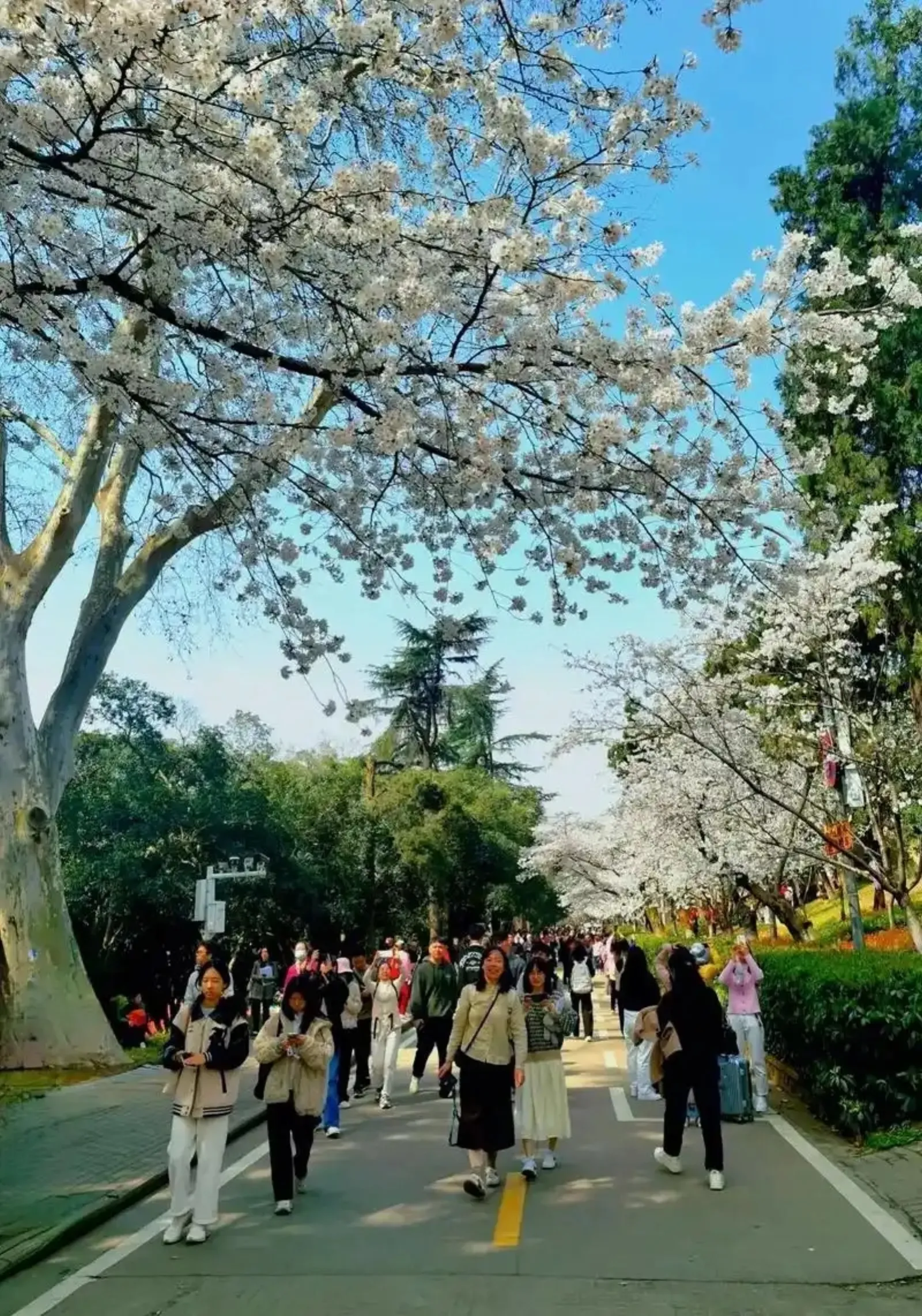
Cherry Blossom Avenue in late March: 1,000 trees blooming at once, framed by 1930s academic buildings.
I know what you’re thinking. It’s a university. Why are tourists going to a university?
Because Wuhan University isn’t just a university. It’s a 130-year-old institution built on a hill overlooking East Lake, with 1930s stone-and-green-tile architecture, a botanical garden, and 1,000 cherry trees that explode for two weeks every spring. The Chinese media calls it “China’s most beautiful campus”, and for once, the hype is accurate.
I didn’t study here (I went to Wuhan University of Technology, across the river), but I’ve been walking through this campus for eighteen years. I know which path to take when the crowds come, where the quiet benches are, and which building has the best view of the lake.
The cherry blossom madness
The practical version starts here.
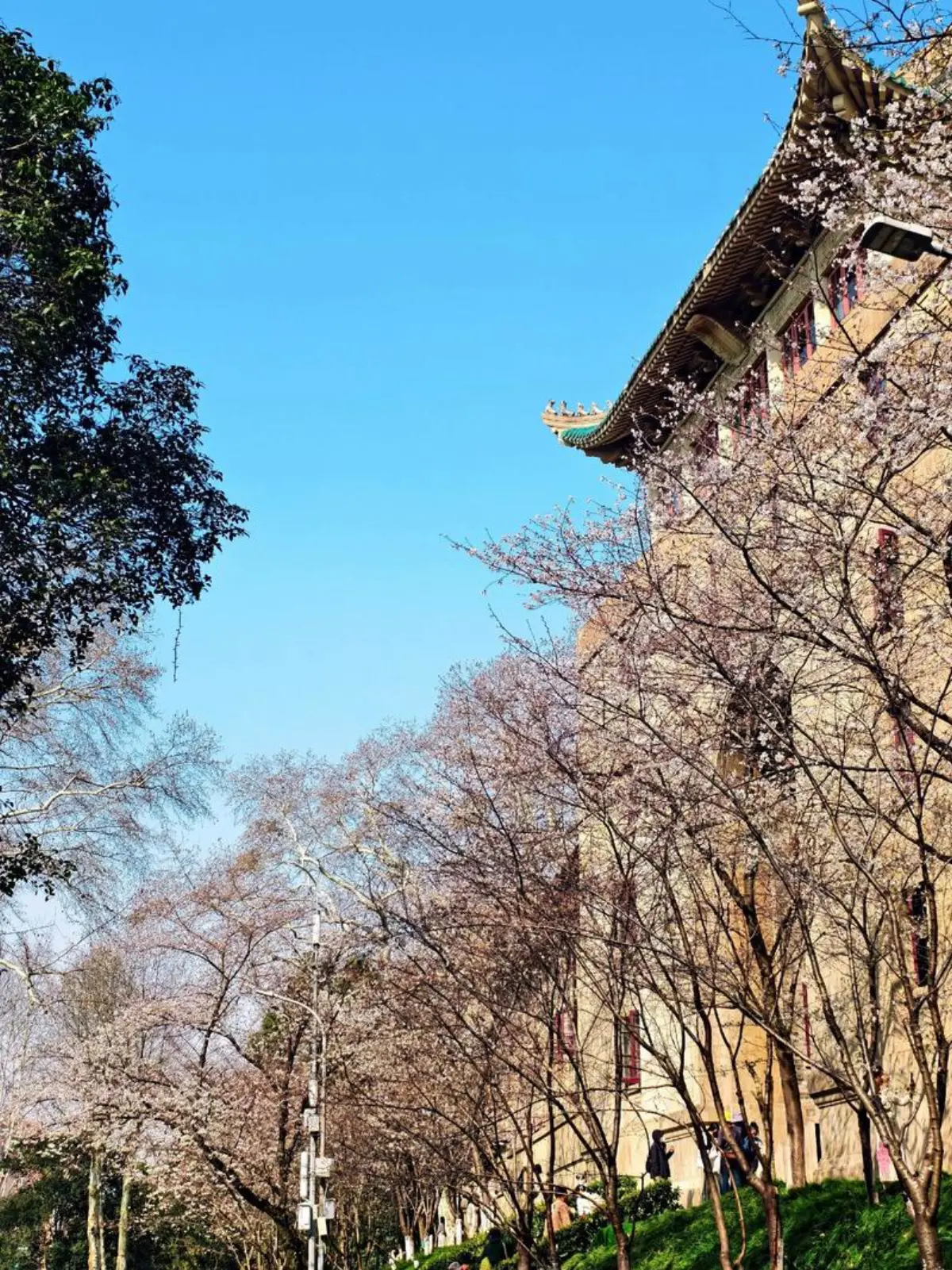
Cherry blossoms arching over the main path: peak bloom lasts about ten days.
When: Mid-March to late March, roughly. The exact peak shifts every year depending on winter temperatures. The university announces the bloom forecast on its WeChat official account (search “武汉大学”) in early March. If you’re planning a trip around it, check that first.
The crowds are real. During peak bloom, the university caps daily visitors at 30,000. You need to make a free reservation through the WeChat mini-program three days in advance. If you show up without a reservation, you will not get in. I’ve watched tourists argue with the guards at the south gate. The guards always win.
The route everyone takes: South Gate → Cherry Blossom Avenue (樱花大道) → Old Library → Luojia Square → East Gate. This takes about 90 minutes if you’re walking slowly and stopping for photos. During peak season, it takes two hours because you’re moving at crowd speed.
The route I take: Enter from the East Gate near East Lake, walk up through the botanical garden, come down via the Old Library, exit through the West Gate near Guangbutun metro. Same flowers, half the crowd, because most tour groups enter from the south and never make it to the garden side.
Is it worth it?
Yes. I’ve seen cherry blossoms in Tokyo, Washington D.C., and Kyoto. Wuhan University’s are different: they’re framed by grey stone academic buildings with green glazed-tile roofs, not by temples or parks. The architecture makes the flowers look more vivid. And there’s something about seeing 1,000 trees bloom on a hillside above a lake that hits different from a flat park.
If you can’t make March, come in October instead. The campus is empty, the ginkgo trees turn gold, and the osmanthus smells like the whole city is baking cookies.
The architecture: 1930s Chinese Renaissance
The cherry blossoms get the Instagram posts, but the architecture is what makes this campus genuinely special. Even without flowers, the buildings are worth a visit.
The Old Library: green-tile double eaves, red pillars, stone steps worn smooth by 90 years of students.
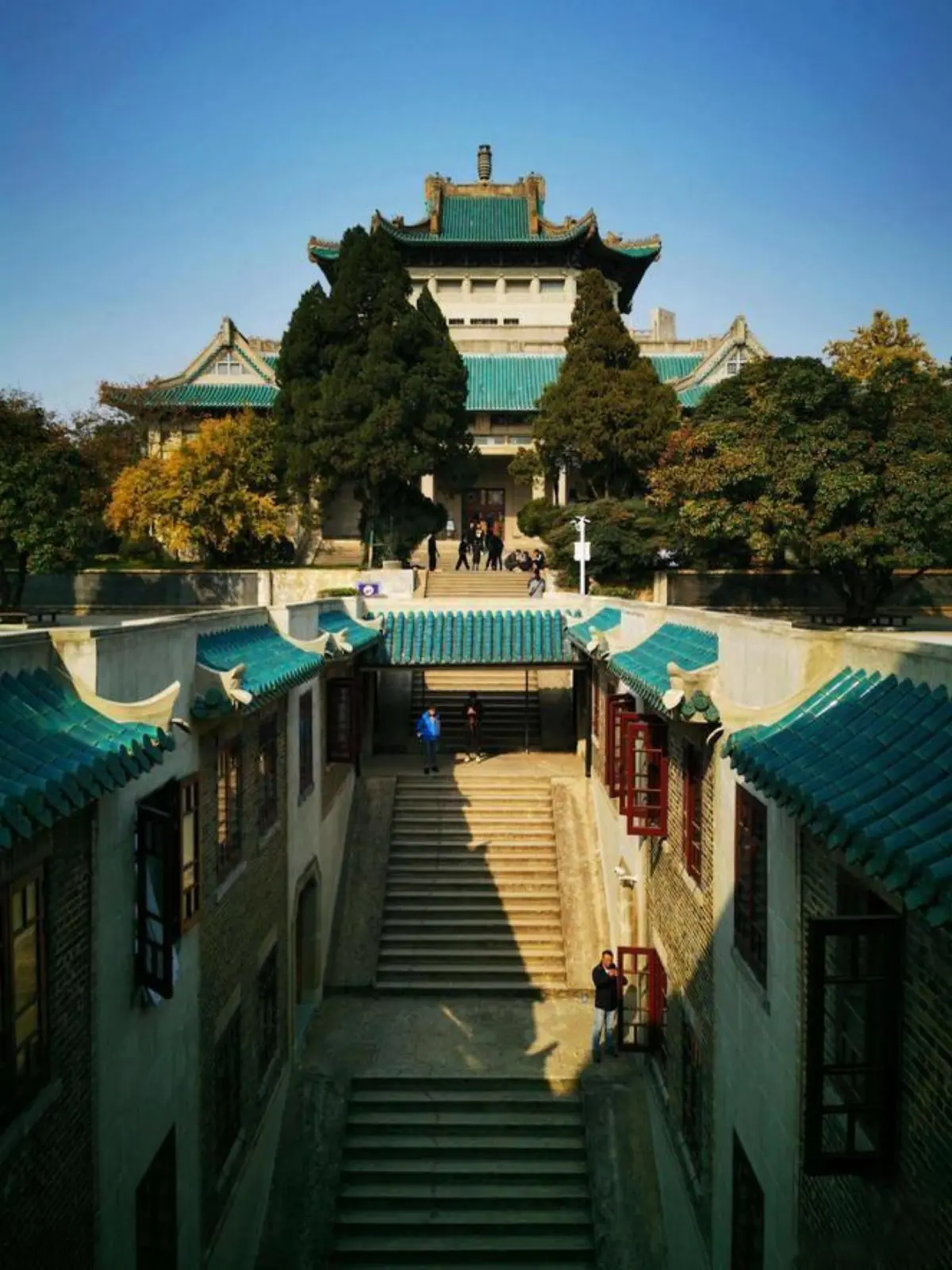
The campus was rebuilt in the 1930s by architects Li Sizu and Kai Cheng, who designed a style they called “Chinese Renaissance”: traditional Chinese rooflines and proportions applied to modern concrete-and-steel structures. The result is buildings that look ancient but function as modern academic facilities.
The Old Library (老图书馆) is the crown jewel. Perched at the top of the hill, it has a double-eaved green-tile roof, red pillars, and stone steps worn smooth by 90 years of students. Climb to the landing in front of it and turn around: you’ll see the entire campus cascading down the hill toward East Lake. This is the view that sells postcards.
The Student Union Building (老斋舍) is a long dormitory row with arched corridors and rooftop terraces. During cherry blossom season, the trees lining the road in front of it form a pink tunnel. Even without the flowers, the arched corridors are a photographer’s dream. The light hits differently at 4:00 PM.
Luojia Square (珞珈广场) is the open lawn at the center of campus. Students play frisbee, practice dance choreography, or nap on the grass. It’s the best place on this campus to sit and do nothing for 30 minutes. There’s a reason Chinese university students call this campus “Luojia Mountain Resort.”
The hill and the lake
Wuhan University sits on Luojia Hill (珞珈山), which rises about 100 meters above East Lake. The campus is built into the hillside, which means you’re constantly walking up and down stone staircases between buildings. Wear comfortable shoes. I’ve seen tourists in heels, and it did not go well.
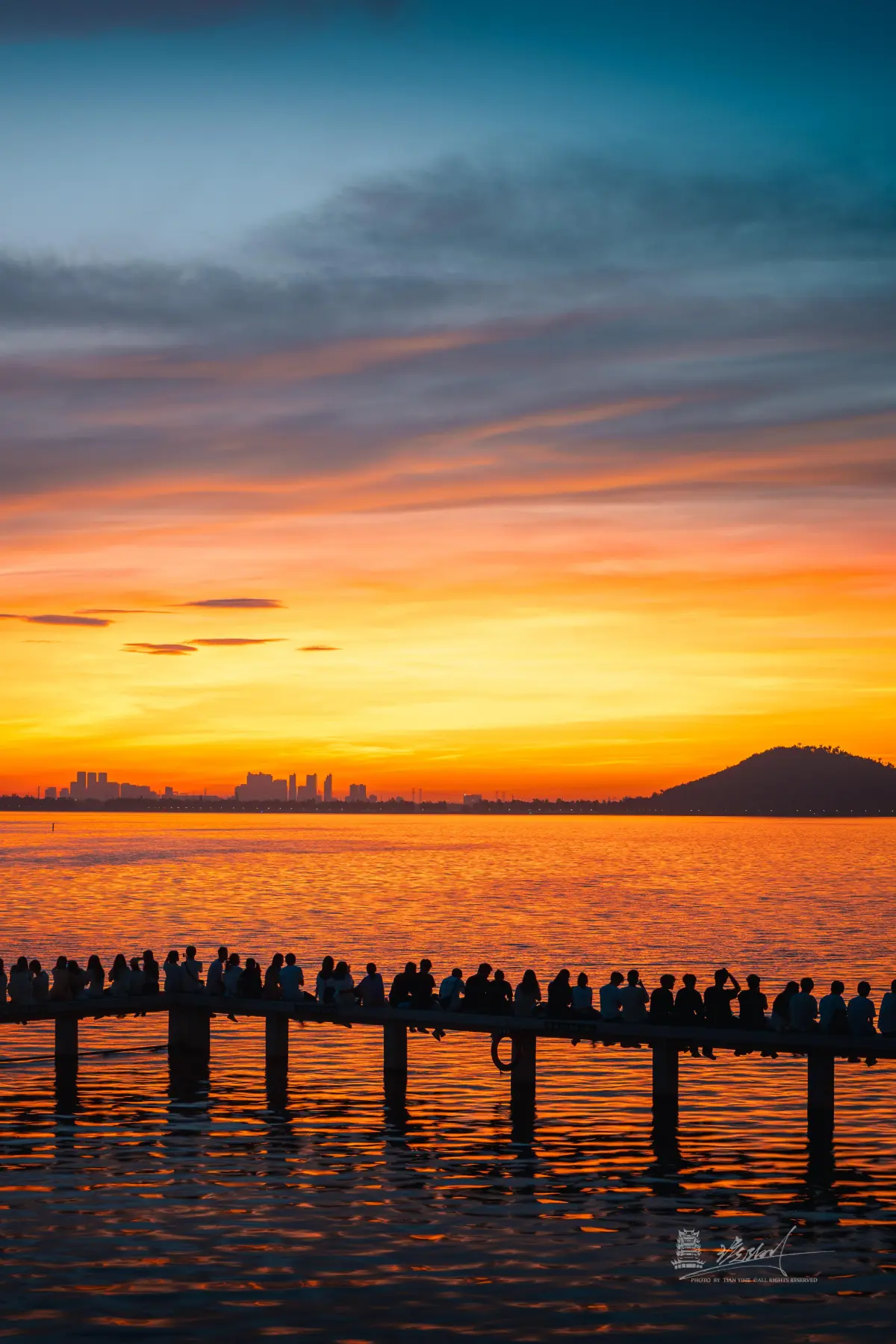
From the hillside path behind the Old Library: all of East Lake opens up below you.
The best views aren’t from the famous buildings: they’re from the paths that run along the hillside’s eastern edge, between the faculty housing and the lake. Walk the path that starts behind the Old Library and heads north. You’ll pass through bamboo groves and eventually reach a lookout point where you can see all of East Lake. On a clear day, you can see the Yellow Crane Tower on the opposite shore, 5 kilometers away.
The campus also has a botanical garden (植物园) on the northwest slope, with 800 species of plants. It’s usually empty because tourists don’t know it exists. Enter from the path near the West Gate, walk for 10 minutes, and you’ll find yourself alone in a forest of camphor trees and magnolias.
Practical info
| Item | Details |
|---|---|
| Entry | Free, but reservation required during cherry blossom season (mid-March) |
| Reservation | WeChat mini-program “武汉大学”: 3 days in advance during bloom |
| Hours | 6:00 am-10:00 pm (outside bloom season, walk in freely) |
| Metro | Line 2, Guangbutun Station (广埠屯站), then 10-min walk to West Gate |
| Best season | March (cherry blossoms) or October (ginkgo + osmanthus) |
| Time needed | 1.5-3 hours |
| Food | Student canteens are cash-only and sometimes require a student card. Eat before you come, or walk 5 minutes to the restaurants near the East Gate. |
| Photography | Allowed everywhere. Drone photography is prohibited. |
Studied here? Have a favorite corner of the campus I missed? Email me. I always look for excuses to go back.
Related:
-
Wuhan’s Universities: Why 1.3 Million Students Call This City Home: Wuhan University is just one of 84 campuses in the city
-
East Lake: Wuhan’s Green Heart: the campus sits on the lake’s western shore
-
3 Days in Wuhan: A Local’s Itinerary: the university is Day 2 evening
-
Yellow Crane Tower: Beyond the Poem: visible from the campus lookout on a clear day
-
Wuhan’s Year: Festivals and Events Calendar: cherry blossoms are March’s main event, but the whole year has a rhythm
-
Hot Dry Noodles: Ultimate Guide: grab breakfast before you come