
The temples nobody talks about
If you search “Wuhan temples” in English, you’ll find almost nothing. The travel guides skip them. The tourist itineraries don’t include them. Most foreigners who visit Wuhan leave without knowing the city has active Buddhist temples that are older than the United States.
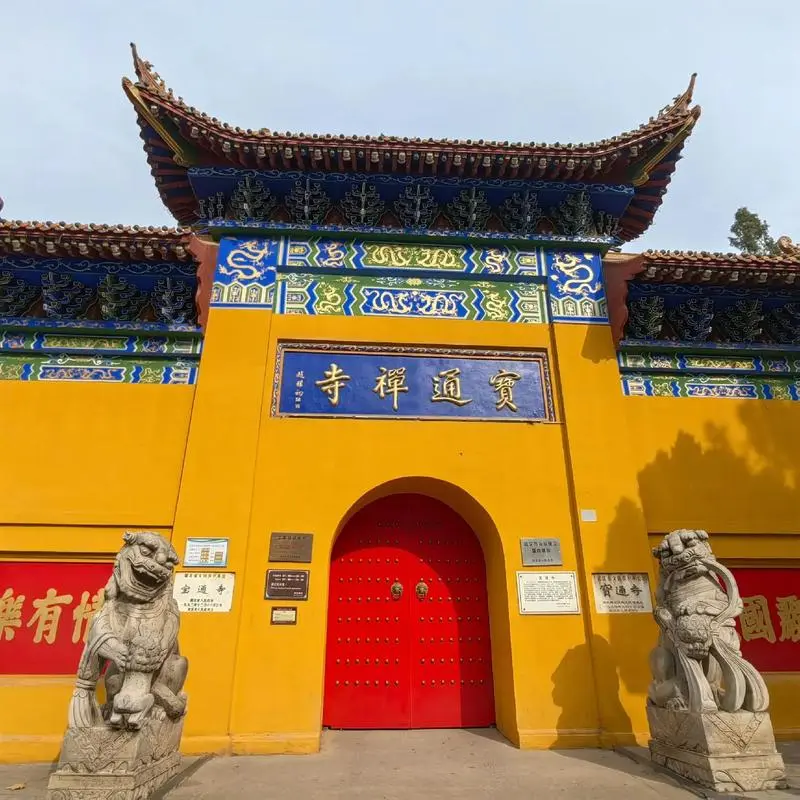
I get it. Wuhan isn’t known for temples. It’s known for noodles, for the 1911 revolution, for the Yellow Crane Tower (which is not a temple, despite what some tourists think). The city sells itself on food and history, not spirituality. And the temples here aren’t grand complexes like Beijing’s Lama Temple or Hangzhou’s Lingyin. They’re smaller, quieter, and less photogenic.
That’s why you should go.
The two temples worth visiting are Guiyuan Temple (归元寺) in Hanyang and Baotong Temple (宝通寺) in Wuchang. They’re on opposite sides of the city, they belong to different Buddhist traditions, and they feel completely different from each other. Together, they tell you something about Wuhan that the noodle stalls and the riverfront don’t.
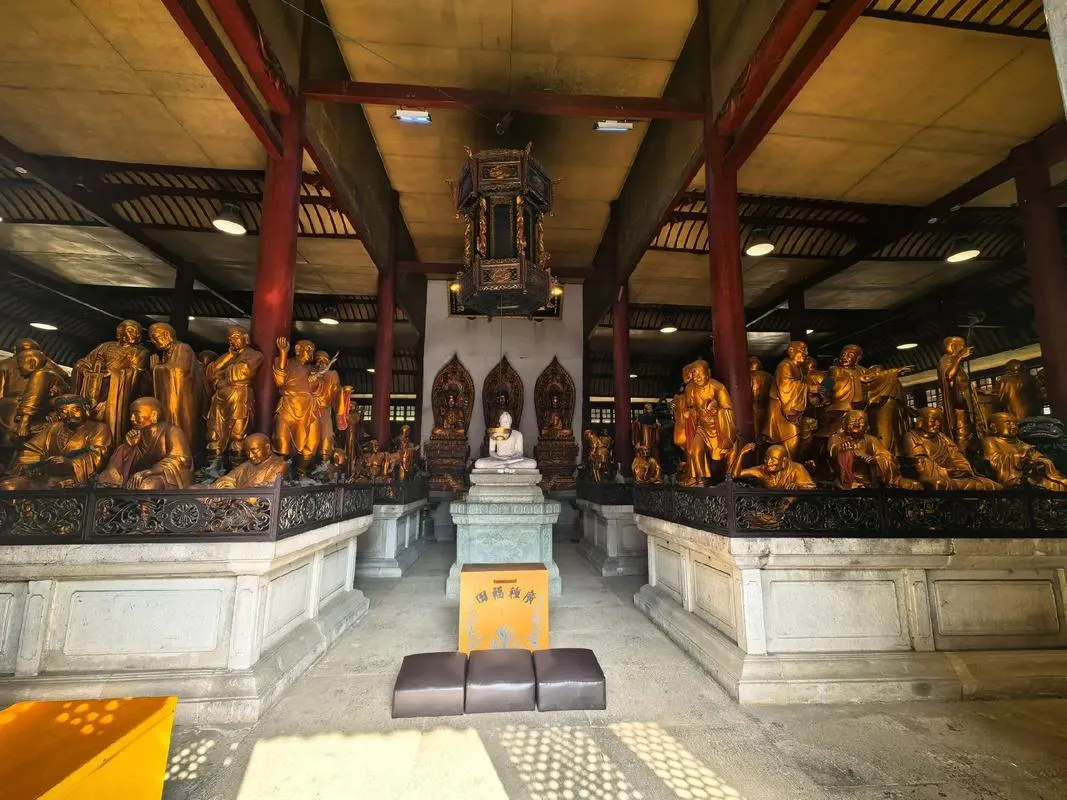
Incense smoke at a Wuhan temple, 300 years of burning, still not optimized for tourists.
Guiyuan Temple: the arhat count
Guiyuan Temple is in Hanyang, about a 15-minute walk from the Yangtze River Bridge. Founded in 1658, during the early Qing Dynasty, it’s one of the “four great Buddhist temples of Wuhan”, a label that sounds impressive until you realize most Wuhan residents can’t name the other three.
The temple complex is not large. You enter through a gate, cross a courtyard, and you’re in the main hall. Incense smoke hangs in the air while monks in grey robes sweep the stone floors. The murmur of sutras comes from somewhere you can’t see. It takes 20 minutes to walk the entire grounds at a normal pace.
The reason to come is the Arhat Hall.
The Arhat Hall contains 500 golden statues of arhats, enlightened disciples of the Buddha, each one with a different facial expression. Some are laughing, some are scowling, some look bored, and some look like they’re about to tell you a joke. The statues are arranged in rows, filling a large rectangular hall, and the effect of walking in and seeing 500 golden faces staring at you is something I can’t describe well in writing. It stops you in the doorway for a second.
There are 500 golden arhats, each with a different face, and you count to your age to find yours.
Here’s the ritual: you find the statue labeled with the year you were born. You start counting from that statue, moving clockwise, one statue per year of your age, and the one that corresponds to your current age is “your” arhat. The expression on its face tells you something about the year ahead.
I’ve done this four times and my arhat has been different each time. Last year, he was scowling. The year before, he was smiling. I can’t say the predictions have been accurate, but that’s not the point. The point is the act of counting. You walk slowly through 500 golden faces, touching each one with your eyes, and by the time you reach yours, you’ve forgotten whatever you were thinking about when you walked in.
Is this Buddhist theology? No. It’s folk religion dressed up in Buddhist clothing. The monks don’t endorse it. They tolerate it. The counting ritual is what brings people in: on weekends, the Arhat Hall is full of families, couples, and solo visitors all counting silently on their fingers.
The vegetarian canteen
Guiyuan Temple has a vegetarian canteen that’s open to the public. It’s in a side building, unmarked, and you’ll only find it if someone tells you it’s there. I’m telling you it’s there.
The food is Buddhist vegetarian: no meat, no garlic, no onions, no pungent roots. Tofu, mushrooms, lotus root, bamboo shoots, soy-based mock meats. The lotus root dishes are the best thing on the menu. They come stir-fried with a light sauce that lets the crunch and the subtle sweetness of the root come through. I’ve eaten here maybe ten times, and I’d rank it above half the restaurants in Wuhan.
A full meal costs 15 yuan. You sit at a long table with whoever else is there: monks, temple volunteers, elderly regulars, the occasional confused tourist. Nobody talks much. The food arrives on metal trays, you eat, you return the tray, and you leave.
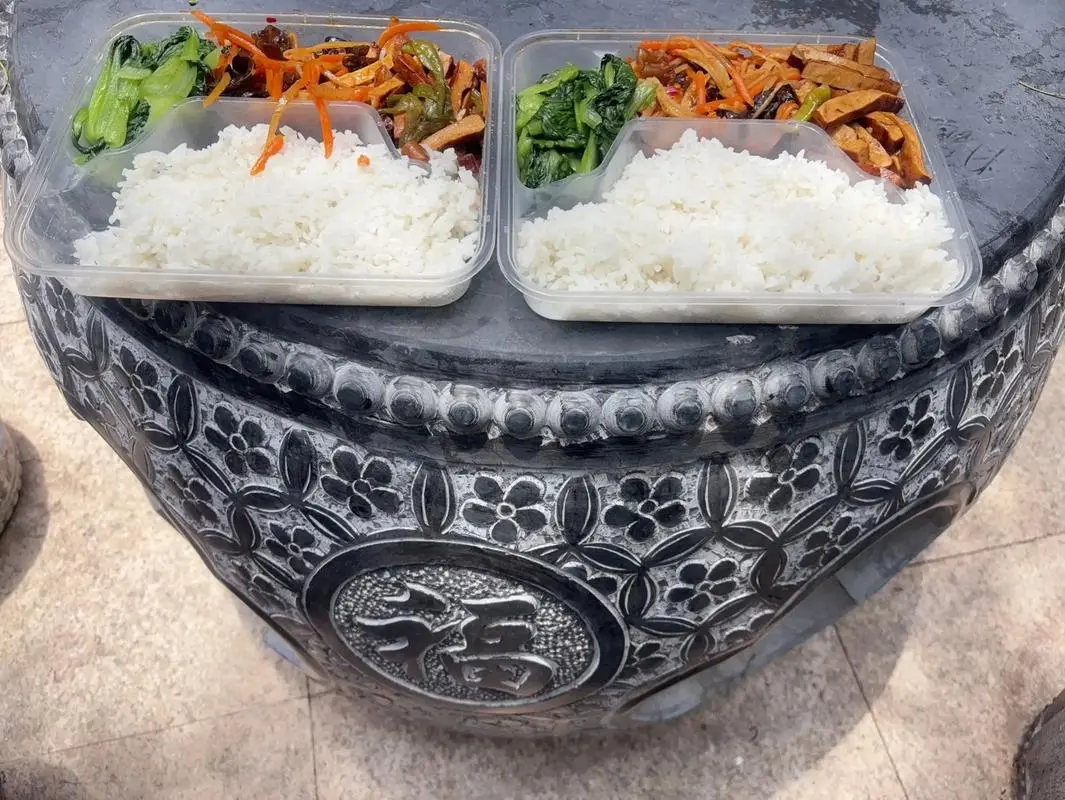
15 yuan, metal trays, lotus root stir-fry. The best meal in Hanyang might be at a temple.
Baotong Temple: the pagoda on the hill
Baotong Temple is in Wuchang, on the southern slope of Hongshan (洪山, “Flood Mountain”). It’s older than Guiyuan. The original temple dates to the Southern Dynasties period, around 420-589 AD, making it roughly 1,500 years old. The current buildings are Qing Dynasty reconstructions, but the site has been continuously occupied by a temple for a millennium and a half.
The temple sits on a hillside, which means you climb as you go. The layout is vertical: gate at the bottom, main hall in the middle, pagoda at the top. Stone steps connect the levels, worn smooth by centuries of footsteps. Old cypress trees line the path, their trunks twisted into shapes that look deliberate, as if someone bent them on purpose hundreds of years ago.
The main hall is active. Monks chant here twice a day: once at dawn, once at 4:00 PM. If you time it right, you’ll hear the chanting before you see the hall. It’s not a performance. It’s not for tourists. The monks are doing what they do every day, and you’re allowed to stand at the back and listen.
At the top of the hill is the Hongshan Pagoda (洪山宝塔), built in 1271 during the Yuan Dynasty. It’s seven stories tall, octagonal, brick and stone, with narrow windows on each level. You can climb it. The staircase is a steep, narrow spiral, barely wide enough for one person. The view from the top is worth the climb: Wuchang spread out below, the Yangtze visible to the north, East Lake to the east.
Baotong Temple gets fewer visitors than Guiyuan. On a weekday morning, you might have the grounds to yourself. The monks sweep the courtyard and incense burns at the altars. Cats sleep on the warm stone steps. It’s the quietest place I’ve found in Wuhan, and I include the lakes in that assessment.
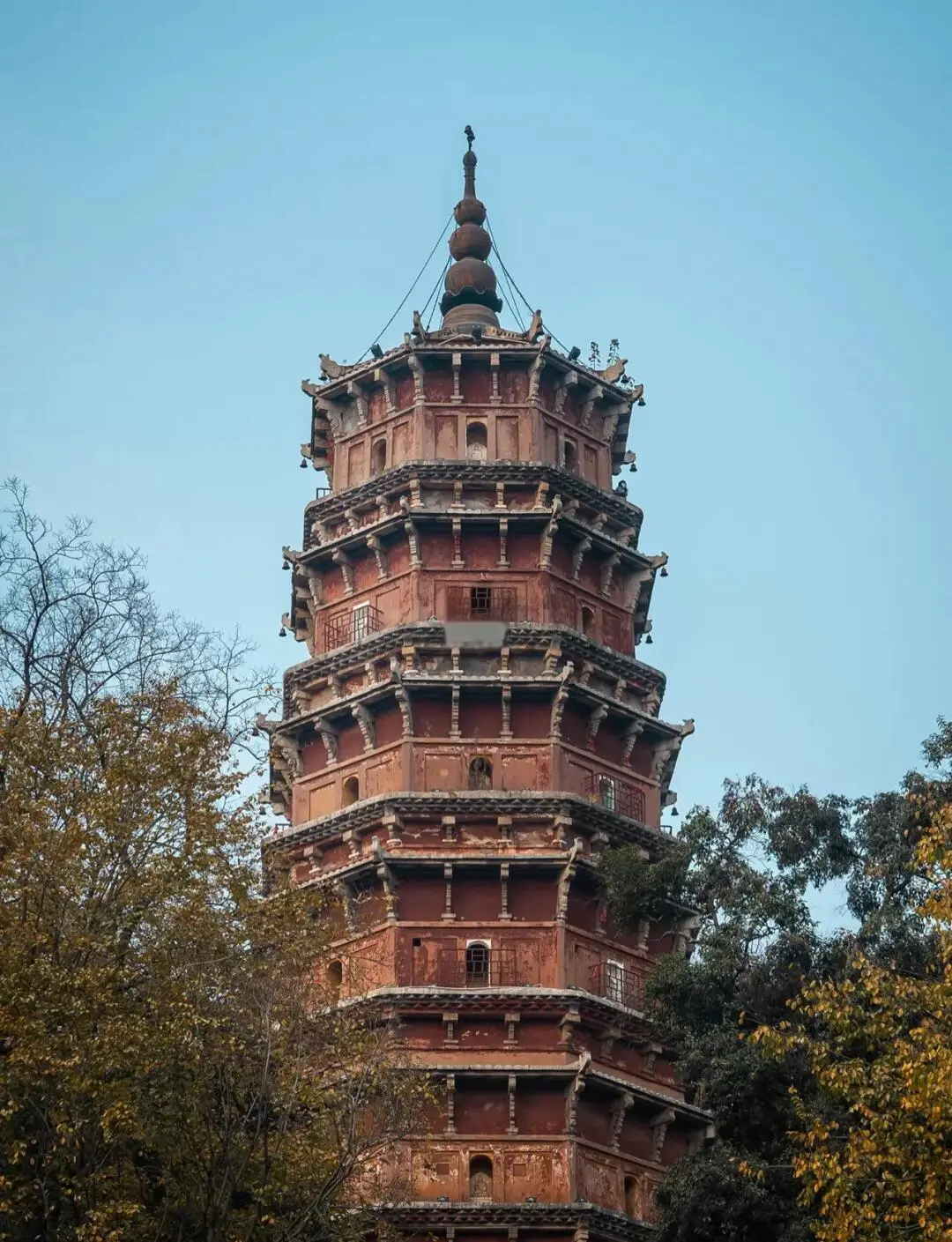
The Hongshan Pagoda, seven stories, built 1271, climbable if you don’t mind narrow spiral stairs.
What makes these temples different
I’ve been to temples in Beijing, Shanghai, Hangzhou, Suzhou, and a handful of smaller cities, and in those the famous ones have been optimized for tourism. Ticket booths, audio guides, gift shops, photo spots, “incense experiences” where an attendant lights a giant bundle for 100 yuan and tells you to make a wish. The temples are beautiful, but they feel like museums with monks.
Wuhan’s temples haven’t been optimized. Guiyuan Temple charges 10 yuan at the door. That’s it. No tiered pricing, no “premium experience,” no guide offering to explain the statues for 200 yuan. The incense is free: there’s a box of thin sticks near the main hall, and you take what you need. The monks don’t pose for photos. They sweep, they chant, they eat in the canteen, they ignore you.
Baotong Temple charges 10 yuan as well. The ticket booth is a wooden window with a person inside who hands you a paper ticket. There’s no gift shop. The only thing you can buy is incense, from an unattended stall where you drop coins into a box and take a bundle.
This won’t last. China’s tourism industry is relentless, and eventually someone will decide these temples need to be “developed.” But for now, in 2026, they’re still what they’ve been for centuries: places where people go to burn incense, count arhats, eat vegetarian food, and sit quietly. Not attractions. Temples.
The other two
For completeness: the “four great Buddhist temples of Wuhan” also include Lianxi Temple (莲溪寺) in Wuchang and Zhengjue Temple (正觉寺) in Hankou. Lianxi is small, primarily a nunnery, and rarely open to casual visitors. Zhengjue was largely destroyed during the Japanese invasion and rebuilt on a smaller scale. Neither is worth a special trip unless you have a specific interest in Buddhist architecture. Guiyuan and Baotong are the two that matter.
Practical info
| Item | Guiyuan Temple (归元寺) | Baotong Temple (宝通寺) |
|---|---|---|
| Location | Hanyang, Cuiwei Road 20 | Wuchang, Wuluo Road 549 |
| Entry | 10 yuan | 10 yuan |
| Hours | 8:00 AM-5:00 PM | 7:00 AM-4:00 PM |
| Metro | Line 4, Qiaokou Road, 10 min walk | Line 2, Baotong Temple Station, 5 min walk |
| Best time | Weekday morning, quiet | 4:00 PM for chanting |
| Vegetarian food | Yes, canteen, 15 yuan | No |
| Climb | Flat | Uphill, ~150 steps to pagoda |
| Time needed | 1-1.5 hours | 1.5-2 hours |
How to combine them: You can’t, not in one trip. They’re on opposite sides of the city. If you’re following my 3-day itinerary, Guiyuan fits on Day 2 (the Hanyang afternoon), and Baotong fits on Day 3 (the Wuchang morning). If you only have time for one, pick Guiyuan. The arhat hall and the vegetarian canteen are experiences you can’t get elsewhere.
Etiquette: Dress modestly (no shorts, no tank tops, they’ll lend you a wrap if you forget). Don’t photograph the monks without asking. Don’t point the soles of your feet at the Buddha statues. If you want to burn incense, take one or two sticks, not a handful. The temples are not museums. People worship here.
Wuhan’s temples are one layer of the city’s culture. Read more: Hanyang’s history (where Guiyuan Temple sits), Wuchang’s 1,800-year story (where Baotong Temple stands), and the Yellow Crane Tower, not a temple, but the landmark that defines Wuchang’s skyline.
Related:
-
Hanyang: The Iron Works That Forged Modern China: the town where Guiyuan Temple sits
-
Wuchang: 1,800 Years from Fortress to Revolution: the town where Baotong Temple stands
-
3 Days in Wuhan: A Local’s Itinerary: Guiyuan Temple is Day 2
-
Yellow Crane Tower: Beyond the Poem: Wuchang’s other ancient landmark
-
Walking the Yangtze Bridge at Night: the bridge starts near Guiyuan Temple
-
East Lake: Wuhan’s Green Heart: visible from Baotong Temple’s pagoda
-
Hubei Provincial Museum: 2,400-year-old bells, also in Wuchang
-
Why Wuhan’s Retirees Own This City: temple courtyards are another retiree gathering spot