
There is a specific way to embarrass yourself on your second morning in Wuhan, and it involves a bamboo steamer.
You order soup dumplings. The server sets down a basket of seven, each one the size of a small plum, the skin so thin you can see a grey shadow of broth moving inside it. You pick up chopsticks, grip one by the top, and lift. It comes apart in your hand. Broth runs down the bamboo slats, across the table, onto your sleeve. Across from you, a man who has lived here for forty years watches this with no expression whatsoever and says nothing at all.
He is being kind. I have watched visitors do this roughly three hundred times.
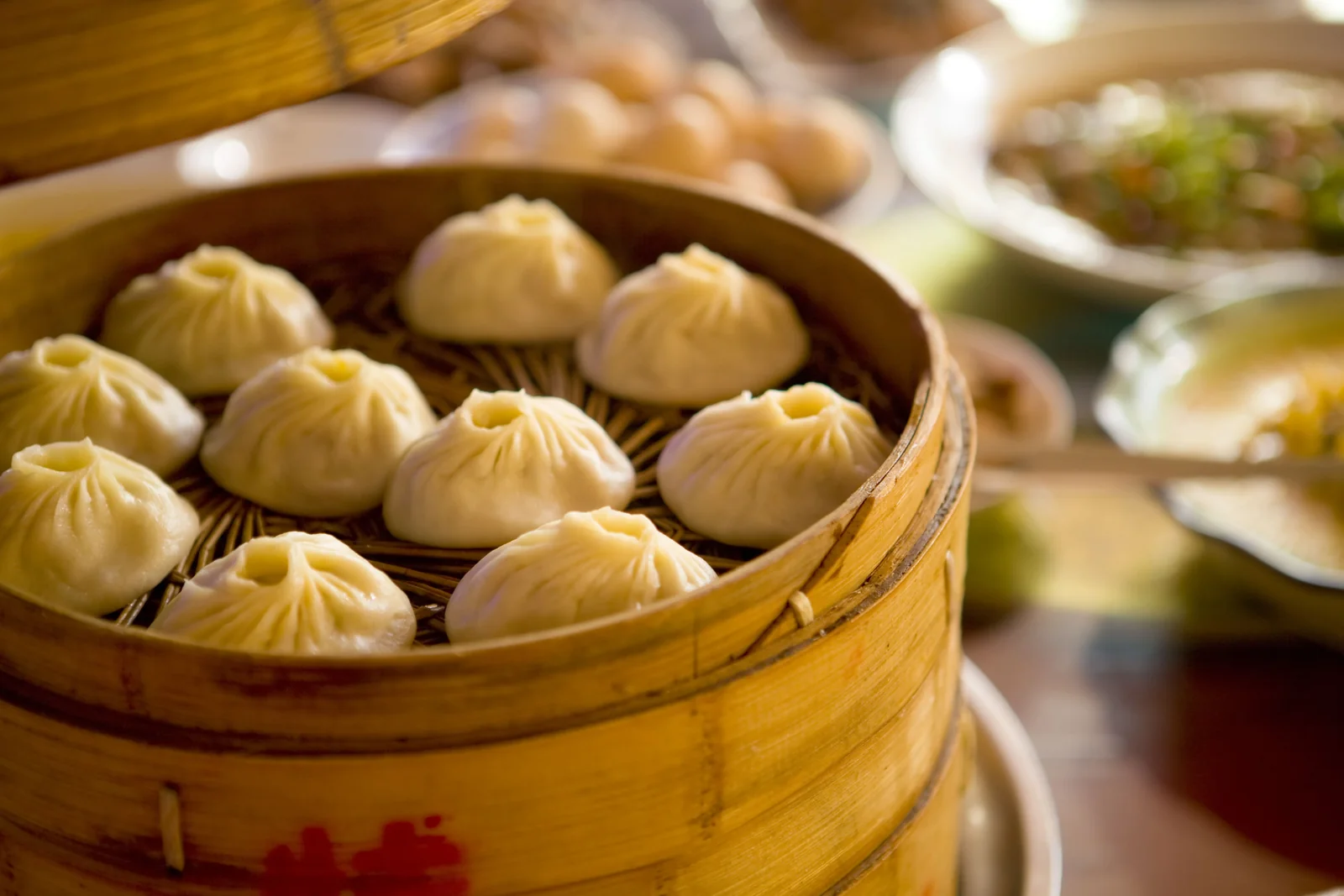
Let me name the confusion first, because everything else follows from it. Wuhan soup dumplings are 汤包, tangbao. Almost nobody outside China knows that word, so you search for “xiaolongbao in Wuhan” and end up with a different dumpling entirely. Shanghai xiaolongbao are small and delicate, folded into a little pouch with a knot pinched at the top so you can lift one without touching the skin. Wuhan tangbao run about twice the diameter, with a skin that is thicker and floppier. There is no knot on top to grab. The broth is pork bone and gelatin, heavier and less sweet than the Shanghai version.
You cannot pick one of these up. It is a spoon food or a disaster, and nothing in between.
Both kinds show up in the same basket on the counters I walk through in my Wuhan breakfast culture guide, and people still mix them up on their fourth visit.
What is actually inside
The soup is the whole point, and it starts three hours before anyone folds anything.
Pig trotter skin goes into chicken broth over low heat for close to three hours until the collagen dissolves. You strain it, cool it, and it sets into a clear jelly. That jelly is chopped and folded into seasoned pork. Then the whole thing goes into a wrapper and hits the steamer, and the heat does the rest: the jelly melts back into liquid inside the dumpling.
This is why a good tangbao sloshes when you shake the plate, and why a bad one does not. It is also why the soup tastes like broth rather than like seasoned water. You are drinking concentrated stock that was made hours before you walked in.
The meat is pork leg, and the old standard at Siji Mei was pork leg with a finger’s worth of fat across it, trimmed to exactly that. Too lean and the filling dries out in the steamer. The fat is what keeps it moist.
The word that will trip you up most
Here is a genuinely bad piece of news for anyone reading menus in Wuhan.
In standard Mandarin, 水饺 (shuǐjiǎo) means dumplings. The crescent-shaped boiled or fried ones you have probably eaten in Beijing or Seoul. But in Wuhan dialect the same two characters mean 馄饨, which is a wonton. A thin-skinned wonton in clear broth.
谈炎记 (Tán Yánjì), one of the city’s heritage shops and founded in 1920, built its whole name on Wuhan-style 水饺. It is a bowl of soup with soft wonton folds floating in it.
So if you point at 水饺 on a Wuhan menu expecting crescents, you get handed a soup, and you will spend ten minutes trying to work out what you did wrong. I have watched people blame the restaurant. It is not the restaurant.
Every other food word has a similar trap sitting behind it, and I have mapped the ones that cost visitors the most time in my Wuhan dialect survival guide. Learn about six of them before you arrive and the whole city gets easier to order.
How to eat one without ruining it
The crab roe tangbao makers in Jingjiang, on the other side of the Yangtze, summarise the whole method in twelve characters: lift gently, move slowly, open a window first, suck the soup after. That is the technique in full, and it takes about forty seconds once you have done it twice. Here is how it works in practice.
Set the plate on a tea cup. Sounds strange. It raises the basket a few centimetres and stops it rocking while you work, which means the broth does not slosh out the moment you puncture the skin.
Add the ginger and vinegar. Shredded ginger plus dark vinegar, mixed in the dish. The vinegar is black rice vinegar if you have the choice. Ginger cuts the fat, vinegar sharpens the pork, and the soup is rich enough that it needs both.
Open a window, not a hole. Nibble a small opening in the top edge where the skin meets the pleated side. Avoid the middle entirely, because that is where the pocket of broth sits and a hole there means you lose it down your chin.
Wait. The steam inside is genuinely hot. Give it a few seconds or you will scald the roof of your mouth and lose the taste for the next four.
Seal the opening with your lower lip and suck. Let the broth run into your mouth rather than slurping at the hole. This part feels undignified. Everyone’s lap is doing the same thing at the same table.
Then eat the wrapper and the meat, dipped in the ginger vinegar. By this point the skin has soaked up broth and the inside wall is coated in it. That skin is the best part and the part most visitors throw away.
Three things to skip: do not spear one with chopsticks, do not bite straight through the middle, and do not use a drinking straw. You will find videos online of people sucking the soup out through a straw. That is a Shanghai-area party trick, it is not the Wuhan method, and the straw punctures a wrapper that was pleated to hold.
If you want to see what the rest of the city’s breakfast order looks like next to this one, hot dry noodles are the direct rival and completely different in every respect that matters.
Siji Mei: the reference point
四季美 (Sìjìměi) opened in 1927 on Zhongshan Avenue near the Jianghan Road intersection in Hankou. The name means good food in all four seasons. It earned the title 汤包大王, king of soup dumplings, when the in-house chef turned a Jiangsu xiaolongbao recipe into a Wuhan one and made it work at a larger scale.
Seven pieces to a basket, ginger and vinegar on the side, pork leg filling. Crab roe, shrimp, mushroom, minced chicken and mixed varieties all sit on the same menu, and every one of them is built the same way.
The folding is the part that takes training. A group of American students were once taken through it at this counter and watched the cooks work, and the count they came away with was at least eighteen pleats per dumpling. They were told to try it themselves. The verdict from the visitors was that it is not easy.
A Hubei television editor who is also an intangible heritage holder has spent years studying this shop. His description goes like this: the skin is thin as a cicada wing, you can lift it and it hangs like a pouch, open a small mouth and suck the broth, and the fragrance is fresh enough to knock your eyebrows off.
The shop sits on Jiqing Street now, the 民俗街 heritage food street in Hankou, where Laotongcheng (老通城) has its doupi counter at one end and Siji Mei has its tangbao baskets at the other. Both are near Jianghan Road if you are already walking that way, which you probably are, since I have a full guide to Jianghan Road and the streets around it.
Budget around 26 yuan a head there, and you will be properly fed for that money.
What locals actually eat
Here is the part most heritage write-ups skip. The old names are still worth one visit, but nobody in Wuhan is arguing about Siji Mei any more. The daily argument is about which neighbourhood shop has the better stock.
Wansongyuan is the loudest of them, three streets of food that the local government helped designate as Hubei’s first Dianping must-eat street back in 2020. 雪松路, 万松园横路 and 劲松巷, packed end to end, and packed again after dark. You will find crab claw noodles, crayfish and grilled skewers there alongside the tangbao stalls.
Shops worth the walk, prices from Dianping listings:
| Shop | Where | Per head |
|---|---|---|
| 四季美 Siji Mei | Jiqing Street | ¥26 |
| 今楚汤包 Jin Chu | Xuesong Road, Wansongyuan | ¥25 |
| 高记陋室汤包 Gao Ji | Zhangzhidong Road | ¥24 |
| 易胖汤包 Yi Pang | Beihu Zheng Street | ¥22 |
Wansongyuan also does a tomato soup dumpling, which sounds like a gimmick and absolutely is not. The sour-spicy broth cuts through the pork fat and it is the version I order when I want tangbao but have already eaten hot dry noodles that morning.
The reason these street shops keep beating the heritage name is freshness. Tangbao has a short window where the skin is right and the soup is still hot. A shop doing high volume folds continuously and sells what it made fifteen minutes ago. A famous shop with a queue out the door is selling what it made an hour ago, held in the steamer to keep the count.
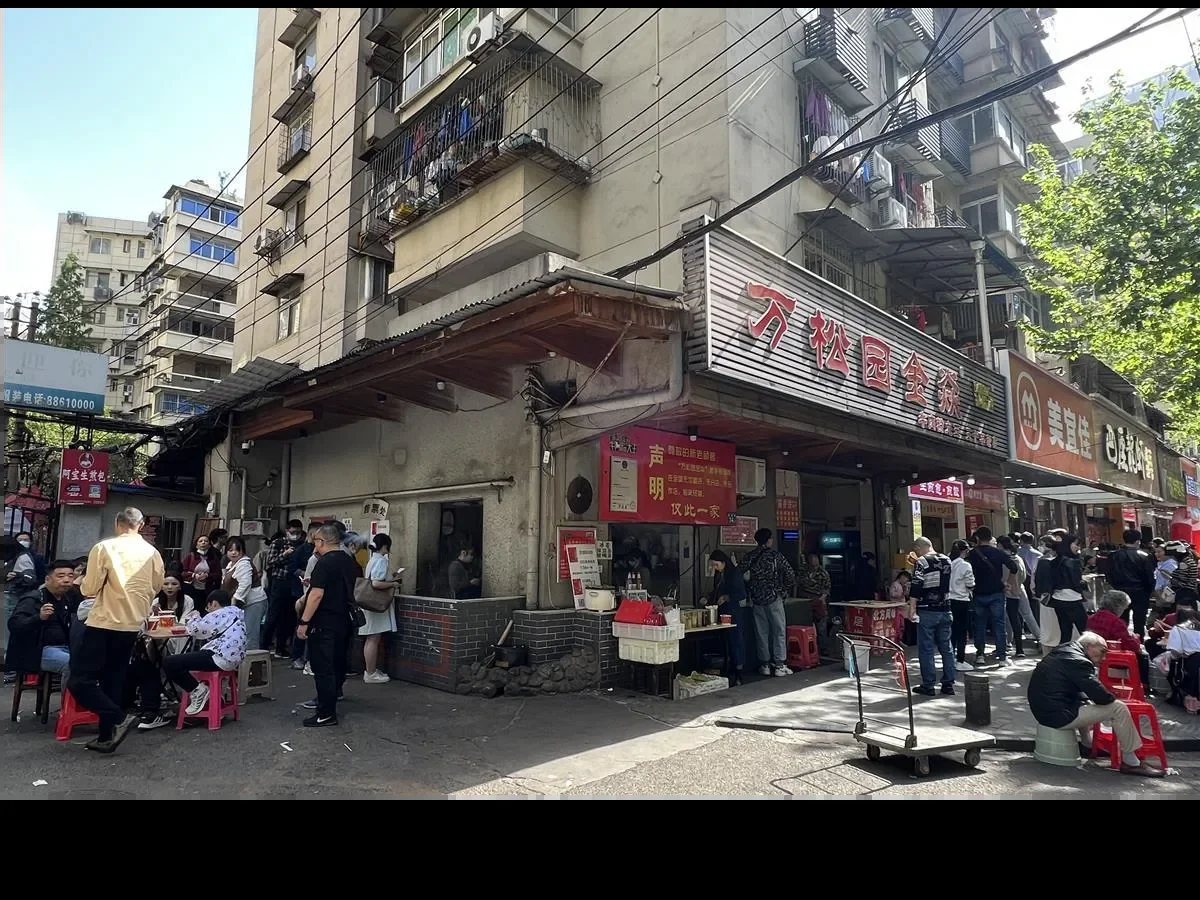
If you are here for the street food scene rather than the monuments, my night market guide covers the other half of the city’s eating day. Breakfast is the half nobody photographs.
Crab roe has a deadline
Everything on the list above you can eat in any month of the year. The crab roe version is a different story.
蟹黄汤包 (xièhuáng tángbāo) is built with roe and meat from Yangcheng Lake hairy crabs, and those crabs are seasonal. The window opens around late September, peaks through October, and closes as the supply thins through November.
So if you want crab roe tangbao, October is the month. Not next year in May, not whenever your itinerary happens to land. The dish is genuinely worth it, because the roe adds a second layer of richness to broth that is already pork bone heavy, and the good shops fold them to order rather than batching them.
This is the one thing on this whole list with an expiry date, and it happens to be right now. My autumn guide covers the wider window.
Ordering, Phrased for a Foreign Speaker
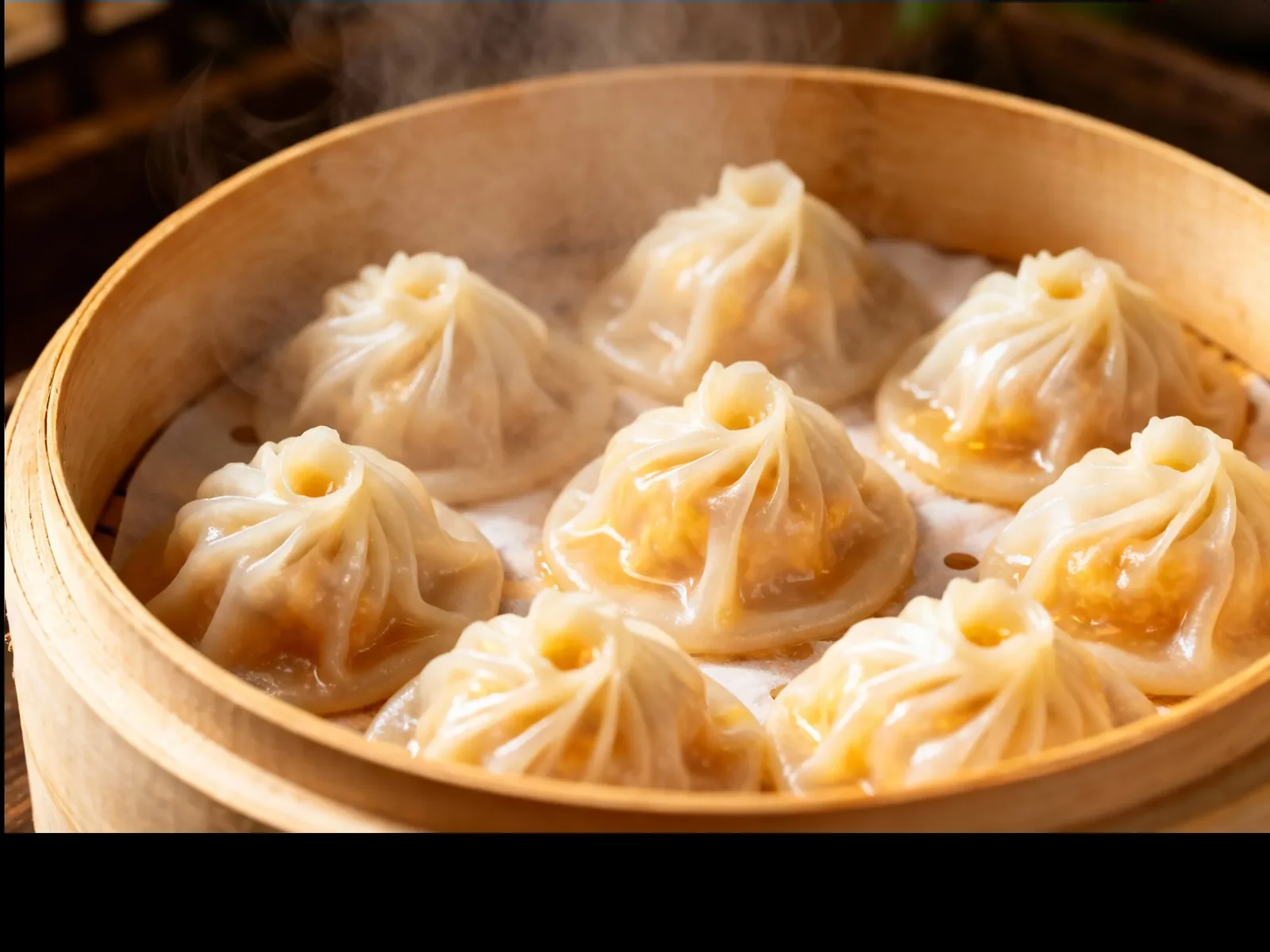
Point at the menu and say this: 一笼鲜肉汤包, one basket of plain pork soup dumplings. 七只 comes as seven pieces.
Start with the plain pork. It is the version that tells you whether the stock is good, and once your palate has the benchmark you can move to crab roe or mushroom with something to compare against.
Ask for 姜丝 and 醋 in a side dish if they do not bring it automatically. They usually do, but not always at the smaller shops.
Eat them while they are still hot. Fifteen minutes after they land, the wrapper has gone soft and lost the slight resistance that makes it good.
What I would skip
Skip the pilgrimage version of this food. There is a reason the four old Wuhan names, Siji Mei for tangbao, 老通城 for doupi, Cailinji (蔡林记) for reganmian and Tanyanji (谈炎记) for 水饺, get treated as a checklist. It turns a street you can eat in into a museum you queue for.
Skip the doupi at Siji Mei’s neighbours as a way to judge tangbao. Different shop, different cook, different job.
And skip anywhere that puts a laminated English menu with a photograph of soup dumplings on the wall near Jianghan Road. The photographs are stock images of Shanghai xiaolongbao. You will get small, delicate, knot-topped dumplings, you will lift them by the top, and you will not be eating Wuhan tangbao at all.
The Honest Summary
A Wuhan soup dumpling is a piece of engineering. Three hours of stock, a jelly that becomes soup in the steamer, and a wrapper pleated tightly enough to hold liquid that would rather be anywhere else. It is the most technically demanding breakfast item in a city that treats breakfast as a civic ritual, and it costs about twenty-five yuan.
Learn the twelve characters. Learn that 水饺 means soup. Go in October if you want the crab roe, go to Wansongyuan if you want the version locals argue about, and give Siji Mei one basket on Jiqing Street because you should see what a ninety-nine year old shop does with the same three ingredients.
Then do not wear a pale shirt. I cannot stress this enough.