
Every Saturday and Sunday morning before the sun clears the office towers on Jiefang Avenue, something happens in Wuhan’s People’s Park that you won’t find in any guidebook.
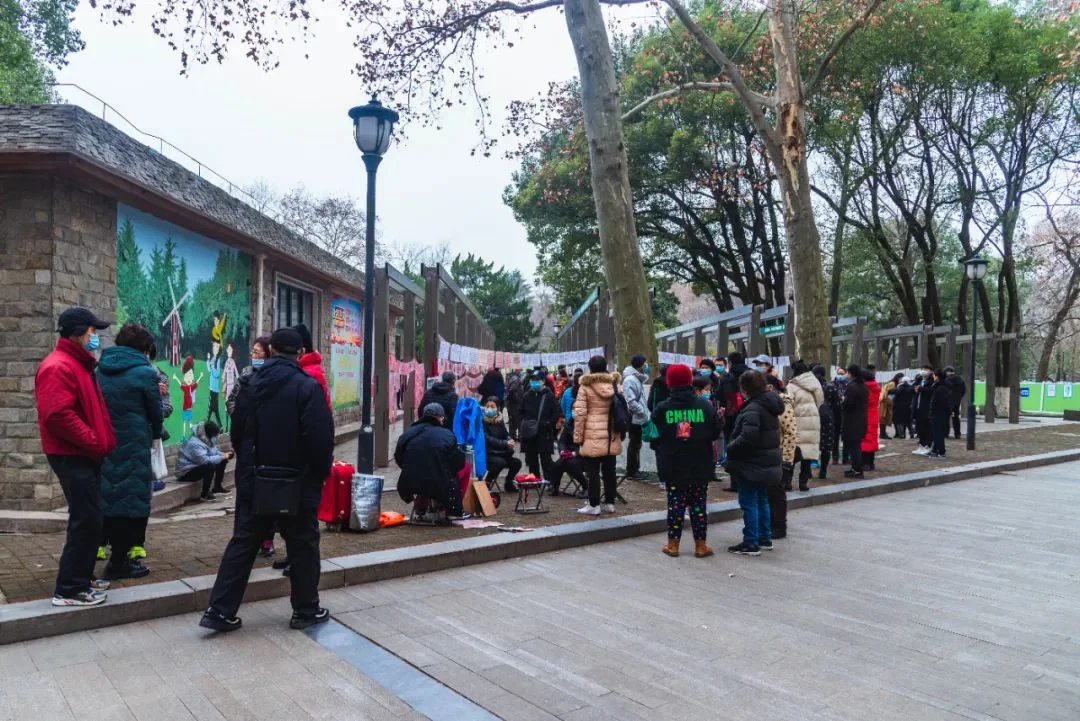
Wuhan’s People’s Park on a Saturday morning. A4 CVs dangle from willow branches, and every sheet is a parent’s entire emotional portfolio.
Parents show up with folders, binders, and plastic document sleeves. They unroll white sheets of A4 paper, each one a printed resume detailing the vital stats of their unmarried child: age, height, weight, monthly salary, apartment ownership status, and star sign. Some laminate their sheets. Others use ring clips. Then they pin them to tree trunks, spread them on park benches, or string them on clotheslines tied between willows.
Each A4 sheet is a human being reduced to data points. And the parents who hold them have to defend that data against total strangers who will, in the time it takes to smoke a cigarette, decide if their child is good enough for their daughter. Or, more often, utterly not.
This is Wuhan’s marriage market (相亲角, or “matchmaking corner”). If you walk through it on a weekend morning, you’ll come away with a sharper understanding of how middle-aged Wuhanites think about love, class, and the entire point of getting married than you’d get from a year of dating locals.
When I visited last Saturday, the first thing I noticed was how quiet it was. No shouting, no chaos. Just fifty or sixty middle-aged people standing in a loose grid, reading, like a library where every book is a human being reduced to a salary figure and an apartment size.
A 33-year-old Hankou local who asked to be called Mr. Zhang, in software sales and divorced, told me: “The divorced guys come here because nobody else will introduce them to anyone. It’s not shameful. It’s realistic.”
1. The basics: what you actually see
Head to People’s Park (人民公园), the big green space in Hankou near Jianghan Road. The matchmaking corner sets up along the paved paths near the main entrance on the park’s eastern side. Any time after 9 AM on a weekend, you’ll see clusters of parents hovering over handwritten boards and printed sheets. Some sit on tiny folding stools. Others stand in tight circles, comparing their kid’s CV to someone else’s with the intensity of used car inspectors checking an engine block.
The format is always the same: a single sheet listing Name (often redacted or listed as “Male A” / “Female B”), Age, Education (university tier matters a lot), Job (government and state-owned enterprise are gold stars), Height, Income, and Property ownership. Specifically, does this person own an apartment, and if so, in which district.
Walk the circuit for twenty minutes and you’ll notice patterns.
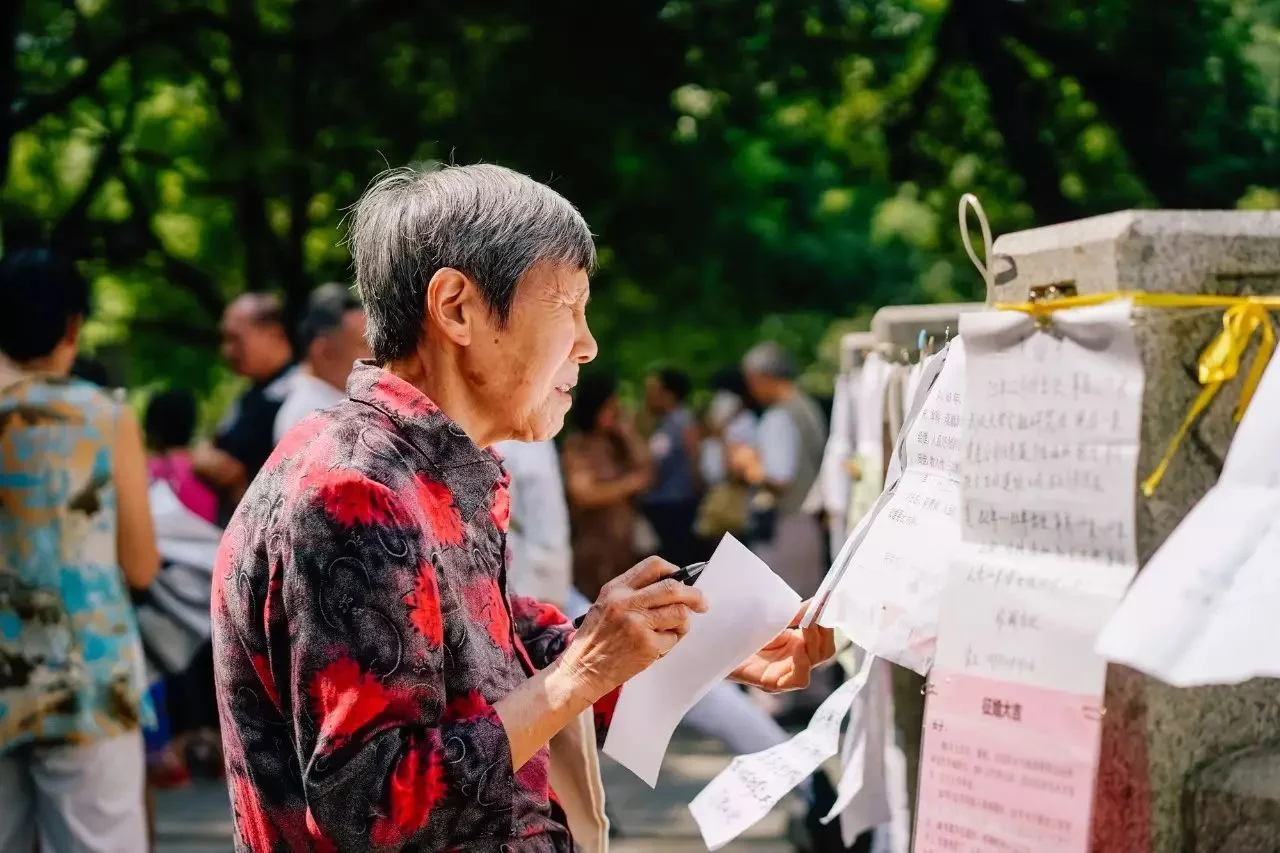
One mother has been reading CVs every Saturday for eighteen months. “Good ones get taken within twenty minutes, so you have to be early,” she tells me.
Most of the CVs are for women in their late twenties and early thirties, and most of the parents are mothers. The fathers tend to hang back and smoke, only stepping in when the conversation gets to “does he own property.” Almost every sheet lists the Wuhan district of residence: Hankou (汉口区) is valued over Wuchang (武昌区) in the park’s internal pecking order, and anything outside the Third Ring Road gets a visible wince.
But the real story is in what the parents do.
They intercept each other in the path. “What’s your daughter’s income?” they’ll ask a total stranger, mid-stride. They read CVs at arm’s length and frown, then move on. They stand in small groups with other parents and loudly compare stats, the way Wuhan aunties compare vegetable prices at the morning market. They haggle. They make offers. They walk away.
And all of this is happening on behalf of children who, in many cases, fully know their parents are here. The kids themselves rarely show up.
2. The real economy behind the A4 sheets
“Face value” at the marriage market is a specific math problem, and every parent who’s been coming here for a few weeks can recite it fluently.
First question: Does he own an apartment?
Not “does he own a home.” In Wuhan’s marriage market, only a Wuhan apartment counts. Parents from outside provinces (Jiang Hunan, Henan, Anhui) learn this the hard way. Your son might own a lovely flat three hours away, but the auntie reading his CV will simply move on. Wuhan only. Ideally Hankou.
Second: What tier of university?
Wuhan has China’s densest concentration of universities, so the benchmark is fierce. Tsinghua and Peking University are the ceiling. Wuhan University and Huazhong University of Science and Technology, both local, get strong approval. Third-tier colleges get a polite nod and no callbacks. The interesting part is the “Overseas Master’s Premium”: if the CV says a year abroad, it adds roughly the same negotiating weight as thirty square meters of extra floor space.
Third: Government or private sector? (体制内 is the magic word. Anyone who works in a government agency, public institution, or state-owned enterprise is called a 体制内 worker, and this caps CVs. A 体制内 CV with an apartment is the marriage market’s equivalent of a royal flush.)
Fourth: age. For women, this is the tightest number. Thirty is the cliff edge you’ll hear referenced constantly. “Still fine at thirty,” one auntie told me, drumming her fingers on her niece’s laminated sheet. “After thirty-five? Forget it.”
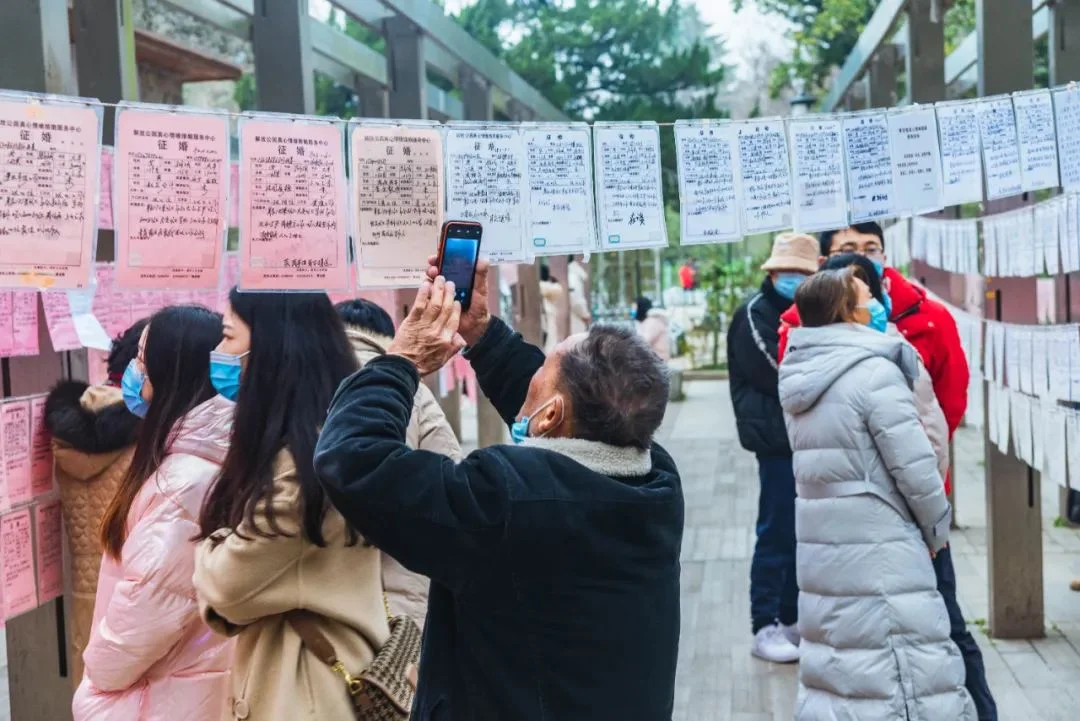
Every sheet lists the vital stats: age, salary, apartment ownership in which district. Laminated sheets signal a serious, long-term campaign by the parents.
“在婚姻市场上,女的二十八岁是个分水岭,三十岁是个悬崖。男的能宽容几年,但有房的男的根本不用来这个地方。”
“In the marriage market, twenty-eight is the watershed for women and thirty is the cliff edge. Men get a few more years of tolerance, but a man who owns an apartment doesn’t need to come here in the first place.”
That’s what one regular parent told me. She comes every Saturday and has done so for two years.
3. The parents who stay for years
Not everyone at 相亲角 is a first-timer testing the water. A core group of about fifty or so come every week, some for up to five years. Why so long?
One woman, hovering over a handwritten poster titled “Female, 34, Master’s, Bank Employee,” explained it plainly. Her daughter had graduated, worked, become financially independent, and, in her daughter’s view, simply not met anyone she wanted to marry. “She says she’s not in a hurry,” the mother told me. “I’m in a hurry.”
Another father, a retired factory worker with a creased jacket and a Wuhan University graduate son who was already thirty-five, had been coming for four years. The son had explicitly asked him to stop, but the father came anyway. “He doesn’t understand,” the father said, still holding his son’s CV. “His mother and I married at twenty-three. We don’t get why he can’t just pick someone.”
The generational chasm between these parents and their children is the actual story. Most of the parents shaping this market belong to a generation who didn’t so much choose their spouse as accept the arrangement that came to them: a work unit’s matchmaker, a cousin’s friend, a neighbour. They genuinely believe marriage is a practical thing you do, like buying insurance, and they cannot comprehend why their children treat it as something to be “felt into.”
Their children, meanwhile, mostly see the marriage market as a form of emotional warfare waged on their behalf without permission. Relationships sour over it. Parents who find matches find their kids “go through the motions”: first dates that end after the parents’ prescribed three-meeting rule. Every family here has a story that started with a park CV and ended in the same silence the CV was meant to fill.
4. The red ladies (红娘) and their paper kingdom
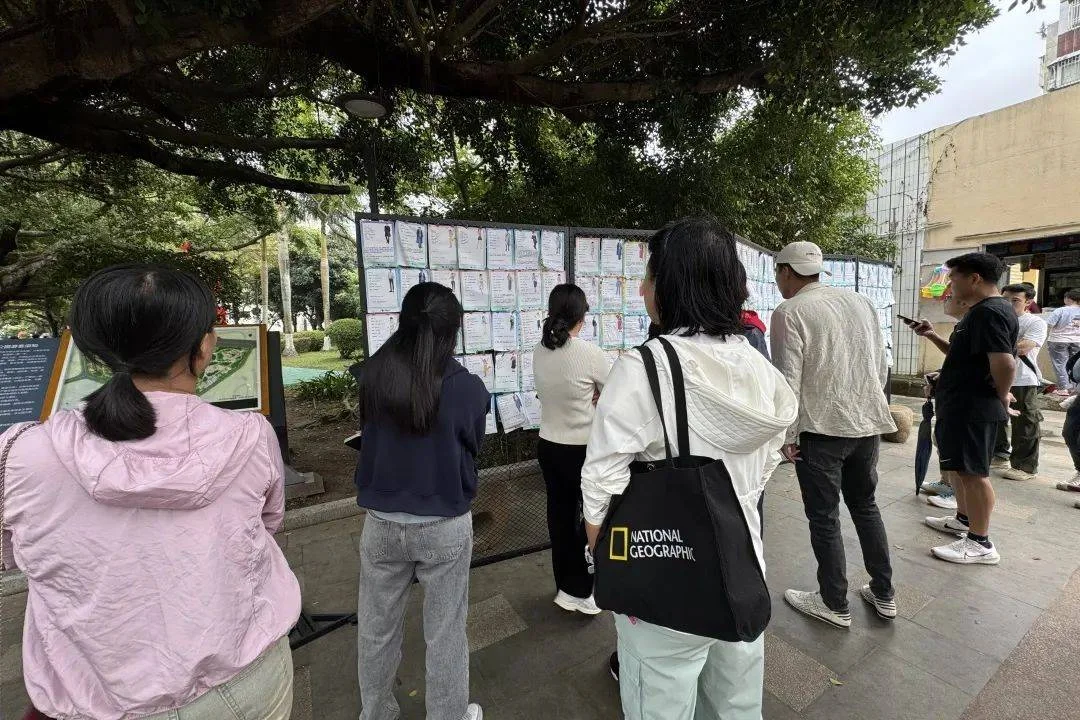
A retired factory worker checks names against her handwritten database. She has been here every Saturday for four years. Her son asked her to stop. She comes anyway.
Not all the players here are parents. A cluster of self-styled matchmakers (红娘, “red ladies”) operate small stalls or clipboards, collecting CVs for a fee and running speed matching sessions in side gardens.
They talk a good game. One red lady I interviewed claimed she had arranged over four hundred marriages. Her rate was 2,000 yuan up front, another 3,000 upon success. She carried a binder organized by district and salary bracket, a real Excel-sheet-in-the-wild of Wuhan singles. She had rules: no one under a third-tier university, one free “rescission” (cancel and restart), and a hard cut-off of thirty-five for women.
“She doesn’t believe in personality,” one onlooker quipped from the next bench.
The red ladies are polarizing. Parents who have come for months without a single callback are vulnerable to the promise of professional matchmaking. But the red ladies’ interest is in matches, not marriages. Sustainable marriages are bad repeat business.
5. The kids who actually walk through
For all the parental chaos, there are a handful of unmarried adults who come, either out of curiosity, resignation, or to confront their parents in person.
One woman, a thirty-two-year-old English teacher who asked to be called Xiao Liu, told me she came to “size up the competition.” She walked the circuit for an hour. She found the experience degrading and also, she had to admit, intriguing. Another, a thirty-seven-year-old software engineer, told me he came because his mother kept hanging his CV without permission. “I’m here to take it down,” he said. He didn’t end up taking it down.
The emotional experience of walking through 相亲角 for someone of matchmaking age is a specific vertigo. You see yourself reduced on paper. You watch people perform instant rejection on strangers as casually as ordering breakfast. And you absorb the fact that in your parents’ generation’s eyes, romantic love, the kind you’ve been waiting for, is a luxury consideration at best and a self-indulgent fantasy at worst.
A young woman reading a cluster of male CVs, holding her own CV behind her back, told me: “You come here thinking, ‘I’m better than this.’ Five minutes later, you realize you are this.”
6. Why Wuhan’s version is different
Marriage markets exist in Beijing’s Zhongshan Park, in Shanghai’s People’s Square, in virtually every Chinese city with a park and a population of worried parents. But Wuhan’s version has a few local flavors.
First is the sheer density. Wuhan has over seven hundred thousand university students at any given time, one of the highest concentrations in China. Every year, a large percentage graduate and stay. This has created an unusually large pool of educated, semi-employed twenty-somethings whose parents, also Wuhan-born, refuse to let them marry “down” or “out.” The market’s volume is bigger than in many peer cities, and the tone is more Hankou-centric than most.
Second is the reganmian (热干面) factor, or more precisely, the casual conversational style of Wuhan aunties. The bluntness of the Wuhan matchmaking corner is less filtered than in Shanghai. Your salary? Stated out loud. Your waist size? Mentioned as though it were a shoe size. Your parents’ retirement plans? Fair game. The conversation around age limits, height requirements, and “proper” districts has none of the euphemism you’d see in a Shanghai park or the softened sales pitch of Beijing.
Third is the humor. Despite the serious stakes (unmarried status is still, in many families, an active source of shame), the park fills with laughter and sarcasm. Parents mock each other’s CVs. They make exaggerated faces at low salary claims. One regular was famous for wearing a sign around his neck that read: “My son has an apartment. It’s in Huangpi. But it counts.”
7. What it tells you about Wuhan itself
Spend a full Saturday morning walking through this marriage market and you’ll understand something about this city that no travel article can capture: the tension between fierce parental pragmatism and genuine, tender worry.
The hard negotiating (the apartment demands, the salary tiers, the age cut-offs) masks the fact that almost every parent I spoke to came out of genuine fear. They’re afraid their child will be alone. They’re afraid that without marriage, their child will lose face in the family network. They’re afraid the paperwork of happiness (the property deed, the joint bank account, the banquet table) will never get filled out.
Wuhan is a city that eats, drinks, argues, and loves loudly. 相亲角 is all of that energy pointed, for once, at the one thing the city can’t entirely shout down: the question of whether someone you raised, someone you love more carefully than they’ll ever know, will be okay when you’re gone.
Walk the park’s eastern paths early on a Saturday morning, and you’ll see the whole city laid bare on white A4 sheets, every hope trimmed, laminated, and pinned to a tree.
--- What these weddings actually look like is in ‘Wuhan Weddings: Red Envelopes, Matchmakers, and the Brutal Arithmetic of a. Approximately 1,800 words. Images: Four A4-sheet close-ups showing real CVs (with faces and names redacted), park wide shots of the matchmaking corner, a parent examining CVs, and a matchmaker’s binder. Estimated reading time: 7 minutes. Word count: ~1,800 main body + excerpts.