
On the third floor of a crumbling walk-up in Qiaokou District, every Tuesday at one o’clock, the elevator doesn’t work so you climb forty-two stairs, push past a door that doesn’t lock, and walk into a living room that smells of cigarettes and 碧螺春 tea.
Four people are already seated. The table has been going since nine in the morning. The players don’t introduce themselves. One auntie barely glances up and just reaches for the next tile. Within two minutes of your arrival, someone’s vacated their seat, and you’re told: “坐. Play.”
Now you’re in the middle of 血流成河 (the Wuhan mahjong variant whose name translates as “Bloody Stream” or “Blood River Flows”) and by the end of your first round, you’ll understand why.
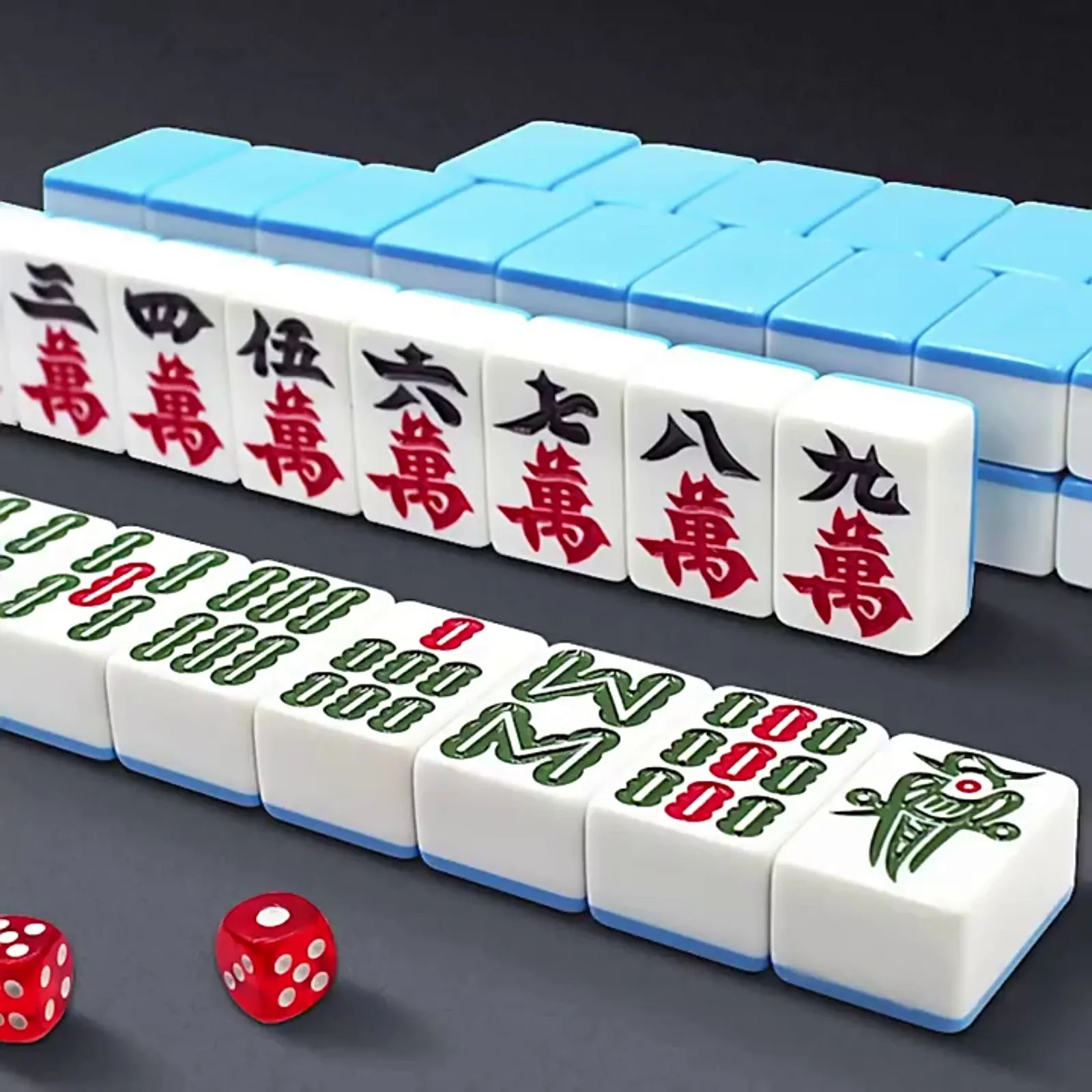
The 108 tiles of Wuhan mahjong: characters, dots, and bamboo, with no winds, no dragons, no flowers. Every tile earns its place. There is no ornament.
1. All mahjong is not the same
If you’ve played Cantonese mahjong (the kind popular in Hong Kong and the Pearl River Delta) or the international tournament standard (MCR from Beijing), Wuhan mahjong will feel like someone turned the dial on “aggression” up by half and “waiting” down to almost nothing.
Wuhan mahjong is played in the 川麻 (Sichuan-style) family but has developed its own local personality. The terms you need are these:
血流成河 might sound violent, but the name reflects the constant flowing of chips, the multiple hu’s in a single hand, the feeling that money keeps moving like a river whether you want it to or not.
The simplest description of 血流成河 goes like this: instead of one winner per round collecting from the losers, you can have two or three winners, and each of them can continue playing to try to win again. A single twenty-minute round might have ten or twelve hu’s declared, and the chips flow spectacularly from one pocket to the next. The maths changes entirely from anything you’re used to.
2. The basic rules that matter
The core structure of Wuhan 血流成河 uses 108 tiles: the characters (万), dots (筒), and bamboo (条) from one to nine, four of each. No winds. No dragons. No flowers.
Why does removing the flowers matter? Because in Wuhan mahjong, streamlining the tiles is the point. Tiles that don’t directly contribute to forming hands are gone. The “ornament” is stripped out. What’s left is aggressive, rapid-fire pattern completion.
缺一门 (missing one suit): Before the round begins, each player chooses one suit they will not use for the round. The entire game must be played on the remaining two suits. You cannot hold a single tile of the suit you declared missing, and once you’ve chosen, that’s locked in for the full four rounds.
缺一门 is the stratagem that defines the local game. It forces every player to frame their entire strategy around two suits instead of three. This speeds up every hand and removes the dithering between multiple options. You commit to a channel and you barrel down it.
查花猪 (pig-check): if someone finishes the round holding tiles from their declared-missing suit (a “pig” outcome), that player pays severe penalties. The “pig” is brutal: you lose big, everyone else wins. The term 猪 is used freely, and you’ll hear it barked across tables.
The defining mechanic is the 血流成河 flow itself. One player declares 胡 (a winning hand) and collects payment according to the hand’s value. But here’s where it gets wild: the round doesn’t end. The other three players continue playing the same hand minus the winner, and if another player declares, they collect from the remaining players. Only when all four players have gone down (or reached a “draw” 黄庄) does the round end. An entire single deal can have four, five, six hu’s stacked on top of each other. The chip count can swing like a cricket score.
…but this would be an over-simplification. The actual mechanism is more subtle.
In practice, the game proceeds in 轮 (rotation-based rounds), each consisting of 圈 (four hands), and the remaining players continue to tile-draw and discard after someone declares, with payout tracked per declaration. The phrase 血流成河 refers to the cascading multiple payments rather than a single continuation per se. A single rotation’s chip count can easily hit triple digits in a low-stakes game, and the round “flows” in multiple directions simultaneously.
3. Why Wuhan plays it this way
The origins are murky. Some players trace 血流成河 back to the 1990s, when central China’s yangtze River ports needed a game that could be played fast, between cargo loads, with a rotating cast of players who came and went from the table as work demanded. Some credit it to the flow of people between Sichuan and Hunan, the two provinces on either side of Wuhan: a hybrid that took the Sichuan framework and stripped it down further.
Wuhan mahjong historian (yes, there is one) Professor Jiang Wei of Wuhan Sports University has written that the local variant “reflects the river city mentality: decisive movement, no waiting, constant action.” The 缺一门 rule, he argues, reflects the city’s tripartite settlement pattern (三镇), in which each of the three towns developed its own identity and the game forces each player to abandon one identity to survive on the other two.
The explanation is poetic and probably partly invented after the fact. But it captures something accurate. Wuhan mahjong is the product of a transit city, a place where people move through, where long slow strategy games wouldn’t have survived, and where the whole point of gathering around a table is not to win once but to sit there for hours.
4. Where the tables are
You don’t “play mahjong in a parlour” in Wuhan as you might in Hong Kong or Taipei. You play in the living room of someone’s grandmother, the back room of a tea shop, the cleared-out storage unit of a factory that closed in 1998, and the balcony of a thirty-floor apartment building. Most famously, you play at fold-out tables set up on the pavement under the cloth awnings of the old alleys.
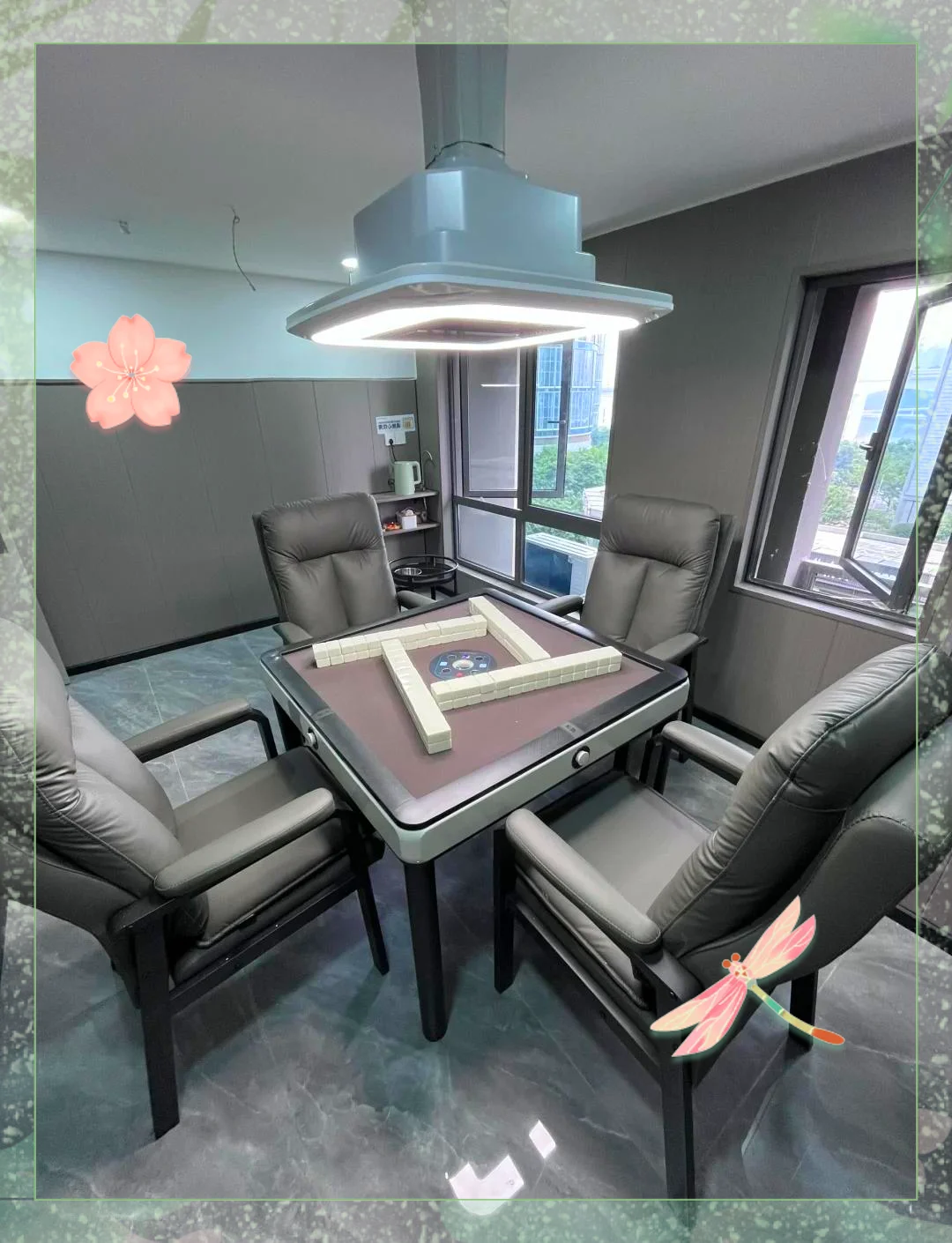
A typical Hankou thirteen-floor walk-up: the lift has been broken since 2015, the tiles since 1998, no signage, no reviews, just the slap of bamboo on wood every Tuesday and Thursday.
In Hankou’s 江汉区 and Qiaokou’s Hanzheng Street (汉正街) area, several of these informal parlours have run for decades. They’re not advertised. They don’t have Yelp pages. You find them by word of mouth or by recognising the sound of tiles being slapped onto a wooden surface at ten in the morning on a Wednesday.
“My table has been here for eleven years. Five twenty-five a seat, three hours. We have one two-hour break for lunch, and bring your own food or eat at the wet market downstairs. Nobody plays under thirty unless it’s with their parents.”
A 58-year-old owner of a Hankou living-room parlour who asked to be called 周姐 (Sister Zhou).
Entry fees vary: 5-10 yuan gives you three to four hours of play. Refreshments are tea, hard-boiled eggs, sunflower seeds, and whatever 咸菜 the parlour owner’s wife has made that morning. The currency is change: 5 元 and 10 元 notes stacked beside each player’s knee.
You can also find games in:
茶馆: Proper tea houses with dedicated tile rooms back from the main hall. These are more expensive (30-80 yuan per head) but offer quieter environments and better tea.
社区活动中心: Community centres in larger residential compounds. Public tables anyone can sit at, but the atmosphere is more muted and less 血流成河.
Street-side tables under awnings: The informal, legendary version. Fast, loud, the players changing every twenty minutes as neighbours drop in. This is the culture’s beating heart.
5. The social atmosphere: sitting at the Wuhan mahjong table
Wuhan mahjong is first and last a social activity. Yes, money changes hands. Yes, tempers flare. But if the gambling were the point, there would be casinos. The point is the table, and at the table, people talk. They gossip about children, neighbours, politicians. They argue about nothing. They comment on your tiles and your face. They insist on handing you 橘子 from their bag without asking. They mock your 缺一门 choice after you inevitably form a “pig” and hold leftover tiles.
For a foreigner, pulling up a seat at a Wuhan mahjong table is one of the fastest ways to be absorbed into local social life. Not because the locals particularly want you there, but because the game creates a structured environment where strangers can sit together for four hours without ever having to do the hard work of small talk. The tiles do it for you.
6. The stakes and the streets
Outside the parlours and the awnings, Wuhan has an active street-culture of pickup games. During summer’s white nights, tables appear on sidewalks all over the city: plastic stools, paper scorecards, the click of tiles mixed with 烧烤 smoke and beer bottles clinking. These games are typically penny-ante: 1-2 yuan per 胡. Nobody gets rich. Nobody goes broke. The evening’s total take rarely exceeds 50 yuan.
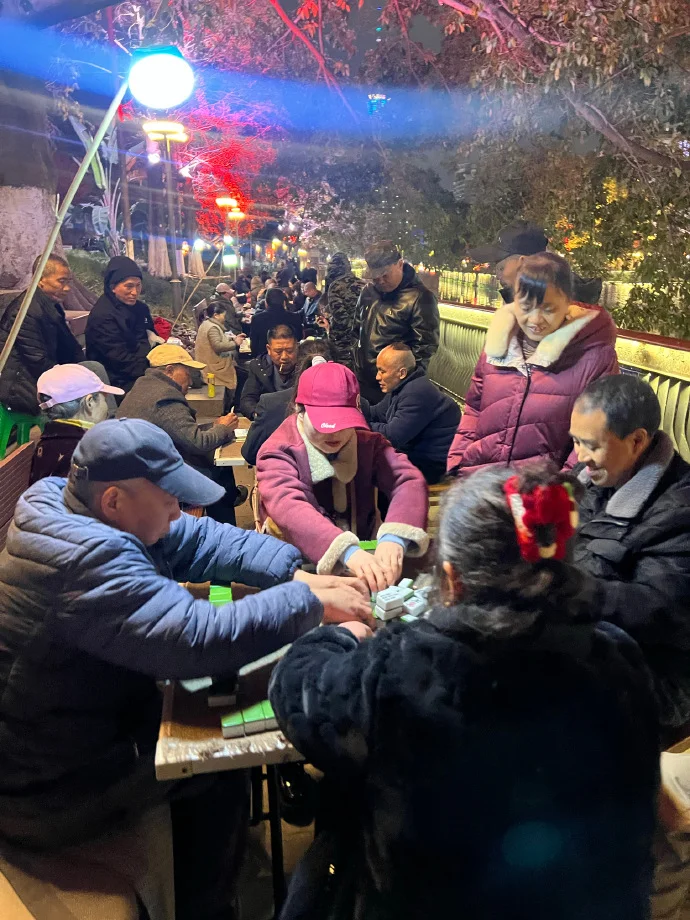
汉正街 street-side table: the evening game runs from seven until one in the morning. The BBQ cart three metres away is not a coincidence.
More serious parlours (the ones in residential high-rises with the doorbells and guards) play at 5-10 yuan per 胡 with multipliers that can push a single round into the hundreds. These are skilled regulars who’ve been playing together for years. The conversation is quieter, the criticisms sharper, the cigarette smoke thicker.
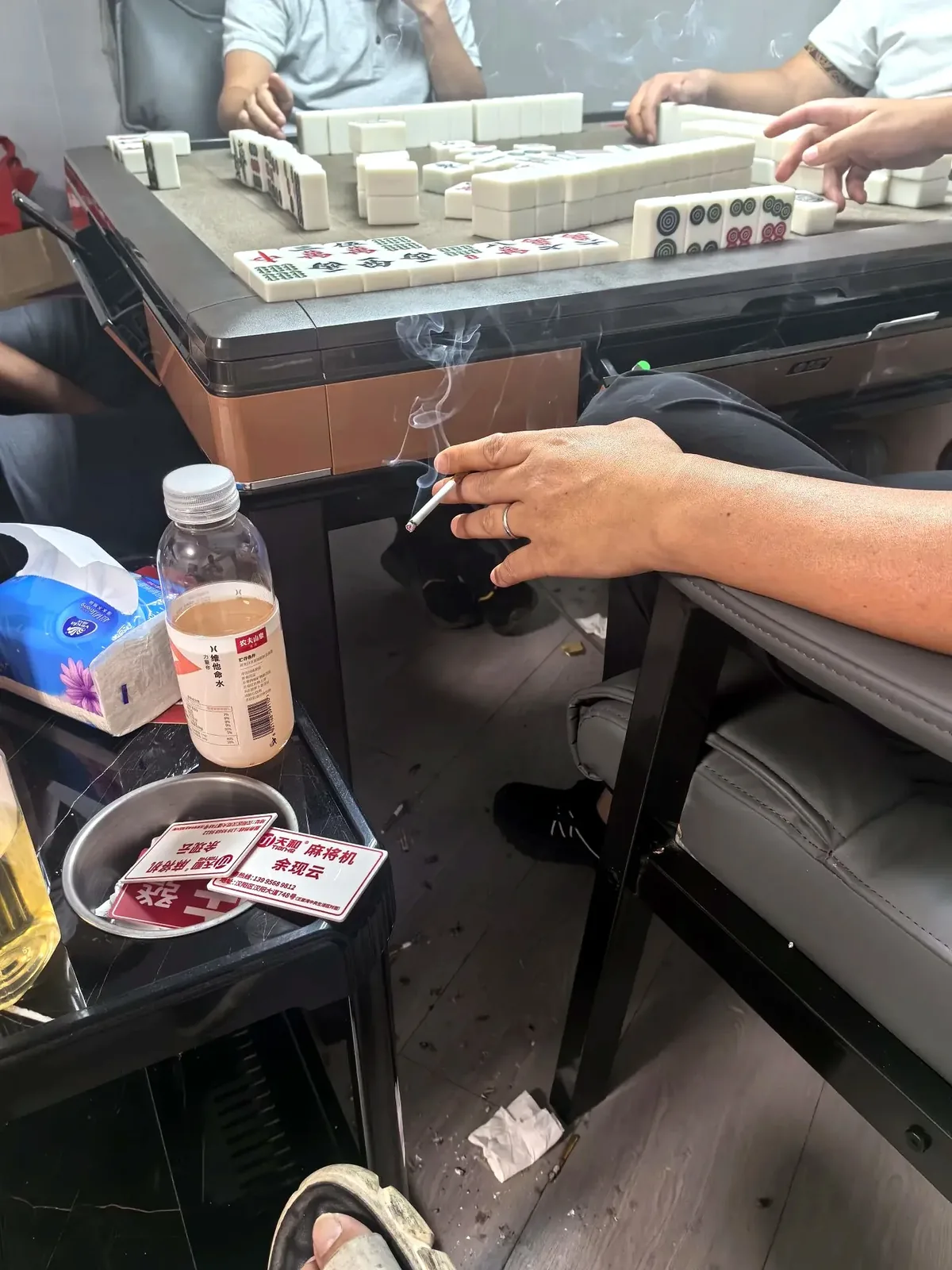
The table currency: a 5 RMB entry buys three hours; 10 RMB notes stack beside every knee. The scorecard at the top tracks every hu declared this rotation. There are already eleven.
The Wuhan Public Security Bureau occasionally cracks down on “赌” (gambling) but the line is clearly drawn: if the daily turnover per player doesn’t exceed roughly 200 yuan and the game is in a private residence, the police tend to leave it alone. The parlour owners have phone contacts for exactly this scenario.
7. What Wuhan mahjong says about Wuhan
The game mirrors the city in ways that locals don’t even bother to articulate anymore.
Fast and aggressive. No long, contemplative waits. You make decisions or you lose the position.
Insistently social. You can’t play alone. The point is to be present at the table.
Constant movement. Between three towns, between living rooms and tea shops, between morning and night sessions. Nothing stays put.
Competitive but communal. You sit for three hours and leave with maybe 5 yuan less than you started with, knowing you’ll be back tomorrow.
“在宜昌打麻将,你会冻死在河边。在武汉打麻将,你会笑死在同一张桌子上。”
“Play mahjong in Yichang and you’ll freeze to death on the riverbank. Play mahjong in Wuhan and you’ll die laughing at the same table.”
Old saying heard in a Qiaokou teahouse.
Wuhan is a city of river merchants, bridge builders, noodle sellers, retired factory workers, and university students who’ve been in town long enough that they no longer remember where they’re originally from. All of them sit at a mahjong table on a Wednesday afternoon. And in that room, the game gives them exactly what a transit city needs: a reason to stop, stay, and keep dealing.
8. How to sit down at a table (and not be terrible)
For a foreigner willing to try at a street-side table, a few basic 礼仪 rules:
Don’t sit down immediately. Stand at the edge, watch for about two minutes, and wait for someone to make space. Standing for two minutes is also your 查缺一门 moment.
When you sit, place your 5 yuan entry fee on the table. Don’t hold it out to the host. That’s considered standoffish.
Don’t sweep the tiles when someone says 洗牌. Hold still and let the person beside you control the chaos. You’ll understand the flow within five minutes.
胡 when you 胡. Announce it clearly. If you’re slow to call it, the table will teach you the sharpness of Wuhan auntie correction within one hand.
But above all: bet small and lose slowly. The locals will teach you the rest.
Read this article a second time, then go find a table. You won’t regret the afternoon you spend in a Hankou living room that smells of cigarettes and 碧螺春, while someone’s grandmother counts out your change and tells you 缺一门 with bamboo was a terrible call.