
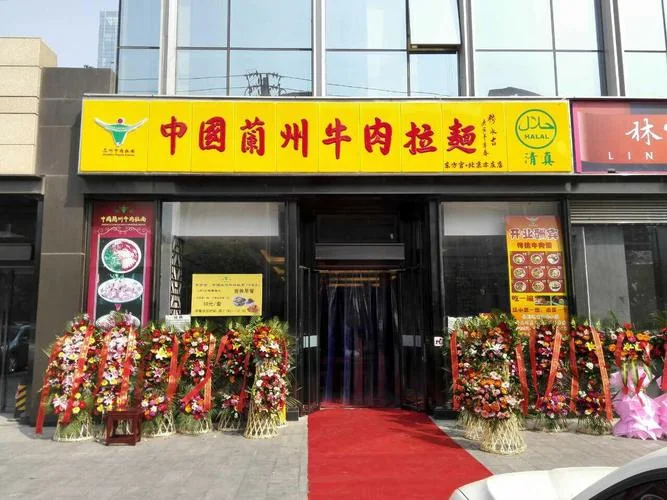
If you are Muslim and you are about to eat in Wuhan, the first thing you need to know is that there is no halal certification you can check.
In most countries you open an app, look up the restaurant, see a certificate number and an expiry date. None of that exists here. Not because anyone is hiding anything, but because the regulatory framework to produce it was never built.
So the 清真 sign on the shopfront is the entire verification system, and it is a self-declaration by the business. That is not nothing, because falsely claiming halal is punishable in China. But it is a deterrent, not a check, and the difference matters when you are the one eating.
Here is how to work with that, then where to actually go.
What China does and does not have on halal
There is no national halal food regulation. No dedicated national statute governs it. The national ethnic affairs commission has issued guidance on respecting minority customs and some provinces have worked toward a unified marking standard, but the nationwide picture is a framework that does not exist yet.
There is no unified certification standard. Research from the Northwest University of Political Science and Law’s institute for ethnic and religious studies puts it directly: China has no single unified standard for halal certification and the regulatory system for the industry is still incomplete.
Some provinces went the other way. Shaanxi abolished its halal food certification scheme outright, and others have followed.
And there is no unified marking style. Regulation does not prescribe what a halal label must look like, which is why the sign differs from shop to shop and why you are reading the characters rather than looking for a logo.
The one part that functions: Chinese quality authorities publish enforcement guidance on the unauthorised use of the halal certification mark, so a business putting 清真 on the front has something at stake.
Hold those two facts together. The mark means something, and it means nothing you can independently verify. Both are true.
The menu traps that will actually hurt you
This is the part worth bookmarking, because it is where the risk actually lives.
Treat bare 肉 as pork until told otherwise. In most of China, 肉 means pork. 回锅肉 twice-cooked pork, 肉丝 shredded pork, 肉包子 pork bun, 肉夹馍 pork sandwich. If it names the animal, you are fine: 牛肉, 羊肉, 鸡肉 are unambiguous.
Ask about 料酒. Cooking wine goes into a great deal of Chinese stir-frying and braising and it is usually Shaoxing wine, which is alcohol. A Hui kitchen handles this differently from a normal one. Ask directly rather than assuming, and ask in a Hui-run place where the answer will be reliable.
Watch pig fat in vegetarian dishes. 猪油 is lard, and Chinese vegetarian cooking uses it routinely. This is the one that catches people who are not thinking about it, because the dish looks safe on the menu and is not.
Avoid the pig-derived names outright. 猪 anything, 腊肉 cured pork, 香肠 sausage, and blood products such as 毛血旺, which is a Chongqing dish made with duck and pig blood.
Ask whether the kitchen is Hui-run if you need certainty. A Hui-owned kitchen will not be cooking pork next door. A Chinese-owned shop with a 清真 sign on the door is a different proposition, and the sign alone does not tell you which one you have.
Check the drinks list, because the 清真 mark covers the food and not the bottles. This is the one nobody warns you about, and it caught me out reading a real menu.
That menu belonged to a halal restaurant in Wuhan, and its drinks section listed 金徽老窖 at 368, 668 and 998 yuan a bottle, which is baijiu, a distilled spirit, sitting a few lines below the lamb skewers. It also listed beer, 乌苏 and 百威, at 10 yuan.
So a shop can be genuinely halal about its ingredients and still pour you a spirit. Beer is widely served in Chinese halal restaurants and accepted by most Muslims, so that is not usually your problem. Baijiu is. Read the drinks list rather than assuming the sign has covered it, and decide for yourself where your own tradition sits on it.
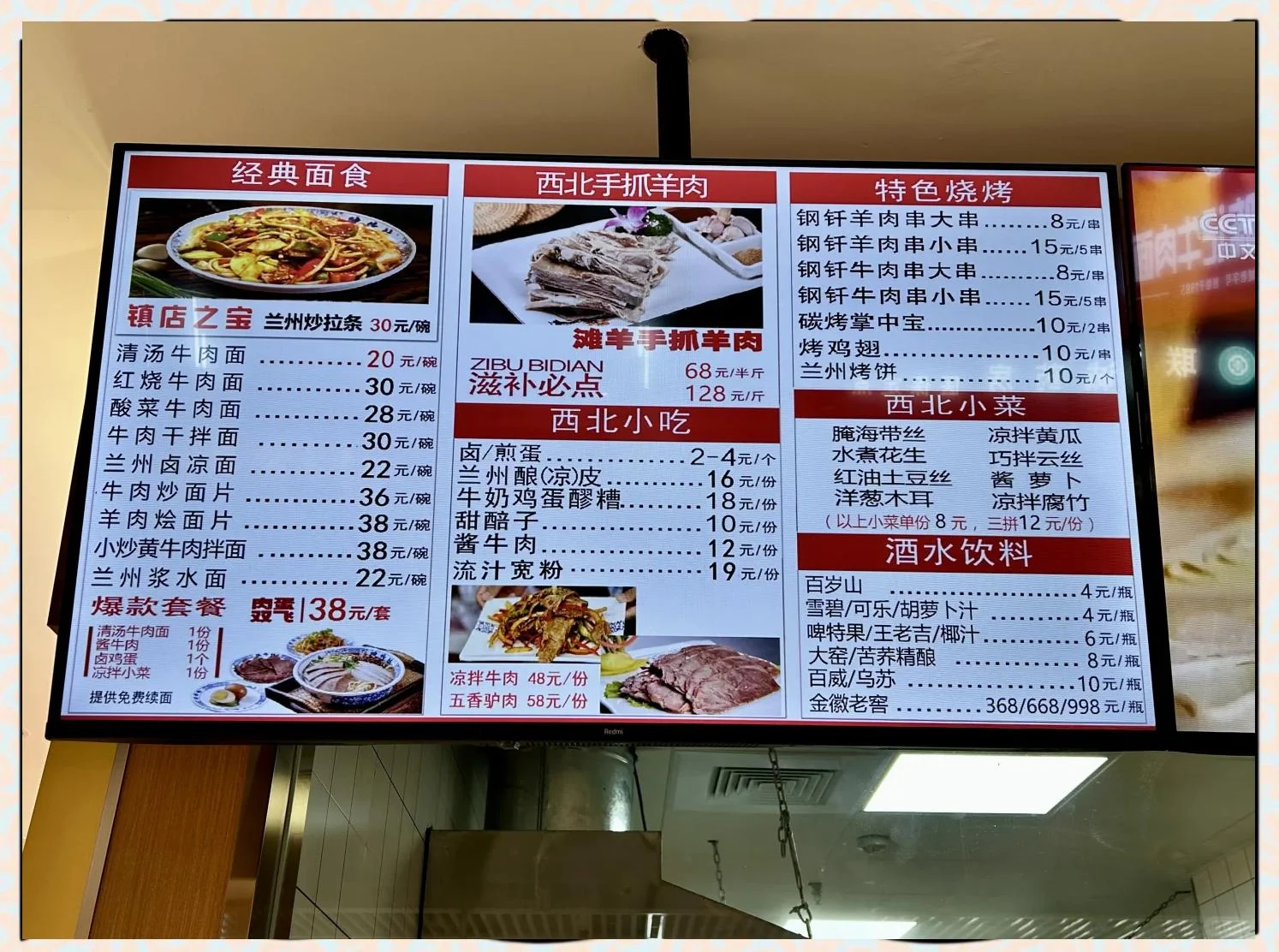
That same menu is worth reading for the prices, because they are lower than most visitors expect. A clear broth beef noodle, 清汤牛肉面, was 20 yuan. Braised beef, 红烧牛肉面, 30 yuan. Lamb with wide flat noodles, 38 yuan. Lamb skewers came at 8 yuan each, five small ones for 15. Northwest hand-grab lamb was 68 yuan for half a jin, and there was donkey meat on the menu at 58 yuan a portion, which is a halal ingredient people do not expect.
Not one pork dish appeared anywhere on that board, and the notice at the bottom said free noodle refills. That is what a genuinely halal kitchen looks like on paper.
Where you can actually eat
I am deliberately not handing you a list of ten restaurants, and the reason is worth more than a list would be.
Every business I could find carrying a halal registration in Wuhan is an ordinary 兰州拉面 noodle shop, plus one older halal hot pot house, 东来顺, at 民众乐园. I could not establish enough about their current operation, their menus or their supply chain to tell you they will meet your standard. A registered business name is not evidence about what is in the pot, and in a country with no certification to check, there is nothing behind that name either.
So, practically.
The Lanzhou noodle shop is your reliable default. Not because it is the best food, but because the dish is beef and broth and the trade is Muslim-run end to end. It is in every Chinese city, it is cheap, and the odds of a stray pork in a beef noodle shop are low. If you only need to eat once in Wuhan, this is the safe bet.
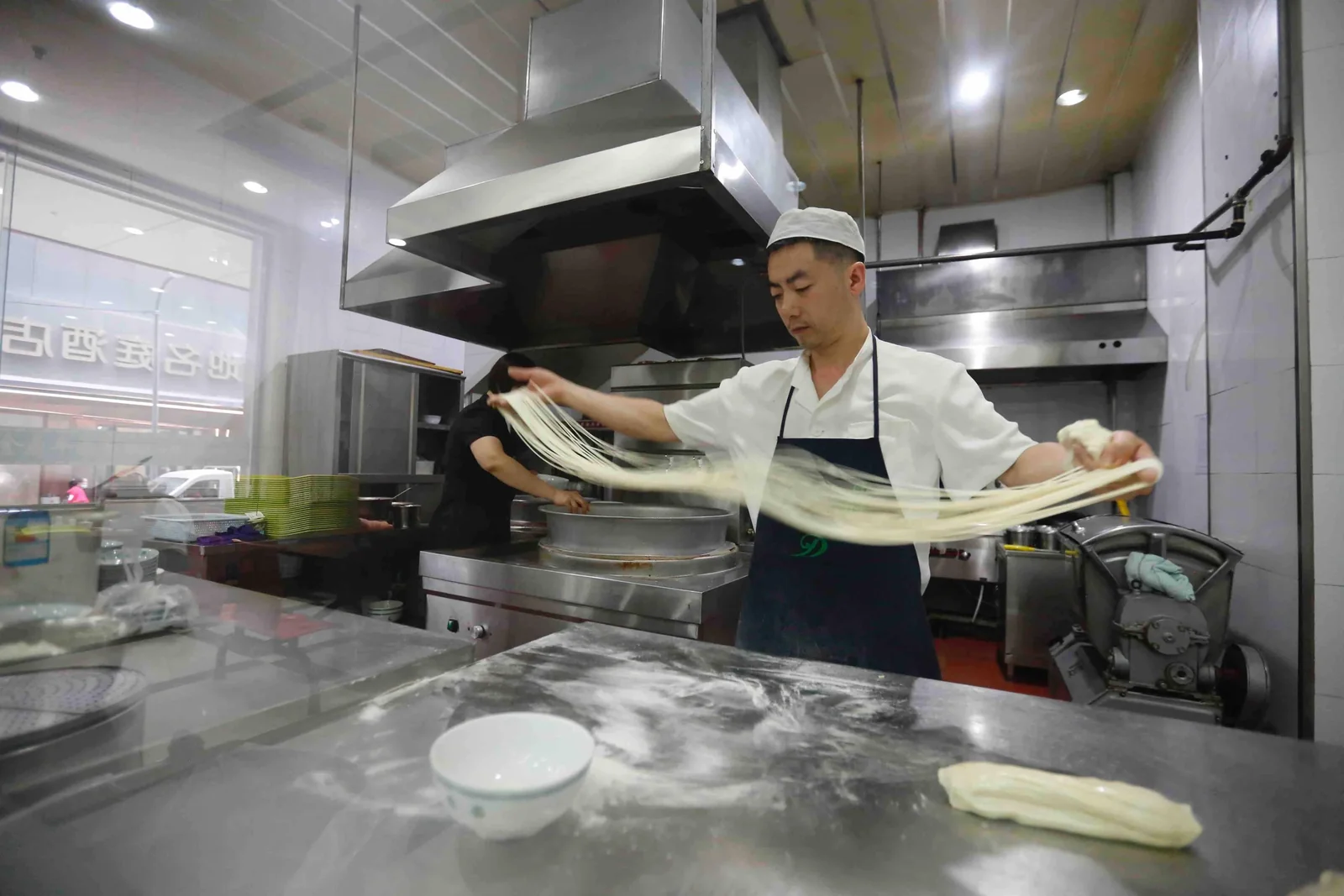
The dish itself is worth knowing so you can order it. 拉面 is pulled noodle, made on the spot from a stack of dough by hand, which is why you will see the cook stretching it before it reaches your bowl. 牛肉面 is the beef version and the default order; 小碗 and 大碗 are small and large, and the small is a sensible first choice if you have not eaten Chinese noodles recently. 加蛋 adds an egg. Nothing in that list is ambiguous, which is exactly why it works as a default for someone who cannot read the rest of a menu.
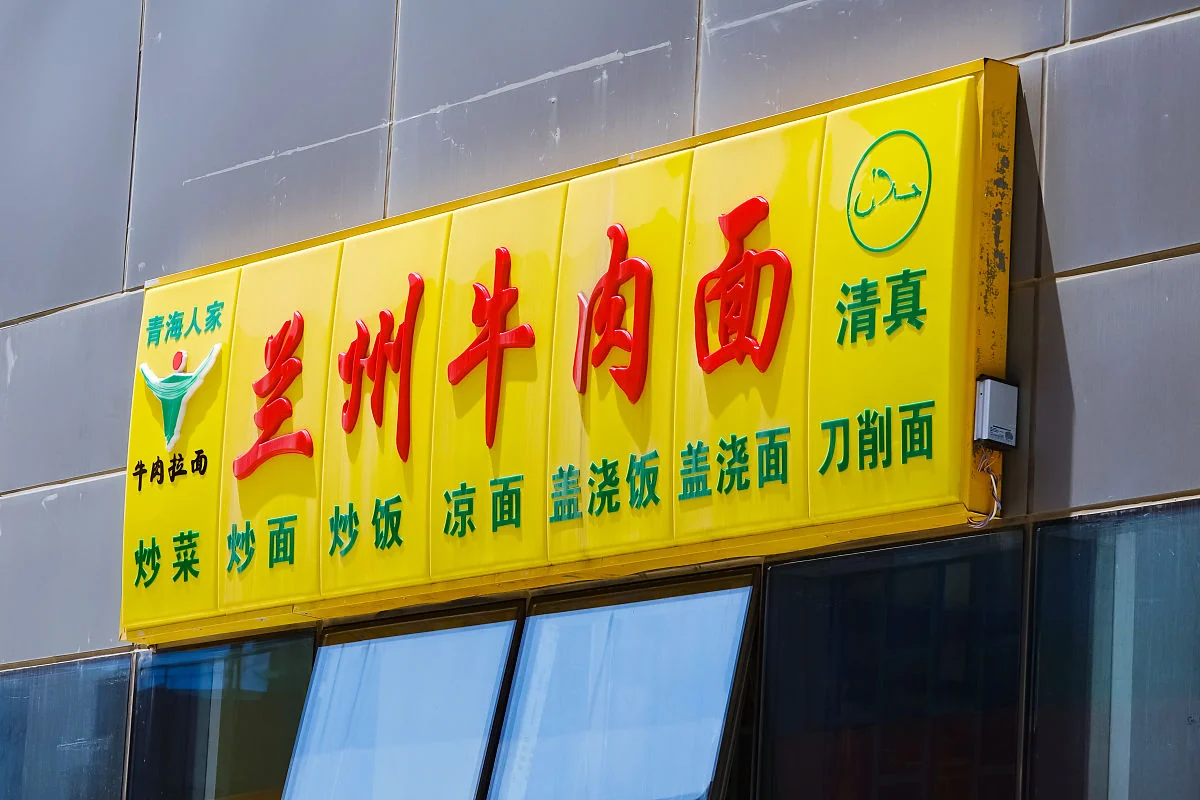
Look for 清真 on the door. That is the whole of it. In practice it means a noodle shop or a Hui-owned restaurant.
Go to the Hui quarter when you want something more than noodles. The Minquan Road and Hualou Street area, and the Jiang’an station end of the old railway, are where a Muslim-run kitchen is most likely to be operating by habit rather than by assumption. That is the same narrow merchant street fabric I have written about in my piece on the old neighbourhood alleys, which tells you how long the community has been there.
If certainty matters more than variety, change your routing. Wuhan is not the easiest Chinese city for this. Guangzhou, Shanghai and Beijing are all easier, and if you are building an itinerary around a strict requirement, you should know that before you arrive rather than at nine in the evening.
The mosque, for the part of you that wants to know
The history is real and it is old, and I would rather you had it than not.
汉口民权路清真寺, also called 广益桥清真寺 or 汉口清真大寺, stands at 民权路146号 in Jianghan District at the junction of Minquan Road and Hualou Street. It was founded between 1723 and 1735, so roughly two hundred and fifty years ago, and it was rated one of Wuhan’s outstanding historic buildings in 2013.
It is five storeys and organised like a small institution rather than a shrine. The ground floor is ablution water rooms, the second a reception room and scripture room, the third the main prayer hall, the fourth the offices of the Wuhan Islamic Association, 武汉市伊协, and the fifth an event hall also used as the Friday prayer hall. If you want to attend Friday prayers, that is the fifth floor, and you are a visitor at a working neighbourhood mosque rather than the only person there.
The community arrived in two waves and they are not the same story. The mosque predates the railway by about a hundred and seventy years.
The second wave came in 1906, when the Beijing to Hankou railway opened and Zhoukou in Henan was hit by drought. Muslim families travelled the new line west and settled at the southern end of it, around Jiang’an station, and that concentration is still there today. Wuhan now has three small Hui settlements, and this is the one the guides never mention.
Wuhan now has three small Hui settlements, and Minquan Road is the one every English guide to this city has missed.
It sits in Jianghan District, the same district as the Jianghan Road pedestrian street and the old commercial core I have covered in the river port history. That is not a coincidence. The quarter came out of the port, which is how a Hui community ended up settled here at all. A railway terminus that connected a drought-struck county to the biggest inland trade port in central China, and the people who got off at the end of it stayed.
What I would skip
Skip trusting a restaurant name that came from a travel guide or a listicle, for the regulatory reasons above.
Skip assuming a Hui-run shop and a certified shop are the same thing. One is a habit, the other is a guarantee, and you only get the first.
Skip looking for a late-night halal option near the night markets. Wuhan’s late-night scene is barbecue and street food and it is heavily pork.
And skip assuming that one Muslim quarter makes the whole city easy for you. Wuhan is a Chinese city that happens to have a Muslim neighbourhood in it. Those are very different things.
The Honest Summary
China has no national halal regulation, no unified certification standard, no searchable registry, and at least one province has abolished its scheme. All you get is a self-declared sign, with one protection behind it: faking it is punishable.
Read 肉 as pork until someone tells you otherwise, ask about 料酒, and watch for 猪油 in vegetarian food. Read the drinks list too, because baijiu turns up on halal menus.
The mosque is two hundred and fifty years old and it has been sitting there the whole time while every English guide to this city pointed at 黄鹤楼. If you have that kind of interest, go and see it. If you just need to eat, the noodle shop will do.