
The question that doesn’t get answered
Whenever I read articles about Wuhan’s Optics Valley overseas, they always talk the same way. GDP figures. Square kilometers. The percentage of China’s optical fiber produced there. The number of patents. Policy incentives from the government. All true, all important, and all missing the point.
Here’s what I never read: What does it actually feel like to start a company there? What are the people like? Why would a 25-year-old quit a Singapore master’s program to come back to Wuhan and build AI video software? Why does a 32-year-old return from Silicon Valley to a city he’s never lived in, spend six years making no money, and then land contracts with the Louvre?
I’ve lived in Wuhan for 18 years. I’ve watched the startup scene in Optics Valley grow from a handful of university spin-offs to a community of 160,000 companies and 2 million people. I’ve met entrepreneurs, eaten with them, complained with them about funding and talent and the weather. This article is their story, not the policy’s.

East Lake at sunset. This is what Optics Valley has that Shenzhen and Beijing cannot match: fifteen minutes from any office, you get trees, water, and sky.
The guy who came back from Silicon Valley
Luo Biwen (罗弼文) was born in Hubei, went to the US in his twenties, and spent 2017 working in the San Francisco Bay Area. He was doing AI research for a mid-stage startup. The pay was good. The weather was perfect. By any reasonable Silicon Valley standard, he had no reason to leave.
He came back anyway.
His pitch to himself: there was an opportunity in AI-powered cultural heritage, in museums, historical artifacts, digital storytelling. The US market didn’t see that, because American museums already had audio guides and interactive displays. But in China, and in developing countries, millions of museums and heritage sites had nothing: no budget, no technology, no way to make ancient objects speak to a phone-native generation.
Luo Biwen started his company, Shuming Technology (数命科技), in Optics Valley in 2018. For the first six years, the company made almost no money. “We were building AI digital humans for museum use cases that nobody was paying for yet,” he told me. “We were too early, or too weird, or both.”
Then the technology caught up to the vision. His team developed a way to make any artifact “speak” through a phone’s NFC chip: tap your phone on a card next to an exhibit, and a digital narrator explains the object in 140 languages. It’s not a gimmick; it’s deployed in over 300 museums worldwide. The Louvre has it. The Jingzhou Museum has it. The Hubei Provincial Museum, the one I tell everyone to visit, uses their cards for the Sword of Goujian.
Today, Luo Biwen’s company has 11 employees. They work four days a week. Since June 2025, they’ve had no physical office: “zero-location work,” he calls it. Every employee has an AI assistant that handles routine tasks. His AR cultural cards sell over 2 million copies globally.
I asked him why Wuhan, specifically. He didn’t hesitate: “Rent is one-tenth of Shenzhen, talent is everywhere because of the universities. And nobody bothers you. In Shenzhen, investors call you every week asking about metrics. In Wuhan, they leave you alone until you have something to show.”
The one-person company crowd
In a building on Guanshan Avenue (关山大道), there’s a shared workspace called Modal Space (模态空间). It’s Wuhan’s first OPC community; OPC being “One Person Company,” a legal structure China introduced in 2023 that lets a single founder register a limited liability company with no minimum capital.
The people here are young, averaging under 25, and some are still in university.
Zhang Ao (张奥) was 24 when he dropped out of a Singapore National University graduate program to come back to Wuhan and start an AI video company, Lingjing Engine (灵境引擎). His reasoning, delivered without drama: “Agent元年到了,再不回来就晚了”: “The year of AI agents arrived. If I didn’t come back now, I’d be too late.”
His team of eight is entirely born-after-2000. Their product: an AI system where you describe emotion and intent, and it generates full video: rain hitting pavement, clouds drifting across a sky. The cost and time of traditional video production drops by over 90%. Their product goes live overseas in 2026.
Then there’s Luo Zongyi (罗宗奕), 20 years old, a sophomore at Huazhong University of Science and Technology. He taught himself to code, enrolled his OPC in November 2025, and built an AI agent platform that won a venture capital seed round before he finished his junior year. I met him at Modal Space. He was wearing a hoodie and sneakers that had seen better days, and his English was excellent because he’d learned it entirely through GitHub and AI tools. He struck me as the Wuhan version of those 1980s computer lab stories, except Wuhan’s version doesn’t drop out. It stays in school and starts companies from dorm rooms.
The OPC model changes the math. In the US, starting a company usually means incorporating in Delaware, hiring lawyers, getting a registered agent. The fixed costs alone can run $10,000 before you’ve built anything. In Wuhan’s OPC community, registration is free, the co-working space costs next to nothing, and the government incubation program provides free legal and accounting services for the first two years.
The result: a 20-year-old with a laptop and a good idea can start a company that has legal status, a bank address, and a support network, for the price of a shared desk and tea.
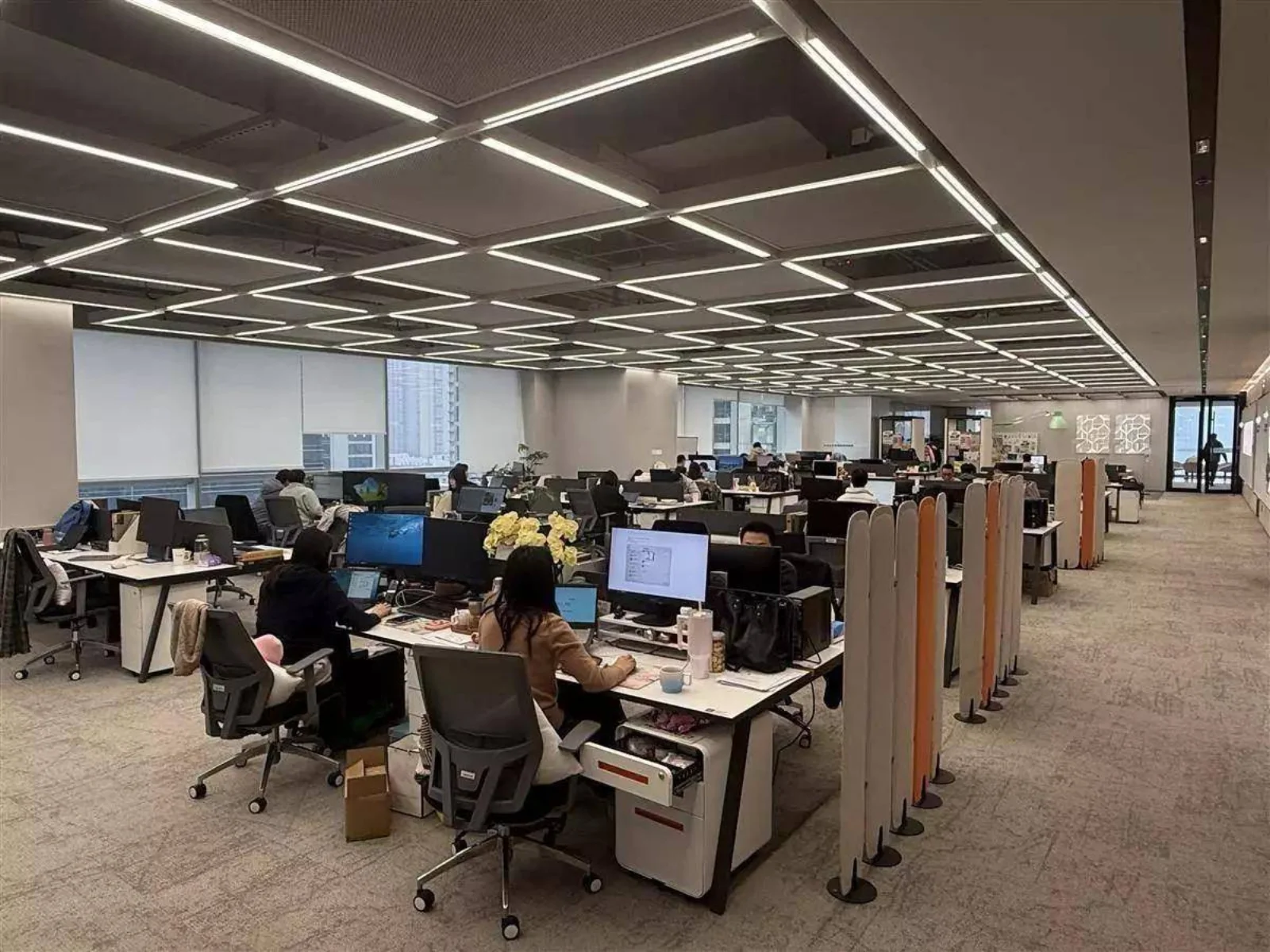
Inside an Optics Valley co-working space. Government-subsidized for the first year, then a few hundred yuan a month. Nothing fancy; that’s the point.
The engineer who saw the problem from the factory floor
Li Min (李敏) didn’t plan to start a company. He planned to be an engineer.
Growing up in Hubei, he studied optoelectronics at Huazhong University of Science and Technology: the university that anchors Optics Valley. In his senior year, he helped a small Wuhan laser cutting company build a controller and earned what he calls his “first bucket of gold”: a few thousand yuan that proved he could solve real problems.
He went into display panel manufacturing after graduation. His job was quality control: looking at screens through imported 3D microscopes, checking for defects. The microscopes cost millions of yuan each. They were made by European or Japanese companies with proprietary technology. When a factory’s microscope broke, they had to wait weeks for a foreign engineer to come fix it. Meanwhile, workers, often young women, spent hours staring at screens through eyepieces, their eyesight deteriorating.
Li Min saw both sides: the market gap and the human cost. He went to Peking University for graduate school, spent years developing algorithms for automated optical inspection, and returned to Wuhan in 2022 to start Chu-Guang 3D (楚光三维). The name comes from “True Light,” a translation of his mission. The “楚” character refers to Hubei: the ancient Chu kingdom, the same one I wrote about in the Chu culture article.
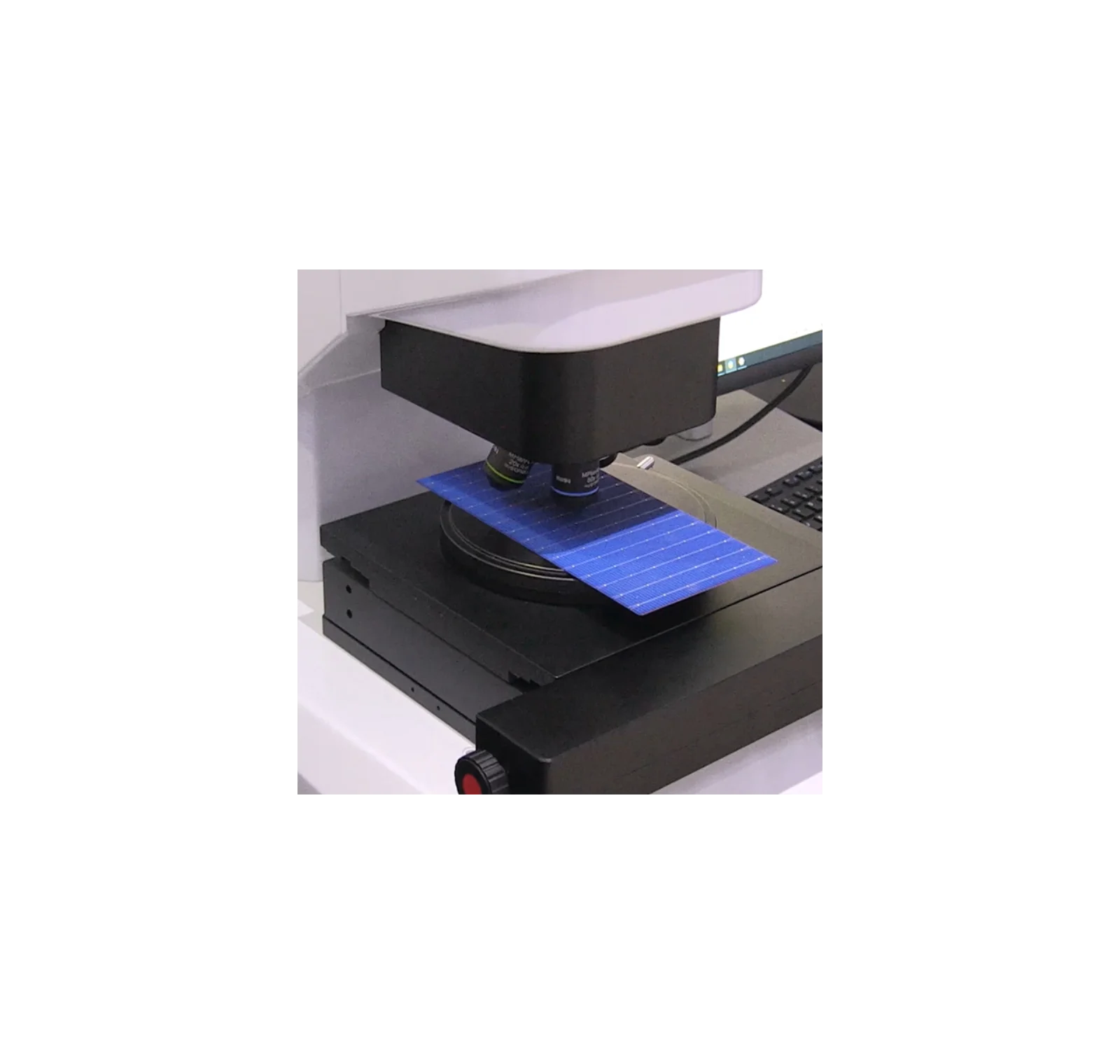
His company makes domestic 3D confocal microscopes that can scan a surface and generate nanometer-precision data in three seconds. The machines cost a fraction of imported equivalents. NVIDIA has used their products. So has Apple.
“The core reason I came back isn’t patriotism,” Li Min told me when I asked. “It’s that my partner, Professor Liu Xiaojun from HUST’s mechanical engineering school, is here. The photonic industry infrastructure is here. And the talent pool is here. Wuhan makes it possible to build hardware in a way that cities like Hangzhou or Chengdu can’t, because the entire supply chain is within two hours of your door.”
When I visited their workshop, I was struck by how small it was. Thirty-odd people. Clean rooms the size of a high school gymnasium. Equipment that looked university-grade, not corporate. The team moved with the focused energy of people who know exactly why they’re there.
Optics Valley at night. The buildings that house 160,000 companies, lit up after dark.
The vocabulary of the valley
After years of talking to people in Optics Valley, I’ve noticed a vocabulary that doesn’t exist in other startup ecosystems.
“追光” (chasing light) is the one I hear the most. It refers to the photonics industry’s origin story: in 1976, Zhao Zisen (赵梓森) pulled the first practical optical fiber in China at a lab by East Lake. But the metaphor has grown beyond hardware. It means: working on something that takes years to pay off, that requires faith in science over quarterly revenue, that will benefit the city even if your own company fails.
光谷精神, “Optics Valley Spirit,” is four phrases I’ve seen on banners and office walls across the zone: “鼓励冒险、宽容失败、激励创新、崇尚成功.” “Encourage risk, tolerate failure, incentivize innovation, worship success.” It’s easy to dismiss as propaganda until you meet the people living it. The OPC kids who fail and start again with a new company the following month. The engineers who spent six years on a product with no revenue. The university professor who spun a 钙钛矿 (perovskite) solar company out of a lab: I wrote about East Lake in this blog; imagine covering its surface with transparent solar glass. The government grant that kept the lights on when the private funding dried up.
“光谷速度”, Optics Valley Speed, is a phrase I hear from officials meant to describe how fast companies get approved and built. Among entrepreneurs, it means something else: the speed at which a new AI model goes from paper to product. One startup I know built a prototype in two weeks from an arXiv paper. In Silicon Valley, this speed exists too, but in Wuhan it exists at one-tenth the salary cost.
What it costs to start here
Let me put numbers to it, because nobody else does.
A one-bedroom apartment within walking distance of Guanggu Square is ¥1,500-2,500/month ($200-350); the same apartment in Shenzhen’s Nanshan district is ¥6,000-8,000. In Shanghai’s Caohejing, comparable.
A hot dry noodles breakfast: ¥5 ($0.70). Lunch at a shop near the co-working space: ¥15-20. You can eat well for under ¥50/day, which means a single founder can live on ¥2,000/month if they’re not trying to impress anyone.
Shared office desk at an incubation space: free for the first year through government programs, then ¥300-500/month. Compare that to a WeWork in Beijing.
Mid-level software engineer salary: ¥15,000-25,000/month ($2,100-3,500). In Shenzhen, the same engineer makes 40-60% more; in Shanghai, more. But in Wuhan, they can afford to buy an apartment. A married engineer couple, both working in Optics Valley, can own a decent two-bedroom flat near East Lake within five years of graduation. That is not possible in Shenzhen. That math drives a lot of returnees.
Venture funding: yes, it’s harder here than in Beijing or Shenzhen. Wuhan’s VC industry is real but small. The government steps in with innovation funds and seed grants, not huge by coastal standards, but enough for a 20-year-old OPC to survive two years. The key difference: government money comes with fewer strings. “They don’t ask for board seats or pivot advice,” one founder told me. “They ask if you need a bigger lab.”
What it feels like on the ground
Visit Optics Valley on a weekday morning and you’ll see something that surprised me: it’s calm.
Not slow. The pace is fast. But the aesthetic is different from Shenzhen’s chaos or Beijing’s intensity. The boulevards are wide and tree-lined. Coffee shops aren’t just for meetings; they’re where you go to write code for three hours because the office feels too much like an office. East Lake is a fifteen-minute walk from most co-working spaces, and you’ll see engineers running there at lunch.
The people are younger than you’d expect. The university pipeline means there are students everywhere: interning, launching companies, working part-time at startups while finishing degrees. The culture borrows from campus life: casual dress, direct communication, less hierarchy than traditional Chinese companies.
When the pitch decks come out, they’re ambitious. AI agents. Quantum computing hardware, bio-tech for aging. 6G radio modules. The same technologies being built in Palo Alto or Tel Aviv, but built here with the particular pragmatism Wuhan brings. Nobody’s building a social app for dog-walking. The hardware is real. The physics is hard. The problems being solved are ones where China’s supply chain dependency hurts.

The kind of equipment Optics Valley startups actually build: precision instruments at a fraction of the import price. Domestic engineering, global-quality output.
Wuhan’s startup advantage, stated honestly
Here’s what I’ve come to believe after years of watching:
Wuhan’s advantage isn’t cost; plenty of Chinese cities are equally cheap. It isn’t talent; Beijing and Shanghai have more experienced tech workers. It isn’t policy; every tech zone in China offers similar incentives.
The advantage is culture. Wuhan is a city that’s used to building things from nothing. It built China’s first steel industry here. It built the foundations of modern Chinese science and rail and bridge engineering from this city. The entrepreneurs I met aren’t following a trend; they’re operating from a city-wide assumption that hard industries worth building take time, that failure is information rather than identity, and that if you put in the work, the city will support you.
Luo Biwen could have stayed in Silicon Valley, and Zhang Ao could have finished his Singapore degree. Li Min could have stayed in Beijing. They chose Wuhan, not because it was easy, but because the combination of low living costs, deep hardware engineering talent, and tolerance for patience is rare. Rarer than venture capital. Rarer than hype.
I’ve been told the “World 光谷” initiative aims for trillion-yuan output by 2035. Maybe. Here’s what I know already: a 20-year-old with a laptop, a government grant, and a dorm-room idea can build a company here that ships real products to real customers in two years. That’s not a slogan. That’s the Tuesday I spent at Modal Space, talking to people who are doing it right now.
Corrections in names and details from previous drafts are welcome, and if you’re building something in Optics Valley and want to email me, I’ll buy the noodles. Story quality may vary but the noodles are guaranteed.
Related:
-
From Iron to Light: How Optics Valley Replaced Its Factories: the industrial history behind the startup scene
-
Wuhan’s Universities: Why 1.3 Million Students Call This City Home: the talent pipeline feeding the valley
-
East Lake: Wuhan’s Green Heart: the lake that borders the zone
-
Walking the Yangtze Bridge at Night: the infrastructure the city was built on
-
Two Rivers, Three Towns: how geography shaped Wuhan’s identity
-
Wuhan Survival Language Guide: The Phrases That Actually Matter